
Why the UAE context shapes the topic
A law doctorate in the UAE is expected to show clarity of purpose, originality and methodological soundness. What makes the UAE distinctive is the number of legal layers a single question can touch. Federal laws apply across the seven emirates; emirates have their own institutions; and the financial free zones have their own legislation and courts. Data protection illustrates this well. The federal Personal Data Protection Law, Federal Decree by Law No. 45 of 2021 (United Arab Emirates, 2021), sits beside separate rules for health data and free-zone regimes such as that of the Dubai International Financial Centre (DIFC) (UAE Government, 2025).
For a doctoral topic, the first question is therefore not "what is interesting?" but "which law, applied by which body, to whom?" A question that does not specify its layer will usually be too broad to answer. General advice on choosing a doctoral topic, such as matching it to your goals, testing its tractability and checking that sources are available, applies here too (Lei, 2009); see also how to select a PhD topic and doing a PhD in law.
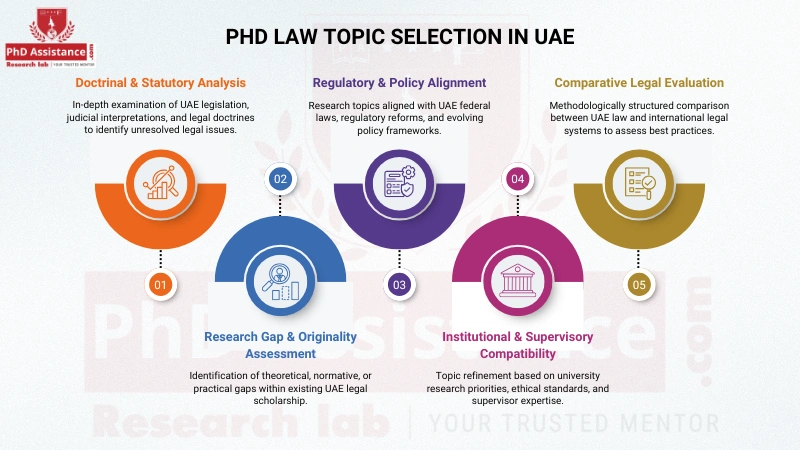
Four research routes
Three routes are common: doctrinal, regulatory and comparative research. An empirical, socio-legal route belongs alongside them. Each route implies a different kind of question, source and method.
| Route | Example UAE question (illustrative) | Main sources | Method |
|---|---|---|---|
| Doctrinal | How do onshore courts interpret the grounds for setting aside an arbitral award under the federal Arbitration Law? | Legislation, court judgments, commentary | Interpretation and systematisation of legal sources |
| Regulatory and policy | Does the federal data protection law give data subjects effective remedies against private controllers? | Legislation, regulator guidance, enforcement material | Doctrinal analysis with policy evaluation |
| Comparative | How do DIFC and onshore approaches to a contract doctrine differ, and why? | Laws and judgments of two systems | Functional or contextual comparison |
| Empirical (socio-legal) | How do in-house counsel in Dubai choose between onshore and free-zone dispute resolution? | Interviews, surveys, case files | Qualitative or quantitative social research |
Doctrinal research asks what the law is and how it should be understood, using legislation and judgments as its primary material. It is a method in its own right, with its own standards of source selection and argument (Hutchinson & Duncan, 2012; Byrne & Olsen, 2024). Arbitration is a natural doctrinal field in the UAE: the Federal Arbitration Law (Federal Law No. 6 of 2018) was amended in 2023 by Federal Decree-Law No. 15 of 2023, so any topic must work from the amended text.
Regulatory research examines how rules shape behaviour in finance, technology, sustainability or corporate governance. Recent instruments give it new material: beyond data protection, the UAE published a national charter for the development and use of artificial intelligence in 2024 (United Arab Emirates, 2024), which raises questions about how soft-law principles relate to binding obligations.
Comparative research is unusually rich in the UAE because comparison can be internal: the onshore courts and the common-law courts of the DIFC and Abu Dhabi Global Market (ADGM) can address similar disputes under different rules. Comparison needs an explicit framework explaining why these systems and what is being compared (Taekema, 2018). Empirical research asks how law works in practice and must meet the standards of social science inference (Epstein & King, 2002).
Map existing UAE scholarship before claiming a gap
A gap claim is only as good as the search behind it. This article does not attempt a survey of UAE legal scholarship; instead, the steps below show how to build one for your own topic, which is what examiners will expect to see in the literature review.
- Search law databases and general indexes for your topic with "United Arab Emirates", "UAE", "Dubai", "Abu Dhabi", "DIFC" and "ADGM" as alternative terms, in English and Arabic.
- Check authors' affiliations on the publisher page to identify work by researchers based in the UAE, and note which universities and journals publish most on the topic.
- For each study, record the legal layer, the sources used (legislation, judgments, interviews), the method and the limitations the authors report.
- Check whether the study predates important legislative change, such as the 2023 arbitration amendment or the 2021 data protection law; older work may describe superseded rules.
- Add practitioner and regulator material separately, as context rather than as scholarship.
Look for a gap that is a genuine problem rather than an absence: an inconsistency between courts, a rule that has not been tested in the free zones, or an assumption in the literature worth questioning (Alvesson & Sandberg, 2011). For a step-by-step method, see how to identify a research gap.
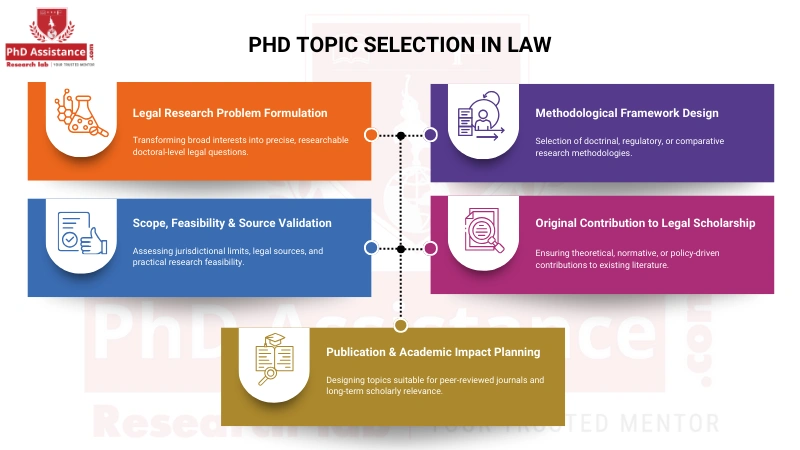
Institutional expectations and supervision
In the UAE the topic is tested formally. The national accreditation standards require doctoral programmes to include a comprehensive examination that covers a defence of the research proposal (Commission for Academic Accreditation, 2019). At UAE University, the proposal must define the research problem and objectives and outline the methodology, and the PhD Advisory Committee must approve it before the student advances to candidacy (United Arab Emirates University, 2018). A topic chosen without a clear method or source base will be exposed at that stage.
Align the topic with your supervisor's expertise early. A supervisor who works on arbitration can guide a doctrinal arbitration thesis; an empirical study of dispute-resolution choices may need a co-supervisor with social research experience. Check also whether you can read the sources you need: federal legislation is issued in Arabic, and judgments may not be published in English.
Worked example: from area to question (illustrative)
A researcher begins with "arbitration in the UAE". That is an area, not a topic. Narrowing by layer, she chooses onshore court review of arbitral awards. Narrowing by time, she focuses on decisions since the 2023 amendment. Narrowing by issue, she selects the public-policy ground for setting aside. Her question becomes: "How have onshore UAE courts applied the public-policy ground for setting aside arbitral awards since the 2023 amendment, and is their approach consistent with the law's stated aims?" The route is doctrinal, the sources are published judgments and the amended law, and a comparative chapter could contrast DIFC court practice. Before committing, she checks how many relevant judgments are accessible and in which language.
| Check | Question to ask |
|---|---|
| Layer | Which legislation and which courts or regulators govern the question? |
| Currency | Does the topic reflect the law as amended, including recent decrees? |
| Sources | Are judgments, regulatory decisions or participants accessible, and in which language? |
| Method | Is the route doctrinal, regulatory, comparative or empirical, and is that explained? |
| Gap | Is there a specific problem in existing scholarship, not just an absence of UAE studies? |
| Supervision | Does a supervisor have expertise in both the area and the method? |
For comparable guidance in other jurisdictions, see the articles on Saudi Arabia, Qatar and the UK; for data protection titles, see GDPR and UAE data protection law.
Common mistakes
- Choosing an area ("UAE commercial law") instead of a question.
- Ignoring which layer of the system applies, or mixing onshore and free-zone rules without saying so.
- Relying on commentary written before recent amendments.
- Claiming a gap because no UAE study exists, without showing why the question matters.
- Choosing an empirical design without access to participants or case files.
- Proposing a comparison without a framework explaining what is compared and why.
Key takeaways
- Start by identifying the legal layer: federal, emirate or free zone (UAE Government, 2025).
- Choose a route (doctrinal, regulatory, comparative or empirical) and explain its method (Hutchinson & Duncan, 2012; Taekema, 2018; Epstein & King, 2002).
- Work from current law, including recent amendments and new instruments such as the data protection law and the AI charter (United Arab Emirates, 2021; United Arab Emirates, 2024).
- Map existing scholarship and look for a real problem, not just an absence (Alvesson & Sandberg, 2011).
- Prepare a topic you can defend at the proposal stage required in UAE programmes (Commission for Academic Accreditation, 2019; United Arab Emirates University, 2018).