Single chapter
You need focused mentoring on one chapter of your own draft.
From$349
Delivered in 7 to 10 working daysChoose Single chapter- Dedicated point of contact

Mentoring on the chapters or sections you choose, from abstract to conclusion.
Stuck on one chapter, or a single section such as your literature review, methodology, analysis or discussion? A mentor from your discipline picks up wherever you have paused and works with you on your own draft: feedback, restructuring, methodology and analysis support, and editing.
Every PhD scholar feels the pressure of writing a dissertation chapter, whether because of a heavy schedule, limited research or academic writing experience, or advanced and unfamiliar subject matter.
Completing a well-researched, structured, goal-oriented dissertation is hard enough without deadlines or the struggle to find a suitable research framework.
This is where part dissertation mentoring helps. It does not matter whether you are midway through or have not yet begun: your mentor steps in at the point where you need a hand, makes sure the chapter aligns with your research objectives and your university's requirements, and helps you pick up from where you left off.
Mentors are drawn from universities in the UK, the UAE, Europe, the USA and India, and are matched to your subject area.
Your mentor picks up at the chapter where you stopped and agrees a clear timeline with you, so the work keeps moving.
Your mentor guides your literature review so you can establish the gaps and connect them to your aims.
Support to choose suitable methods, data collection approaches and research design, and to formulate clear, testable hypotheses, research questions and objectives.
Guidance on the right statistical or thematic analysis for your data (regression, SEM, ANOVA, t-tests, thematic coding in SPSS, R, Python or NVivo), and on interpreting outputs against your research questions.
Help to plan an outline or storyboard, structure your chapters and sections, and build logical transitions between them, in line with your supervisor's feedback.
Technical proofreading for grammar, style and academic tone, formatting to APA, Harvard or your university's guide, and help to organise your references.
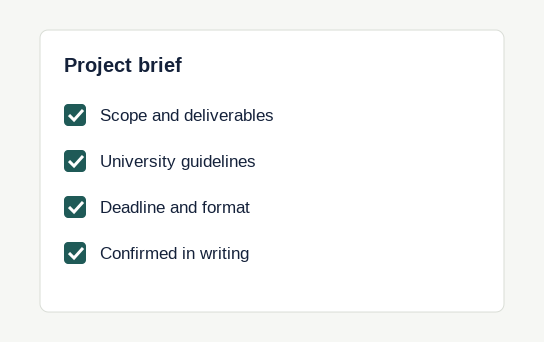
Your mentor checks every chapter against your research objectives, your university's requirements and accepted academic standards, and checks with you before moving to the next chapter.
Your mentor reads up on your topic and analyses it before starting. At every stage of the dissertation we check with you before moving to the next chapter, and we follow your university's latest guidelines.
Your mentor reviews whether your content aligns with your academic requirements and research objectives.
An expert review of language quality, clarity, formatting consistency and overall readability.
We check that your instruments and tools are well designed and support the credibility and accuracy of your research design and measurement.
Once instrument validity is examined, your mentor helps you assess reliability: instrument standard error, sampling independence, content heterogeneity and instrument usage.
Support with filter and contingency questions, pre-coding and standard response formats, the logical flow of questions, Likert scales and other measures, and with your administration mode, sample selection criteria, time frame, data collection procedures and documentation of pilot outcomes.
Your mentor supports the chapter or section you choose, in line with your research area, study design, target population and expected outcome, and with your discipline's theory, practice and policy needs. We also support gap analyses, annotated bibliographies, theoretical and conceptual frameworks, interview guides, appendices and ethics forms, and secondary research.
A brief overview of the study: background, objectives, methods, key findings and conclusion. Example: refining a 250 to 300 word abstract for a study on AI integration in healthcare.
Sets the context, research problem, gaps, aims, objectives and research questions, and justifies the study. Example: framing a lack of digital literacy among rural healthcare professionals as the research problem.
Covers theories, conceptual frameworks, key debates and gaps, building the theoretical and empirical background your study fills. Example: existing models of adherence in managing chronic illness.
Research design, methods, sampling strategy, data collection and ethical issues, justifying how the research is done. Example: a mixed-methods design on e-learning adoption among university students.
Hypothesis testing, data assumptions and statistical modelling in SPSS, R, AMOS, NVivo or similar, using the right methods for your data. Example: t-tests and ANOVA in SPSS to test hypotheses.
Presents descriptive or inferential statistics, graphs, themes or patterns, and connects them to your research aims. Example: statistical analysis of survey data on job satisfaction among public sector workers.
Interprets your findings, compares them with the literature, explains unexpected results and draws out implications for theory. Example: whether results support or refute the Technology Acceptance Model in online learning.
Summarises key findings, limitations, implications for theory and practice, and directions for future research. Example: how social media affects young people's political engagement.
Full, correctly formatted citations in your required style, such as APA 7th edition, MLA or Harvard.
Browse examples from our sample work library.
A sample topic selection document. View sample
A second topic selection sample. View sample
Future research directions on psychological ownership in business. View sample
Part dissertation mentoring helps you complete the chapters you choose, such as the introduction, literature review, methodology, results, discussion or conclusion, to your university's guidelines. Where your methodology or results chapter needs it, your mentor also supports basic descriptive or inferential analysis in SPSS, R or Python.
Send these with your request.
Part of every part dissertation mentoring order.
Available as add-ons or other services.
Every part dissertation order comes with added support: quality checks, referencing and formatting, and the study materials your chapter draws on.
We run a quality check at every step. Your mentor checks the work against your requirements, covering language, technical terms, subject matter, referencing, formatting and plagiarism.
Your mentor works to the word count your university sets for each chapter. Word counts exclude references, charts and tables, the table of contents, appendices, the bibliography and interview responses.
Everything that builds on other authors' thoughts and ideas is acknowledged appropriately, so your reader can identify and find every source. References sit mainly in the main body, while the introduction and conclusion rest largely on your own ideas.
Your chapter follows the formatting guidelines you give us, and citations are set in your required style, such as APA, Harvard, MLA or Oxford.
We share the reference materials used in your work, so you know what it draws on: journal articles, textbooks, PhD dissertations, translated works, newspaper articles, dictionary and encyclopaedia entries, lectures, legal or historical texts, web pages, PDFs, slides, YouTube videos and annual reports, wherever access and copyright allow.
Your mentor points you to recent journal articles, textbooks, corporate documents and national and international regulatory documents, and to the academic databases that hold them.
The research journey is messy, full of difficulties and surprises, hard work, beginnings and some form of closure. PhD Research Lab travels with you on this journey, mentoring researchers across the globe.
“I am struggling to write a clear and concise abstract for my PhD dissertation. It reads as ordinary, or too brief rather than concise.”
Your mentor helps you shape a short, clear abstract that reflects your aim, objectives, methodology, results and conclusion.
Usually works best: Fixed price See packages“I am finding it difficult to craft an introduction that states the research problem and scope of my study. I am not sure what to include and what to leave out.”
Your mentor works with you on the background, aim, problem statement and significance, so your introduction lays a strong foundation for your research.
Usually works best: Fixed price See packages“I am confused about how to conduct a literature review for my PhD research. I have collected a lot of literature but do not know how to use it.”
Your mentor shows you how to find the research gap, problem statement, key trends and debates in your sources, and organise them coherently.
Usually works best: Fixed price See literature review support“I am not sure how to draft the methodology section of my PhD dissertation. I need help writing it to academic standards.”
Your mentor helps you set out and justify your research design, sampling method, data collection and data analysis methods.
Usually works best: Hourly mentoring Hire a researcher by the hourScenarios are illustrative, based on requests we often receive.
Prices depend on your discipline, degree, chapter length and deadline. Every package starts with a free quote, so you know the exact price before you pay.
Prices in USD, PhD level shown. Master's is 15% lower; postdoc and faculty 15% higher. Your exact price is confirmed in a free quote.
You need focused mentoring on one chapter of your own draft.
You need support across two or more chapters that must connect.
You want chapter support plus time with a mentor to work through comments together.
One single point of contact (SPOC) stays with you through every step, so you always know who to ask.
PhD Research Lab mentors every chapter to your university's guidelines. Our mentors have supported doctoral researchers at universities around the world, including the UK, the USA, Europe, the Netherlands, Germany, Switzerland, Australia, the UAE, Qatar, Kenya and Nigeria, and they know the rules different institutions set. We understand plagiarism tolerance policies and check every document we return for originality, in full confidence and to the requirements you set at the start.
*Where access and copyright allow.
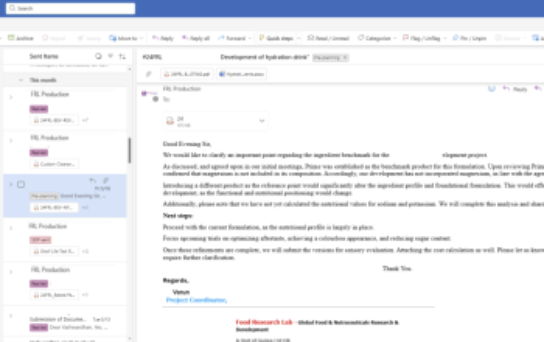
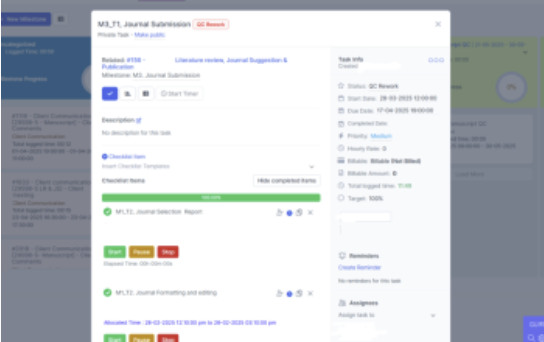
We have supported PhD projects for scholars around the world, and every task follows the same checks. These are real screens from our workflow.
No. Your mentor works with you on your own chapters: giving feedback, suggesting restructuring, supporting your methodology and analysis, and editing. The research and the final text remain yours, in line with your university's academic integrity rules.
Yes. You can talk to your mentor by email, Skype, WhatsApp chat or phone. Our project coordinators arrange an appointment so you can speak to your mentor directly.
Any chapter or section: abstract or executive summary, introduction, literature review, theoretical framework, research methodology, results and interpretation (with basic descriptive or inferential analysis if needed), discussion, conclusion and recommendations, references and bibliography, and appendices, plus proofreading, formatting and citations (APA, Harvard, etc.). If your chapter includes elements of a pilot study, your mentor can also support the background theory, the pilot study report format, and your explanation of content validity, face validity and reliability. All support is tailored to your university's format and requirements.
Psychology; computer science; business and management; sociology; statistics and data science; architecture and design; food science; engineering; medicine and health sciences; life sciences; languages, linguistics and literature; economics, finance and accounting; pharmaceutical sciences; environmental studies; political science and international relations; sports, physical education and exercise science; theology, religion and philosophy; media, communication and journalism; education, teaching and pedagogy; social work; law, criminology and human rights; tourism, hospitality and leisure management; and anthropology and cultural studies.
Our mentors hold master's or PhD degrees and have at least five years of academic experience, each in their own specialism, so we can assign a mentor with a relevant academic background to your field. Your mentor sends feedback chapter by chapter, works to your formatting specification or university guidelines, and passes the work to our Quality Assurance Department for a plagiarism check. You receive the QA report and plagiarism report.
Our pricing is the same regardless of location, subject or university. We also offer seasonal discounts and referral offers; contact our project coordinators for details.
No. Revisions within the agreed scope of your order, including changes after supervisor feedback, carry no extra charge. Please read our terms and conditions when placing an order, or contact our project coordinators.
Yes. Our Academy courses and one-to-one mentors teach you to divide dissertation writing into manageable steps. Our guides are a good place to start: writing your dissertation introduction, conclusion and abstract, how to write an introduction for a PhD dissertation and PhD dissertation theories used in marketing research.
Prefer to do it yourself? Our Academy courses teach the same methods our mentors use, step by step.