
Why theory choice matters in a marketing PhD
A marketing PhD is expected to contribute to knowledge, not only to describe a market. Theory is what makes that possible: it tells you which concepts matter, how they are expected to relate and why, and it gives examiners a yardstick for judging what your findings add. Choosing a theory is therefore one of the first design decisions, and it shapes your research questions, measures and analysis.
Two distinctions help. First, not everything called a "theory" in marketing explains anything. Some are managerial frameworks, such as the marketing mix, that organise decisions rather than predict outcomes. Second, theories do different jobs: some explain, some predict, some do both, and some mainly describe (Gregor, 2006). A thesis should say which kind of contribution it is making.
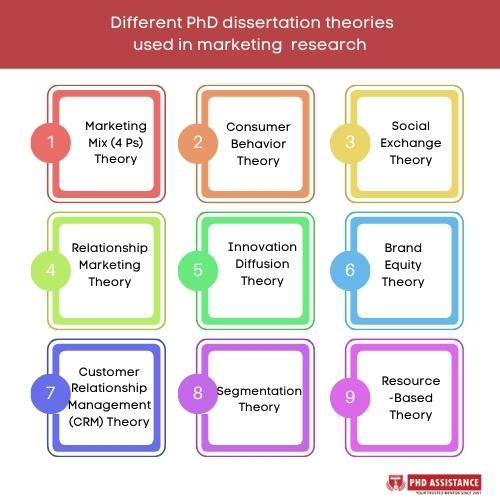
The sections below group the theories most often named in marketing dissertations by what they explain: individual consumer decisions, relationships and markets, and firms. For each, the question to ask is the same: does this theory explain the thing my research question is about, at the level at which I will collect data? If the answer is no, a more familiar theory is not a safer choice; it is a weaker one, because examiners will notice the mismatch.
Theories of consumer behaviour
"Consumer behaviour theory" is not one theory but a family. Three members are especially common in doctoral work.
- Theory of planned behaviour. Intention to act depends on attitude towards the behaviour, perceived social pressure (subjective norm) and perceived behavioural control; intention and control predict behaviour (Ajzen, 1991). It suits studies of deliberate choices such as switching brands or buying sustainable products.
- Prospect theory. People evaluate outcomes as gains or losses from a reference point and weigh losses more heavily than equal gains (Kahneman & Tversky, 1979). It informs research on pricing, framing and promotions.
- Technology acceptance and its extensions. Adoption of a technology depends on its perceived usefulness and ease of use (Davis, 1989); the unified theory of acceptance and use of technology adds social influence and facilitating conditions (Venkatesh et al., 2003). These dominate studies of digital channels, apps and e-commerce.
Theories of relationships, markets and firms
- Social exchange theory. Relationships continue when the parties judge that the benefits of exchange outweigh its costs, and they are sustained by reciprocity and trust. It underpins research on buyer-seller relationships and customer engagement.
- Relationship marketing. Builds on exchange ideas to explain why long-term relationships form and last, with trust and commitment as central concepts. See the Academy page on trust and commitment in relationship marketing.
- Diffusion of innovations. Explains how new products spread through a social system over time, through attributes such as relative advantage, compatibility and complexity and through adopter categories from innovators to laggards (Rogers, 2003).
- Brand equity. Explains how what consumers know and feel about a brand changes their response to its marketing, and so creates value for the firm. Studies usually measure awareness, associations, perceived quality and loyalty.
- Resource-based view. A firm gains sustained advantage from resources that are valuable, rare, hard to imitate and without close substitutes (Barney, 1991). In marketing it is used to explain why capabilities such as brands, customer relationships or data assets lead to performance.
Frameworks often mistaken for theories
Three items on many lists of "marketing theories" are better treated as frameworks or practices. The marketing mix (product, price, place and promotion) organises managerial decisions. Segmentation, targeting and positioning describe a strategy process. Customer relationship management (CRM) is a set of practices and systems, increasingly data-driven, which raises its own questions about privacy and trust (Martin & Murphy, 2017). Each can be the setting of a doctoral study, but the explanation should come from a theory, for example the resource-based view to explain why CRM capability improves performance.
| Theory or framework | What it explains | Level | Typical constructs | Typical design |
|---|---|---|---|---|
| Theory of planned behaviour | Intentions and deliberate behaviour | Individual | Attitude, subjective norm, perceived control, intention | Survey; structural equation modelling |
| Prospect theory | Choices under risk; framing effects | Individual | Reference point, loss aversion | Experiments |
| Technology acceptance / UTAUT | Adoption of technologies | Individual | Usefulness, ease of use, social influence | Survey; longitudinal designs |
| Social exchange; relationship marketing | Formation and continuation of relationships | Dyad | Trust, commitment, reciprocity | Dyadic surveys; case studies |
| Diffusion of innovations | Spread of new products over time | Market or social system | Innovation attributes, adopter categories | Panel data; network analysis; qualitative |
| Brand equity | Consumer response to branded marketing | Individual and firm | Awareness, associations, quality, loyalty | Survey; experiments; market data |
| Resource-based view | Sustained competitive advantage | Firm | Valuable, rare, inimitable resources and capabilities | Firm surveys; secondary data |
| Marketing mix; segmentation; CRM | Organise decisions (frameworks, not explanatory theories) | Firm | Mix elements; segments; CRM practices | Used as context with an explanatory theory |
How to choose and use a theory
- Start with the phenomenon and question, then ask which theories explain it, not the other way round.
- Match the level of the theory to your unit of analysis: individual, relationship, firm or market.
- Read the theory's original statement and its main critiques, not only applied studies that use it.
- Decide what your study does to the theory: test it in a new setting, extend it with a new construct, compare it with a rival, or question its assumptions.
- Prefer a contribution that challenges an assumption to one that only fills a small gap; problematising existing theory tends to produce more interesting questions than gap-spotting (Alvesson & Sandberg, 2011; Sandberg & Alvesson, 2011).
- Let the theory shape the design. Marketing journals publish both quantitative and qualitative work (Hanson & Grimmer, 2007), and the right design depends on whether you are testing, building or refining theory.
Writing the theory section of your thesis
Once a theory is chosen, the thesis needs to present it in enough depth for an examiner to judge how you use it. A useful structure covers five points.
- Origin: who proposed the theory, in what field and to answer what problem.
- Constructs and relationships: the concepts the theory uses and how it says they are connected, ideally summarised in a diagram that becomes your framework.
- Boundary conditions: the settings, populations or types of decision for which the theory was developed and where it may not hold. Theories built for individual consumers, for example, may not transfer directly to buying decisions made by organisations.
- Evidence and critique: what tests of the theory have found, and the main criticisms, such as the gap between stated intention and actual behaviour in intention-based models.
- Your use: how the theory leads to your hypotheses or propositions, and what your study will add.
Many marketing theories were developed before digital channels, platform markets and large-scale customer data. Applying them in those settings is a legitimate contribution, but only if you explain which assumptions change. Data-driven relationship marketing, for instance, raises questions of privacy and vulnerability that older exchange theories did not address (Martin & Murphy, 2017). Naming such changes turns a routine application into a reasoned extension.
Worked example (illustrative)
A doctoral researcher wants to study why small retailers in a mid-sized city are slow to accept mobile payments. Three theories are candidates.
- Technology acceptance and UTAUT would explain adoption through owners' perceptions of usefulness, ease of use and social influence (Davis, 1989; Venkatesh et al., 2003), measured by survey.
- Diffusion of innovations would explain adoption over time through the innovation's attributes and communication among retailers (Rogers, 2003), and suits a longitudinal or network design.
- The resource-based view would ask whether some retailers have capabilities that make adoption valuable (Barney, 1991), a firm-level question.
Because the question is about individual owners' decisions, the researcher chooses UTAUT as the main theory, adds one construct from diffusion theory (observability of other retailers' use) and states the contribution as an extension tested in a small-business setting. The other theories are discussed as alternatives, which shows the examiner that the choice was deliberate.
Common mistakes
- Listing several theories in the literature review without choosing one or explaining how they combine.
- Treating the marketing mix or segmentation as an explanatory theory.
- Picking a theory because it is popular, not because it explains the question.
- Mixing levels, for example using a firm-level theory to explain individual consumer choices.
- Claiming to "use" a theory without saying what the study adds to it.
- Citing only applied studies and never the theory's original statement or critiques.
Related pages: choosing and using theory in a management PhD, theoretical underpinnings of strategic marketing research and marketing thesis titles.
Key takeaways
- Theories explain, predict or describe; say which kind of contribution your thesis makes (Gregor, 2006).
- Treat the marketing mix, segmentation and CRM as frameworks and settings, not as explanations.
- Match the theory's level to your unit of analysis, from individual choice (Ajzen, 1991) to firm resources (Barney, 1991).
- Aim to extend, compare or challenge a theory rather than only apply it (Alvesson & Sandberg, 2011).
- Let the theory, not habit, decide the research design.