
What relationship marketing is
Relationship marketing shifts attention from single transactions to the development and maintenance of continuing exchange relationships. Practical ways to build customer trust, such as surveys, acting on feedback and loyalty programmes, are often listed without the theory behind them.
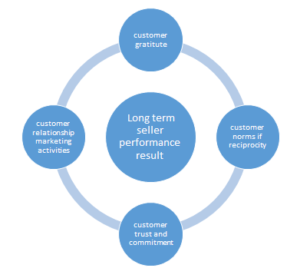
The commitment-trust theory
Morgan and Hunt argued that successful relationship marketing requires relationship commitment and trust, and they modelled the two as key mediating variables between a set of antecedents and a set of relationship outcomes. They tested the model with data from automobile tyre retailers and compared it with a rival model in which trust and commitment were not mediators; the results favoured the mediating model (Morgan & Hunt, 1994).
In the model, trust is a party's confidence in the reliability and integrity of its exchange partner, and commitment is the belief that the relationship is important enough to deserve real effort to maintain it. Antecedents include relationship termination costs, relationship benefits, shared values, communication and opportunistic behaviour (which reduces trust). Outcomes include acquiescence, lower propensity to leave, cooperation, functional conflict and reduced decision-making uncertainty (Morgan & Hunt, 1994).
Two features matter for a thesis. The theory is about mediation, so testing it means testing indirect effects, not just correlations. And the original setting was a business-to-business channel, so applying it to consumers is an extension that needs justification.
What the evidence shows
A meta-analysis of trust in marketing channel relationships found strong and consistent links between trust and other relationship constructs, and showed that trust predicts satisfaction and long-term orientation beyond economic outcomes. Effect sizes were larger in experiments, multi-industry samples and US data than in field studies, single-industry samples and European data (Geyskens et al., 1998). Design choices, in other words, shape the size of the effect you will find.
The largest synthesis, covering 94 studies, supported the core premise that relationship marketing improves performance. Relationship quality, a composite of trust, commitment and related constructs, had the strongest influence on objective seller performance, and commitment the weakest. Relationship investment had a large direct effect, suggesting mediating paths beyond trust and commitment. Effects were stronger where relationships matter more to customers (services, channels, business markets) and when relationships were with an individual rather than a firm (Palmatier et al., 2006).
Customer type also matters. In a study of theatre-goers, overall satisfaction was the main mediator of future intentions for occasional, low-relational customers, while trust and commitment played that role for consistent subscribers (Garbarino & Johnson, 1999). More recently, a survey of 1,473 mobile phone customers in South Africa and the Philippines found that contract status was not related to trust or commitment, whereas customers' relationship intention was (Steyn & Mostert, 2022). A 2025 review of 120 articles describes trust as the foundation that sustains commitment in both business and consumer markets (Rosário & Casaca, 2025).
From practice tips to constructs
These practices can be read as attempts to influence the theory's antecedents. Making that link explicit turns a list of tips into testable propositions.
| Practice | Construct it targets | Testable question |
|---|---|---|
| Surveys and polling | Communication | Does two-way communication raise trust, and through trust, commitment? |
| Acting on feedback | Communication; shared values | Is visible response to feedback linked to perceived integrity? |
| Social CRM | Communication | Does responsiveness on social channels affect trust differently from private channels? |
| Clear interaction policies | Reduced opportunistic behaviour | Do transparent policies reduce perceived opportunism? |
| Reward programmes | Relationship benefits; termination costs | Do rewards build commitment, or only calculative lock-in? |
What doctoral research still tests
Because the core premise is well supported, a thesis that simply re-tests the original model in a new country adds little. Stronger contributions question an assumption or explain a boundary condition (Alvesson & Sandberg, 2011).
| Open question | Why it matters | Possible design |
|---|---|---|
| When does satisfaction rather than trust drive loyalty? | Customer type changes the mediator | Multi-group model comparing low- and high-relational customers |
| Does relationship intention moderate the theory? | Contracts did not predict trust in a recent study | Survey with relationship intention as moderator |
| What mediates relationship investment? | Large direct effects suggest missing paths | Model adding gratitude or reciprocity as mediators |
| Trust in digital and automated service | Many relationships are now with platforms, not people | Experiment varying human versus automated contact |
| Do effects hold over time? | Most studies are cross-sectional | Panel survey or matched behavioural data |
Worked example (illustrative). A researcher studying a subscription service samples 400 customers and splits them into occasional and committed users. A multi-group structural model tests whether trust and commitment mediate intentions for committed users but satisfaction does so for occasional ones, extending Garbarino and Johnson's finding to a digital setting. Retention data from the firm, rather than self-reported intention, serves as the outcome. Because the predictors are measured in one survey and the outcome comes from company records six months later, common method bias is reduced by design. The discussion chapter can then say whether the boundary condition found in theatre audiences also holds for a digital service, which is a contribution an examiner can recognise.
Structuring the literature review
A review on this subject is easier to follow when it is organised by argument rather than by author. A structure that works for many theses has four parts.
- The theory: state the commitment-trust model, its constructs and its original setting, and say which parts your study uses.
- The cumulative evidence: report what the meta-analyses agree on and where effects vary, so the reader sees the boundary conditions before your hypotheses.
- The contested points: set studies that disagree side by side, for example on whether satisfaction or trust mediates intentions, and explain the likely reasons, such as customer type, industry or design.
- The gap: show which assumption or boundary condition remains untested in your setting, and why testing it would change what we know rather than repeat it.
Define each construct once, cite the definition you adopt, and keep it consistent through the hypotheses, the questionnaire and the discussion. Many examiners find that trust, satisfaction and loyalty drift in meaning from chapter to chapter. A short construct table, with the definition, its source and the scale you will use, prevents this and makes the measurement chapter straightforward to write. Where your setting differs from the theory's original business-to-business context, say so explicitly and explain why the constructs should still apply. For more on organising the chapter, see our guide to writing the literature review chapter.
Measuring trust and commitment well
Most studies measure every construct with one questionnaire from one respondent at one time, which invites common method bias. Procedural remedies include separating predictor and outcome measurement in time or source, protecting anonymity and varying scale formats; statistical checks should supplement, not replace, these (Podsakoff et al., 2003). If you estimate the model with partial least squares, follow current reporting guidance on reliability, validity and mediation testing (Hair et al., 2022). See also our guide to confirmatory factor analysis and the annotated service quality and loyalty questionnaire.
Common mistakes
- Citing the commitment-trust theory but testing only direct effects, not mediation.
- Treating consumer and business-to-business relationships as interchangeable without justification.
- Measuring intention as the only outcome when behavioural or performance data are available.
- Using a single cross-sectional survey with no remedy for common method bias.
- Assuming relationship marketing always improves performance, despite the meta-analytic boundary conditions.
Key takeaways
- The commitment-trust theory models trust and commitment as mediators between antecedents and relationship outcomes (Morgan & Hunt, 1994).
- Meta-analyses support the core premise but show effects vary with context and design (Geyskens et al., 1998; Palmatier et al., 2006).
- For low-relational customers, satisfaction rather than trust and commitment drives intentions (Garbarino & Johnson, 1999).
- Relationship intention may matter more than contracts for trust and commitment (Steyn & Mostert, 2022).
- Plan measurement to limit common method bias and test mediation properly (Podsakoff et al., 2003; Hair et al., 2022).