
What "complete" means in a Malaysian doctorate
A doctorate by research in Malaysia sits at Level 8 of the Malaysian Qualifications Framework. The Malaysian Qualifications Agency standards for master's and doctoral degrees describe how it is examined: the thesis must be examined by at least two examiners, one of whom must be external, examiners must hold at least the same qualification as the supervisor and be active researchers, and a viva voce forms part of the summative assessment (Malaysian Qualifications Agency, 2021). The same standards give a typical candidature of three years full-time and four years part-time, and list the proposal defence and progress reports as ways of monitoring progress.
Universities add their own rules, and the most important for planning is publication. Universiti Putra Malaysia's graduation requirements, for doctoral students registering from 2016/2017, ask for two journal articles published or accepted, at least one in an indexed journal on the university's list, with the candidate as first or corresponding author and based on research done during candidature (Universiti Putra Malaysia, 2023). A Universiti Malaya Senate document sets different routes for science and social science candidates, such as an article in a Web of Science indexed journal or two articles in recognised refereed journals, with proof of acceptance before graduation (Universiti Malaya, 2015). Rules change and differ between faculties, so read your own university's current regulations in the first year and plan your chapters with them in mind.
Choosing the structure of the thesis
The MQA standards recognise more than one way of presenting doctoral work, including modes based on prior or concurrent publication (Malaysian Qualifications Agency, 2021). In an analysis of theses and published advice, Paltridge (2002) distinguished the "traditional simple" thesis, organised as introduction, literature review, method, results and discussion; the "traditional complex" thesis, which reports several studies; the topic-based thesis; and the compilation of research articles. Most management theses in Malaysia use a conventional structure, but where publication is required, writing chapters that can become articles saves time later (Kamler, 2008).
| Chapter | What it must do | Question an examiner will ask |
|---|---|---|
| 1 Introduction | State the problem, the gap, the questions and objectives, scope and significance | Why does this problem matter, and why in this setting? |
| 2 Literature review | Synthesise the literature by concept and end with the gap your questions address | Is the gap real, or only a missing combination of variables? |
| 3 Theory and framework | Explain the theory, derive hypotheses or propositions, present the framework | Does the theory generate the hypotheses, or decorate them? |
| 4 Methodology | Justify design, sampling, instruments, ethics, data quality and analysis | Could another researcher repeat this? |
| 5 Results | Report measurement and structural results, or qualitative findings, without interpretation | Are all tests reported, including those that failed? |
| 6 Discussion and conclusion | Interpret results against theory and prior studies; state contributions, implications and limits | What do we know now that we did not know before? |
How Malaysian Industry 4.0 and analytics studies are built
Looking at published Malaysian work in your area shows what a complete argument looks like at article scale. Four recent studies illustrate the range. Soomro et al. (2021), at Universiti Kebangsaan Malaysia and Universiti Malaysia Perlis, surveyed 238 technology firms and used analysis of variance to compare Industry 4.0 readiness, technology use, leadership, strategy and innovation by firm size and age; they presented the results as ten empirical insights and acknowledged that the findings rested on one sample. Shahzad et al. (2023) tested a technology-organisation-environment model of Industry 4.0 adoption among 123 SMEs with partial least squares structural equation modelling (PLS-SEM). Aziz et al. (2023), at the UKM Graduate School of Business, applied the resource-based view to analytics capability in banks and noted that perceptual performance measures limited their conclusions, and Wong and Kee (2022) at Universiti Sains Malaysia linked organisational capabilities and institutional support to Industry 4.0 readiness in manufacturing SMEs.
For a thesis, the pattern is instructive. Each study states its theory before its hypotheses, reports its sample and instrument, and names its limitations. Most rely on one survey of managers at one point in time, which is why a thesis that adds a second data source, a second wave or objective performance data can make a contribution that a single article cannot. A thesis also has room to explain non-significant results, such as the absence of a regulation effect reported by Shahzad et al. (2023), rather than leaving them as a footnote.
Writing the chapters as one argument
Problem and literature
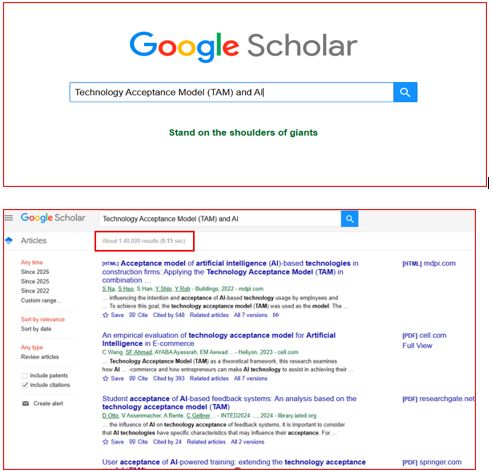
Frame an AI or Industry 4.0 problem that a Malaysian organisation actually faces, then review the literature by concept. A database search for the technology acceptance model and AI (Figure 2) like this is a starting point, but the review must go on to compare findings, not list them. If employees' use of an AI tool is the question, the technology acceptance model, built on perceived usefulness and ease of use, is a natural starting point (Davis, 1989); if firm performance is the question, a resource-based or capability view fits better.
Method and analysis
Choose methods because they answer the questions, not because they are fashionable (Bell et al., 2022). PLS-SEM is widely used in Malaysian management research; if you use it, report the measurement model (reliability, convergent and discriminant validity) before the structural model, and justify the choice of PLS over covariance-based SEM (Hair et al., 2019). If your data come from one respondent per firm, address common method bias in the design as well as statistically (Podsakoff et al., 2003). Machine learning can add value where prediction is the aim, but a model that predicts well does not by itself explain why; say clearly whether a chapter is testing theory or building a predictive tool.
Discussion and conclusion
The discussion chapter is where many theses lose marks. Return to each hypothesis or question, compare the result with Malaysian and international studies, and explain differences. A claim that "AI strategy improves forecasting" is a hypothesis your data either support or do not, not a premise; write it that way. Then state contributions to theory, practice and, where relevant, Industry 4.0 or AI policy, and give limitations that are specific to your design.
Writing support, supervision and feedback
Research in Malaysian settings shows where completion often stalls. Jeyaraj (2020) interviewed postgraduate research students at an overseas university's branch campus in Malaysia and found they wanted clearer supervisory guidance on writing expectations, and gained more from sustained, peer-based support than from one-off workshops. In a study of supervisors at Universiti Utara Malaysia, Hawari et al. (2022) reported that the doctoral students they supervised struggled with grammar, reporting verbs and an understanding of dissertation structure and conventions, and that supervisors and students held different expectations about feedback.
Two practical responses follow. Agree early with your supervisor what kind of feedback you will get and when, and keep a log of comments and how you responded. And join or form a writing group: reading each other's chapters is one of the cheapest ways to find gaps in an argument before an examiner does.
Worked example: a completion plan (illustrative)
A full-time candidate in the third year is studying whether dynamic capabilities mediate the effect of AI-enabled analytics on operational performance in Malaysian manufacturing SMEs. Her university requires two accepted articles before graduation. Her plan is hypothetical but shows the logic.
| Months | Thesis task | Publication task |
|---|---|---|
| 1-2 | Finalise the results chapter; report measurement and structural models in full | Submit article 1 (literature review and framework) if not already under review |
| 3-4 | Draft the discussion and conclusion against each hypothesis | Prepare article 2 from the main empirical results |
| 5 | Revise chapters 1-3 so the problem, gap and theory match what was finally tested | Respond to reviewers on article 1 |
| 6 | Full read-through for one argument; check references, tables and appendices | Submit article 2 |
| 7 | Supervisor review; submission under university procedures | Track acceptance against the graduation rule |
| 8 onwards | Prepare for the viva: summarise contributions and limits; anticipate examiner questions | Revise as needed |
Preparing for submission and the viva
Before submission, read the whole thesis in one sitting, as an examiner would. Check that the questions in chapter 1 are the questions answered in chapter 6, that every hypothesis in the framework appears in the results, and that terms such as "AI capability" or "Industry 4.0 readiness" are defined once and used consistently. Check every table against the analysis output, and every in-text citation against the reference list. Your university's similarity check is part of submission, but it is a check on overlapping text, not on quality.
Because the MQA standards require an external examiner (Malaysian Qualifications Agency, 2021), expect at least one reader who does not know your supervisor's school of thought. Prepare a one-page summary of the problem, the gap, the design, the main findings and the three contributions, and rehearse answers to the questions in the chapter table above. Prepare an honest account of the limitations: examiners respond better to a candidate who can say what the design cannot show, and what a follow-up study would do, than to one who defends every choice. If any articles from the thesis are already published, be ready to explain how the thesis goes beyond them.
Common mistakes
- Writing chapters one after another without revising early chapters to match the final results.
- Leaving publication until after submission when the university requires accepted articles to graduate.
- Adding a machine learning model without explaining what it adds to the research question.
- Reporting only significant paths and dropping hypotheses that were not supported.
- Writing a discussion that repeats the results instead of interpreting them against theory and prior Malaysian studies.
- Treating a similarity report as proof of quality instead of as one check among many.
For the earlier and later stages, see fixing a weak management PhD proposal in Malaysia and writing a journal manuscript from Malaysian management research, the Malaysia country page, and turning a thesis into a journal manuscript.
Key takeaways
- Malaysian doctoral theses are examined by at least two examiners, one external, with a viva voce as part of the assessment (Malaysian Qualifications Agency, 2021).
- University publication rules can make accepted articles a condition of graduation, so publication must be planned during candidature (Universiti Putra Malaysia, 2023; Universiti Malaya, 2015).
- Malaysian Industry 4.0 and analytics studies typically rest on one cross-sectional survey, which a thesis can extend with richer data (Soomro et al., 2021; Aziz et al., 2023).
- Report PLS-SEM measurement and structural models in full and address common method bias by design (Hair et al., 2019; Podsakoff et al., 2003).
- Clear, agreed feedback and sustained peer writing support help postgraduates in Malaysian settings complete their writing (Jeyaraj, 2020; Hawari et al., 2022).