
How to Fix a Weak PhD Research Proposal in Malaysia Management: Addressing Gap Identification and AI Framework Selection
- Home
- Academy
- PhD Research Proposal
- How to Fix a Weak PhD Research Proposal in Malaysia Management: Addressing Gap Identification and AI Framework Selection
Sustainable Practices in Environmental Science
- Step 1: Identify Genuine Research Gaps in Management Research
- Step 2: Conduct Critical Literature Review and Problem Justification
- Step 3: Select Appropriate Theoretical and AI Frameworks
- Step 4: Strengthen Research Design and Methodological Rigour
- Step 5: Improve Research Contributions and Proposal Positioning
- Strategies for Improving a Weak Management PhD Research Proposal
- Conclusion

Recent Post
Introduction
Malaysian management research has been evolving very rapidly due to the impact of digital disruption, Industry 4.0, the use of Artificial Intelligence (AI), sustainability needs and the evolving characteristics of organizations. Universities in Malaysia, in the other hand require a comprehensive research proposal with a strong theoretical grounding and methodology, demonstrating academic contribution as well as practical importance.
Despite this, many doctoral candidates face difficulties in creating convincing management research proposals, exhibiting research gaps, poor theoretical foundations, unsuitable AI framework selection, ambiguous research objectives, weak alignment between research questions, methodology and contributions, etc.
This article describes how to address problems in management research proposals for PhD candidates by detailing practical research gap identification, theory placement, AI framework selection, method establishment, and proposal improvement strategies. Additionally, Professional guidance for PhD research proposal in Malaysia can support scholars to enhance the quality of a proposal, thereby leading to higher admission rates into a doctoral program.
What you will learn?
Step 1: Identify Genuine Research Gaps in Management Research
The primary reason a PhD research proposal is poor is that the researcher has been unable to find and articulate a definitive and relevant gap in research. Researchers usually summarise previous studies instead of critically reviewing the research gap, methodology, and the outcome. An articulate research gap will support the claim that research is original and significant. The lack of a clearly definable and significant research gap is one of the most significant Research Proposal Challenges in Malaysia.
A gap in research might arise due to constraints in a theory, methodological deficiency, a distinct business environment or evolving business circumstances. When doing management research, one must review prior works and see if there is something that has not yet been explored or not explored adequately. Areas like the use of artificial intelligence, organisational transformation, business innovation, sustainability, leadership, performance of SME and so on present many opportunities for future research.
Much of the evidence on management studies within Malaysia is based on the developed economies and is not necessarily transferable to Malaysian organisations. The specific organisational outcomes resulting from management could be influenced by cultural differences, technology preparedness, and the way business is carried out locally. Thus, researchers should evaluate if current theories and findings explain management problems in Malaysia.
Example:
Dwivedi et al. (2023) researched the implications of generative AI technology adoption for business decision-making processes and business functions. The study revealed advantages gained from the adoption of the technology, but there are also gaps regarding the governance structure, employee trust and the strategy of adoption, especially within emerging markets.
Step 2: Conduct Critical Literature Review and Problem Justification
Effective research proposals need more than a description of the existing literature. As well as providing an overview of past research, researchers should be critical and assess the objectives, methods, findings, and shortcomings of previous studies to achieve an “understanding of what is currently known” and the “need for additional research”.
Many PhD researchers fail to synthesise findings from various sources and discuss studies in isolation. A critical review should highlight the inconsistencies and disputes in the literature and suggest how the research proposal will seek to build on and solve existing problems and contribute to knowledge.
Malaysian researchers need to consider if findings derived from an international context are relevant and transferable to Malaysian organisations and industries. The problem justification needs to illustrate the significance of the problem, who are the stakeholders impacted, and how the proposed research will contribute to both theory and practice. A well-formulated justification will only enhance the credibility and significance of the research proposal.
Example
Abbas et al.(2024) illustrated the increase in implementation of AI-enabled decision-making systems in organisations. The researchers admitted that it was not widely understood how managerial capabilities determine a successful integration of AI across varied organisational contexts. Thus, Malaysian management scholars can research how organisational factors will enhance AI-driven changes.
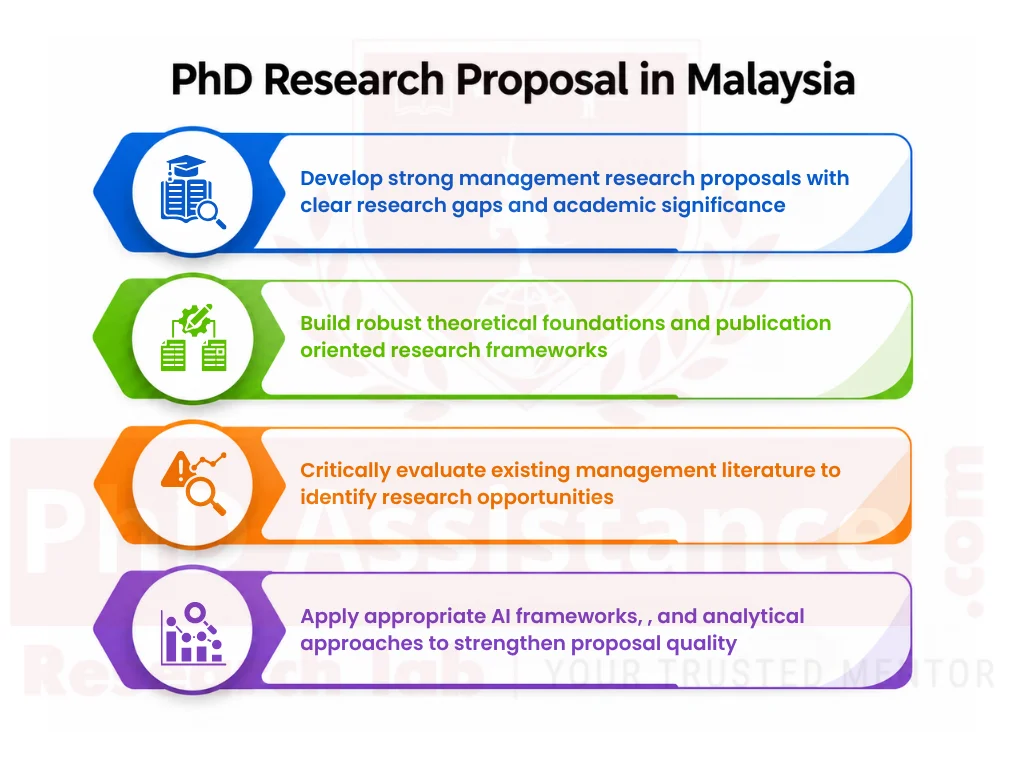
Step 3: Select Appropriate Theoretical and AI Frameworks
One typical deficiency noted in most PhD proposals is the inadequate choice of theories related to the research problem. Theories offer the necessary framework to explain the relationship between variables and help define the overall design of the study. Researchers are expected to adopt theories for their research and expected outcomes.
For management research studies, theory frameworks commonly used by researchers include: Resource-Based View (RBV) theory, Dynamic Capability theory, Institutional theory, Stakeholder theory, and Technology Acceptance Model (TAM). An appropriate theory would be chosen according to the nature of the research problem, variables involved and the business context in the study.
With the increasing volume of research, AI Framework Selection for PhD Research is equally essential. Frameworks like Explainable AI (XAI), Human-AI Collaboration Models, AI Readiness Frameworks, and Responsible AI Frameworks offer deeper insights into technology-driven organisational phenomena. Blending management theory with AI frameworks can further strengthen the analytical rigour of the proposed study.
Example: As shown by Raisch and Krakowski (2024), Human-AI Collaboration frameworks provide a better understanding of decision-making by managers than technology adoption frameworks do. Their work indicates that integration of organisational theory with AI frameworks can strengthen understanding of managers’ interaction with AI systems in complicated business settings.
Step 4: Strengthen Research Design and Methodological Rigour
A most frequent reason for the rejection of a proposal is the weaknesses in methodology. The researchers should not create inconsistencies between research questions, objectives and hypotheses on one hand and the method of data collection and analysis on the other hand. A clear methodology helps to build credibility and robustness of the intended study.
Computational approaches, such as supervised/unsupervised machine learning (ML), deep neural networks, transformer structures, explainable AI, federated learning, and natural language processing (NLP), are now the mainstream of modern healthcare studies. Traditional quantitative modelling approaches such as regression modelling, survival analysis, Bayesian statistics, and predictive analytics are key methods used to explore healthcare outcomes and treatment efficacy.
Researchers must also defend their sampling strategy, the size of their sample, the instruments used for measurement and validity procedures. They must address ethical issues as well as measures to assure data quality to reflect the strength of their proposed study. Strong methods make the researchers more confident of expected results. A very important component in Management PhD Research Proposal Improvement is that a close link between research questions, objectives, hypotheses and analytical methods will guarantee the overall soundness of the study to be conducted.
Example: Wamba et al. (2024) have used PLS-SEM to investigate the influence of AI capabilities on organisational performance; the study also confirms that AI capabilities have positive influences on innovation performance via knowledge integration effectively and thus emphasises the use of strong research methods.
Step 5: Improve Research Contributions and Proposal Positioning
A good quality PhD proposal needs to state the expected contributions to theory, practice and policy. Many PhD proposals do not detail the extent to which the proposed research will add to the existing body of management knowledge or what real-world problems it will tackle. These contributions must be clearly defined to indicate the value and novelty of the research proposed.
Theoretical contributions may consist of extending existing management theories, testing these models in a new setting or formulating theoretical frameworks that attempt to bring together disparate research. Practical contributions can take the form of enhancing managerial decision-making, firm performance or the adoption of technology. It should explain the usefulness of these outcomes to academicians and managers alike.
Furthermore, management research can offer policy implications on digital transformation, innovation, sustainability, and governance of AI. Explicitly outlining how the research connects to academic and social discourse increases the relevance of the research, as well as showing the broader contribution. Outstanding contribution statements often separate weak and strong proposals.
Example: Verhoef et al. (2024) demonstrated that AI-led business transformation improve organizational resilience and competitive advantage. The study also identified the insufficient evidence on the emergence of AI-driven business transformation in Southeast Asian economies. Malaysian management researchers could thus make a theoretical and practical contribution with empirical data on the application of AI-driven business transformation in local organisations.
Strategies for Improving a Weak Management PhD Research Proposal
Conclusion
Crafting an impressive management PhD research proposal is more than selecting a compelling topic. A researcher must select a research gap, construct a substantial theoretical base, select suitable AI frameworks, propose robust methods, and identify meaningful contributions.
As the integration of AI into organisations continues to grow, there are ample opportunities for Malaysian management researchers to provide meaningful theoretical and practical input. Through structured approaches and methodical approaches to improving weaknesses in proposals, doctoral students can produce quality proposals more consistently and increase their odds of proposal acceptance. Professional PhD proposal writing services in Malaysia can help further improve university research proposals and the ability to publish.
Are you facing rejection of your PhD research proposal in Malaysia? At PhD Assistance Research Lab, our experts offer specialised guidance to get your proposal approved.
References
- Dwivedi, Y. K., Kshetri, N., Hughes, L., Slade, E. L., Jeyaraj, A., Kar, A. K., Baabdullah, Bose, I., Brooks, L., Buhalis, D., … Wright, R. (2023). So what if ChatGPT wrote it? Multidisciplinary perspectives on opportunities, challenges and implications of generative conversational AI for research, practice and policy. International Journal of Information Management, 71, Article 102642. https://doi.org/10.1016/j.ijinfomgt.2023.10264
- Abbas, Ali & Saba, Noor & Syed, Muhammad & Ansari, Adeel. (2026). AI and IoT integration in Green HRM: A Framework for Eco-Friendly Talent Management and Optimization. Inverge Journal of Social Sciences. 5. 166-182. 10.63544/ijss.v5i2.255.
- Raisch, S., & Krakowski, S. (2021). Artificial intelligence and management: The automation–augmentation paradox. Academy of Management Review, 46(1), 192–210. https://doi.org/10.5465/amr.2018.0072
- Verhoef, P. C., Broekhuizen, T., Bart, Y., Bhattacharya, A., Dong, J. Q., Fabian, N., & Haenlein, M. (2021). Digital transformation: A multidisciplinary reflection and research agenda. Journal of Business Research, 122, 889–901. https://doi.org/10.1016/j.jbusres.2019.09.022
- Wamba, S. F., Queiroz, M. M., Trinchera, L., & Guthrie, C. (2023). Artificial intelligence capability and organizational performance: The mediating role of knowledge integration and innovation. Technological Forecasting and Social Change, 193, Article 122658. https://doi.org/10.1016/j.techfore.2023.122658