Similarity report interpretation and citation correction for journal manuscripts

Manuscript Similarity Report Correction

Mentoring to read your similarity report, fix citation and paraphrasing problems and disclose reused text before you submit.

Has your manuscript come back with a high similarity score from iThenticate or Turnitin? A percentage alone does not show plagiarism: your mentor works through each match with you, separating properly cited text and standard phrasing from passages that need a citation, quotation marks, a genuine rewrite in your own words or a disclosure to the editor.

Why it matters

Why your similarity report needs careful reading

Most journals screen submissions with Crossref Similarity Check, which uses iThenticate to compare your manuscript with published articles, preprints, theses and web pages. Editors then read the report. A high score can lead to desk rejection or questions from the editor; overlap found after publication can lead to a correction or a retraction.

A similarity score is not a plagiarism verdict. Correctly quoted and cited text, reference lists, standard method descriptions, common phrases and your own preprint or thesis can all be matched. Equally, a low score does not prove a manuscript is free of plagiarism: copied ideas, translated text and figures are not always detected. What matters is whether every borrowed idea, sentence and figure is attributed, and whether any reuse of your own published text is permitted and disclosed.

Scholars commonly tell us they find it hard to tell which matches matter, to paraphrase without losing their meaning or technical precision, to cite every source correctly, and to know how much of their thesis or conference paper they may reuse in a journal article.

  1. 01

    Accurate attribution

    Every quotation, paraphrase, idea, dataset and figure taken from another source is cited, so readers and editors can trace it.

  2. 02

    Paraphrase in your own words

    Close paraphrasing, or "patchwriting", keeps another author's sentence structure with a few words swapped. Real paraphrasing restates the idea in your own words and still cites the source.

  3. 03

    Transparent reuse of your own work

    Reusing text from your earlier papers, conference proceedings or thesis is text recycling. Some reuse, such as methods descriptions, can be acceptable if the journal allows it and you cite and disclose it; presenting the same findings again as new is duplicate publication.

  4. 04

    Honest AI disclosure

    Many publishers require authors to disclose any use of generative AI tools in preparing a manuscript, and COPE states that AI tools cannot be listed as authors. AI-writing detectors are not reliable enough to prove or disprove authorship, so the safe course is to follow your journal's policy and disclose.

  5. 05

    Fewer delays at submission

    A manuscript with clean attribution and clear disclosures avoids avoidable queries from the editor and lets reviewers focus on your science.

Our approach

How your mentor works through your similarity report

We do not chase a number. Your mentor reads each match in context with you and agrees the right fix, and you stay the author of every change.

01

Run or read the report

If you already have a report from your journal, supervisor or institution, we start from it. Otherwise we run a similarity check with a licensed tool, such as iThenticate or Turnitin, and note which sources and exclusions (quotations, bibliography, small matches) were applied.

02

Classify every match

Each match is marked as acceptable (cited quotation, reference list, standard terminology or method wording), needing a citation, needing quotation marks, needing a genuine rewrite, or reuse of your own published work that must be cited or disclosed.

03

Fix citations and quotations

Missing in-text citations and references are added, direct quotations are marked and cited, and the reference list is checked against your target journal's style, such as APA, Vancouver, Harvard or Chicago.

04

Rewrite in your own words

Where a passage is too close to its source, your mentor explains why and suggests how to restate the idea, keeping your meaning and technical terms. You approve or adapt every suggestion. Technical terms, standard names and defined methods are not reworded just to lower a score.

05

Handle text recycling

For overlap with your own earlier articles, conference papers, preprints or thesis, we check your target journal's policy, help you cite the earlier work and draft a short disclosure for your cover letter, following COPE and Text Recycling Research Project guidance. Overlap that amounts to duplicate publication cannot be fixed by rewording.

06

Check figures, tables and permissions

Legends, tables and figures taken or adapted from other works are checked for attribution, and we flag where you need permission or a licence statement from the copyright holder.

07

Recheck and document

After revision, a final similarity check is run and you receive a clean copy, a tracked-changes copy and a short log of what was changed and why, so you can explain your revisions to co-authors, your supervisor or the editor.

What we cover

Similarity problems we help you fix

These are the overlap problems we see most often in thesis-based articles, review papers, clinical and epidemiological studies, and interdisciplinary research.

  • 01

    Missing or incorrect citations

    Paraphrased or quoted material without a citation, citations that point to the wrong source, and references missing from the list.

  • 02

    Unmarked quotations

    Text copied word for word without quotation marks, even when the source is cited.

  • 03

    Close paraphrasing

    Passages that follow the structure and wording of a source too closely, often in introductions and literature reviews.

  • 04

    Text recycled from your own work

    Overlap with your thesis, earlier articles, conference papers or preprints, handled by citation and disclosure in line with journal policy.

  • 05

    Figures and tables

    Reused or adapted figures, tables and captions that need attribution or permission.

  • 06

    Editor or reviewer flags

    Manuscripts returned by a journal with a similarity query: we help you revise the flagged sections and draft a point-by-point response explaining the changes.

  • 07

    Language and flow after revision

    Revised passages are edited for grammar, clarity and consistency with the surrounding text, which helps authors who write in English as an additional language.

What you get

What's included in similarity report correction

Here is what we need from you, what the service covers, and what sits outside it.

What we need from you

Send these with your request.

  • Your manuscript in an editable format (Word or LaTeX)
  • Your target journal and its author guidelines, including any policies on text recycling, preprints and AI use
  • Any similarity report you already have, and any editor or reviewer comments about overlap
  • Your earlier publications, conference papers or thesis, if the manuscript draws on them
  • Your required citation style

What's included

Part of every similarity report correction order.

  • Interpretation of your similarity report, match by match
  • Correction of missing, incomplete or inaccurate citations and references
  • Marking and citing of direct quotations
  • Suggested paraphrases for passages too close to their sources, for you to approve
  • Advice on text recycling and draft disclosure wording for your cover letter
  • Checks on figure and table attribution and permissions
  • Language editing of revised passages
  • A final similarity check, clean and tracked-changes copies and a change log

Not included

Available as add-ons or other services.

Also included with your order

Every order comes with added support: referencing help, source checking and guidance from a mentor in your research area.

Referencing

Citations in your required style, such as APA, MLA, Harvard, Vancouver or Chicago, managed with tools such as Mendeley, EndNote or Zotero.

Source checking

Where a citation is missing, we trace the original source in databases such as Scopus, Web of Science, PubMed, IEEE Xplore and JSTOR, or on publisher platforms such as ScienceDirect and SpringerLink, so you cite the work you actually drew on.

Subject experts

Your mentor has research experience in your field, from engineering, computer science and the life sciences to medicine and clinical research, the social sciences, law, business, management and the humanities.

Study materials

Where access and copyright allow, we share the articles we traced, so you can read and cite them yourself.

Find your starting point

Where are you with your similarity report?

Research journeys are rarely straightforward, with hurdles, surprises, hard work, beginnings and endings. PhD Research Lab travels this journey with you, mentoring researchers worldwide.

“I have used several different cited sources, but I am not sure that I have cited and referenced them all correctly. I am concerned about copying someone's work without knowing it.”
MarekResearcher
How we help Citation and referencing check

Your mentor checks every in-text citation against your reference list for accuracy, consistency and your journal's style, and helps you add missing citations, mark quotations and fix references that do not match their sources.

Usually works best: Fixed price Talk to us
“My draft manuscript came back with a high similarity index. How do I know which sections need a rewrite, and how do I paraphrase effectively without losing my meaning?”
LenaResearcher
How we help Similarity report interpretation and paraphrasing

Together you go through the report match by match. Your mentor shows which matches are acceptable, which need citation or quotation marks and which need rewriting, and guides you to restate those ideas in your own words while keeping your meaning.

Usually works best: Hourly mentoring Talk to us
“I have overlapping text from my previous conference paper in my manuscript. Can you help me make sure I don't get in trouble for self-plagiarism?”
AnjaResearcher
How we help Text recycling and disclosure

We check what overlaps with your conference paper and what your target journal allows. Your mentor helps you cite the earlier paper, revise where reuse is not appropriate and draft a clear disclosure for the editor, following COPE and Text Recycling Research Project guidance. Many journals accept extended conference papers when the overlap is disclosed.

Usually works best: Fixed price Talk to us
“I am submitting to a high-impact journal. I want to be sure that my work passes the plagiarism check and that I am following ethical publishing processes.”
LukasResearcher
How we help Final similarity check and integrity review

We run a final similarity check, review the remaining matches with you and confirm that citations, quotations, figure permissions and disclosures are in place, so you can submit knowing your attribution is sound.

Usually works best: Fixed price Talk to us

Scenarios are illustrative, based on requests we often receive from scholars.

Packages & pricing

Choose the support that fits your stage

We offer similarity support at different levels, depending on how much overlap your report shows and how close you are to submission. Prices depend on length, discipline and deadline, and every package starts with a free quote. An expedited service is available as an add-on.

Prices for

Prices in USD, PhD level shown. Master's is 15% lower; postdoc and faculty 15% higher. Your exact price is confirmed in a free quote.

Basic

For manuscripts with a few flagged passages or citation gaps.

From$79
Delivered in 1 to 2 working daysChoose Basic
  • Similarity check with a licensed tool
  • Annotated similarity report
  • Citation and reference correction
  • Guidance on minor flagged passages
  • Clean and tracked-changes copies
  • Paraphrasing guidance by a subject expert
  • Final re-check
Recommended

Standard

For journal submissions with moderate overlap or thesis-based articles.

From$149
Delivered in 3 to 5 working daysChoose Standard
  • Everything in Basic
  • Paraphrasing guidance by a subject expert
  • Missing references traced and added
  • Text recycling advice and disclosure wording
  • Language editing of revised passages
  • Final similarity re-check
  • Figure and table permissions check
  • Response letter to the editor

Premium

For resubmissions flagged by a journal, or manuscripts with extensive overlap.

From$249
Delivered in 5 to 7 working daysChoose Premium

    Add-ons

    Add any of these to a package, now or later. Your mentor stays the same.

    See full pricing →
    Our process

    How it works, from order to final report

    One single point of contact (SPOC) stays with you through every step, so you always know who to ask.

    1. 1Before we startSubmit your requirementsFill in the secure order form with your manuscript, target journal and its guidelines, citation style and any similarity report or editor comments, then pay online so we can start.
    2. 2Day 1Confirmation and mentor matchYou receive an order confirmation with the timeline, and we assign a mentor with experience in your subject and in journal publishing.
    3. 3ThroughoutRegular updatesWe keep you informed by email and through your client portal, and include any new guidance from your journal, supervisor or co-authors.
    4. 4While we workReview and correctionYour mentor classifies each match, corrects citations and quotations, suggests rewrites for you to approve and drafts any disclosure wording, then runs a final similarity check.
    5. 5ReviewReview and revisionsYou review the changes with your mentor, and we revise in response to your co-authors', supervisor's or editor's comments within the agreed scope.
    6. 6DeliveryFinal deliveryYou receive clean and tracked-changes copies, the final similarity report, your citation files and a change log. We welcome your feedback.
    Our guarantee

    What we promise, we deliver

    PhD Research Lab frames every similarity review to your target journal's originality, text recycling and AI-use policies, and to your university's guidelines where the manuscript comes from a thesis. Our mentors have supported doctoral researchers at universities around the world, including the UK, the Netherlands, the USA, Australia, the UAE, Kenya, Nigeria, China and Russia, and they know that policies differ between institutions and publishers. We do not promise a particular similarity percentage, and we never edit text to evade detection software.

    Scholars we have supported study in
    • UK
    • USA
    • Netherlands
    • Germany
    • Ireland
    • Australia
    • UAE
    • Saudi Arabia
    • Qatar
    • Kenya
    • Nigeria
    • Russia
    • and more
    • Original workEvery document is checked for plagiarism before delivery.
    • On-time deliveryDelivered by the date we agree when you order.
    • Subject matter expertiseA mentor with doctoral-level knowledge of your field.
    • Talk to your mentorMessage your mentor directly through your single point of contact.
    • Ongoing supportQuestions answered at every step, before and after delivery.
    • Current academic sourcesBuilt on recent, peer-reviewed literature.
    • Research articles supplied*Copies of key articles used for your topics.
    • ConfidentialityYour details and work are never shared.

    *Where access and copyright allow.

    Quality and compliance

    See how we keep every project on track

    We have supported PhD projects for scholars around the world, and every task follows the same checks. These are real screens from our workflow.

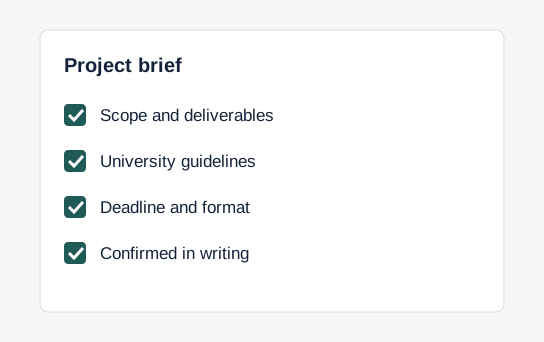
    Project brief checklist showing scope, university guidelines and deadline
    Step 1 · Project brief Requirements confirmed in writing You share your requirements, university guidelines and deadline, and your point of contact confirms the scope with you before work starts.
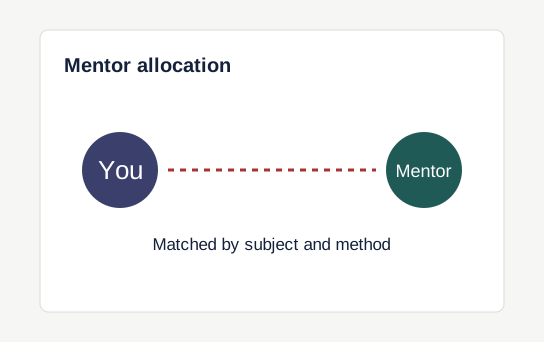
    Subject-matched mentor allocation for your project
    Step 2 · Mentor allocation A subject-matched mentor is assigned Your project is assigned to a mentor who knows your subject and method, and you are introduced before the work begins.
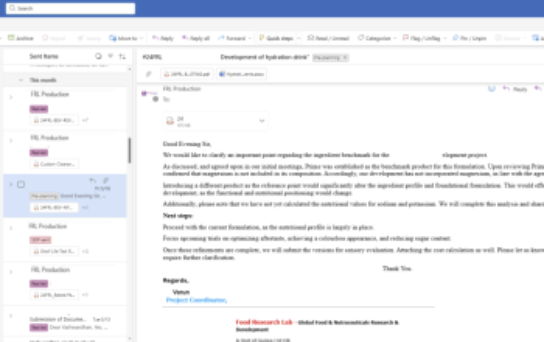
    Email thread between a scholar and our project coordinator
    Step 3 · Regular updates Communication through email Updates, questions and changes from your supervisor go through your single point of contact, so you always have a written record.
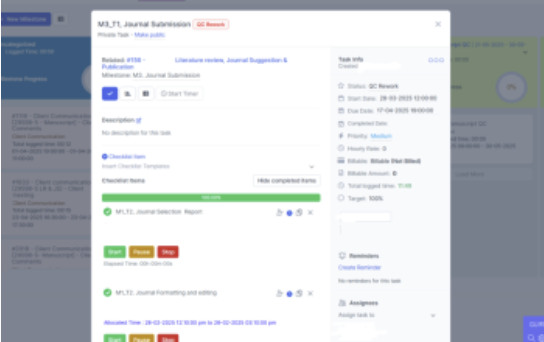
    Task record in our ERP system showing checklist items and quality-check status
    Step 4 · Quality check Quality check in our ERP system Every task is tracked in our project system, with checklists and a manager's quality check before the work moves on.
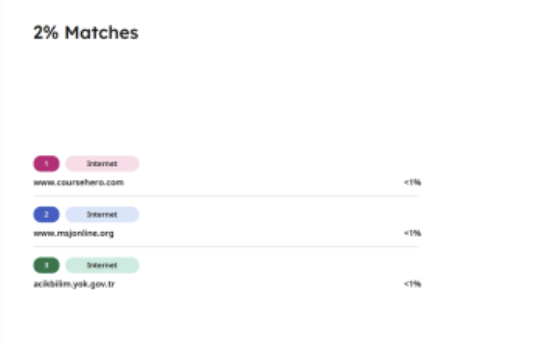
    Plagiarism report showing a 2% overall match
    Step 5 · Plagiarism check Plagiarism report Each document goes through a similarity check before delivery, so you can submit it with confidence.
    FAQs

    Frequently asked questions

    Ask a mentor
    Why does my manuscript need a similarity review?

    Journals screen submissions for overlap and editors act on what they find. Reviewing the report before you submit lets you fix missing citations, close paraphrasing and undisclosed reuse of your own work, so the editor sees a manuscript with clear, honest attribution.

    What similarity percentage do journals accept?

    There is no universal threshold. Editors look at where the matches are and what they are, not just the total: a moderate score spread across cited quotations and standard methods wording may be fine, while a single uncited paragraph may not. Check your journal's guidance, and treat any fixed cut-off you see quoted with caution.

    Can you guarantee a certain similarity score?

    No. We work to make sure every match is properly attributed, cited or disclosed. Lowering a number by rewording text that is correctly quoted, or by disguising copied or recycled text, would not make the manuscript more honest, and editors can see through it.

    Can you make my manuscript pass AI detectors?

    We do not edit text to evade AI-writing detectors. Follow your journal's policy on generative AI: if you used AI tools, disclose how, check every statement and reference they produced, and remain responsible for the content. We can help you word that disclosure.

    Is reusing text from my thesis self-plagiarism?

    Not necessarily. Many journals accept articles based on a thesis, and some allow reuse of methods wording, provided you cite the thesis and say so in your cover letter. Reusing text from a published article is treated more strictly. We check your journal's policy and help you disclose correctly.

    What does the service include?

    Interpretation of your similarity report, citation and reference correction, guidance on paraphrasing in your own words, text recycling advice, figure attribution checks, language editing of revised passages and a final check, delivered with tracked changes so you can see every edit.

    Do you cover all subject areas?

    We support manuscripts across the sciences, management, humanities and arts, including psychology, computer science, business and management, sociology, statistics and data science, architecture and design, food science, engineering, medicine and health sciences, life sciences, languages and literature, economics and finance, pharmaceutical sciences, environmental studies, political science, sports science, theology and philosophy, media and communication, education, social work, law and criminology, tourism and hospitality, and anthropology. Contact us to ask about your area.

    Can I talk to my mentor?

    Yes. You can contact your mentor by email, chat or call, and our project coordinators can arrange a direct appointment.

    Do you charge extra for revisions?

    Revisions within the agreed scope of your package are included. Please read our terms and conditions when you place an order.

    How is pricing set?

    Prices depend on length, discipline, the amount of overlap and your deadline. Our project coordinators can tell you about current seasonal discounts and referral offers.

    Can I learn to do this myself?

    Yes. Your mentor explains each fix as you go, and the PhD Research Lab Academy offers courses on journal writing and academic editing. See the Academy.