

Selecting the Right PhD Topic in Law for Researchers in Qatar: Methodologically Rigorous Research Design for Doctoral Studies
January 20, 2026
Critical review of Decolonial research methodology: an assessment of the challenge to established practice
January 21, 2026PhD Topic Selection in Law for UK research scholars: Developing an Original, Theoretically Grounded, and Publishable Doctoral Research Idea
- January 21, 2026
- Topic Selection
Introduction
Selecting a doctoral research topic is the most significant point in the PhD journey. In terms of originality, theoretical depth, and academic rigour, the expectations for law scholars in the UK are especially high. UK universities consider the clarity of research purpose, constant interaction with legal theory, and the likelihood of academic publication from the proposal stage.
Thus, Law PhD Topic Selection for UK Scholars is more than just picking a field of interest. It is about developing a research problem that is critically focused, methodologically sound, and has the potential to influence ongoing legal discussions. Researchers may benefit from the structured guidance of PhD Assistance to transform their broad legal interests into sharp and theory-driven doctoral research topics.
A properly selected PhD research topic should increase the chance of proposal approval, supervisor alignment, and smooth publication in an academic journal within the context of the UK legal research environment.
Understanding UK Expectations in Law PhD Topic Selection
PhD scholars have a tight work schedule from the selection of the research topic, with the intensive doctoral frameworks of UK universities. UK PhD programmes demand from the very beginning the skills of independent thought, creativity, and a good grasp of the current legal literature.
Therefore, UK PhD dissertation topics in law need to spot a legal issue, explain the lack of research and the importance of the study in the context of comparative law in the UK. Thus, the process of selecting a PhD research topic requires the skill to place it correctly in the research context, regardless of subject knowledge.
Professional topic selection guidance helps scholars ensure their intended research is aligned with UK doctoral standards. Refinement of the research focus, enhancement of the theoretical engagement, and proving of the study’s feasibility within the expected doctoral duration are the main benefits of this guidance.
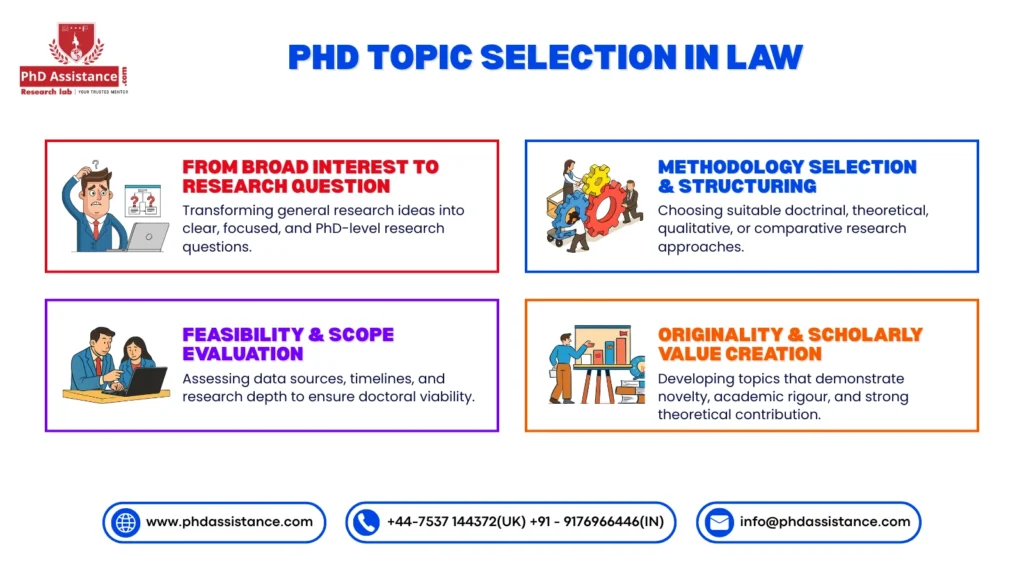
Doctrinal Legal Research: Building Analytical Precision
Still now, Doctrinal legal research is the main research method that PhD students in law in the UK rely on, especially in the fields of constitutional law, administrative law, criminal justice, contracts, and human rights.
Doctrinal research is a very thorough and critical analysis of the legal rules, legislation, and case law, which aims to find a solution to inconsistencies, clarify things that are not clear, or even reconsider the reasoning of the courts.
A good doctrinal PhD topic is not just a matter of stating the law but also providing evaluative and normative insights that will be beneficial to the understanding of law.
The trends for research scholars in the UK on doctrinal topics are usually related to the changing judicial interpretations, the reform of the laws, or the developments of the constitution within the UK legal system.
The expert law PhD thesis topic guidance UK is to ensure that such topics are sufficiently narrow for doctoral depth while remaining intellectually original and publication-oriented.
The way doctrinal PhD research is developed, it will have a significant impact on the legal reform debates it is involved in, and it will also help strengthen scholarly discourse.
Example:
Journal: The Cambridge Law Journal
Study: Elliott, 2017
One recent doctrinal legal research example is the case R (Miller) v Secretary of State for Exiting the European Union, heard by the UK Supreme Court, which Mark Elliott performed in 2017. The analysis revolves around the constitutional concepts of parliamentary sovereignty and the limits of government power from the Court’s perspective.
The author of the study elucidates that not only the case-law analysis, but also the constitutional theory would be the major sources of interconnection with the doctoral-level topics in doctrinal research that provide the judiciary reasoning and constitutional changes with the normative insights. Accordingly, it strongly advocates the topic of UK public and constitutional law being chosen as a model for a doctoral dissertation.
Theoretical and Socio-Legal Approaches in UK Doctoral Research
Theoretical engagement is considered to be a primary indicator of doctoral originality, and so quite a lot of emphasis is placed on it. Thus, a PhD topic limited to doctrinal analysis and not engaging with any legal theory may be rated as low in academic contribution.
Many Law PhD topic ideas for UK universities are therefore taking such a diverse approach as to incorporate jurisprudential, socio-legal, or interdisciplinary perspectives in order to improve the analytical depth.
Socio-legal research subjects usually investigate the relationship between law and society, putting emphasis on the legal rules’ operation in practice and their impact on individuals or institutions. The same is true for the pretending research that may take critical legal studies, legal realism, feminist legal theory, or constitutional theory as its basis and thus reinterpret traditional doctrines.
The professional topic selection support that is made available ensures that these methods are consistent with each other and meet the UK academic standards, so that the quality of the proposal and the research impact in the long run are both increased.

Example:
Journal: Amicus Curiae
Study: Newman & Robins, 2022
One of the most remarkable and notable UK socio-legal research studies is Newman and Robins (2022), which scrutinises the legal aid funding reforms’ effects on access to justice in England and Wales. The research utilises empirical data and a socio-legal approach to reveal the gap between the objectives of legal policy and the impact on the most vulnerable people.
This research confirms that PhD students grounded in socio-legal methodology can integrate theory, policy evaluation, and real-world evidence to produce academically original and socially relevant scholarship in the UK legal context.
Comparative Legal Research: Enhancing Scholarly Value
Comparative legal research is still very much alive in UK doctoral law studies, where it remains the most important method, especially in the post-Brexit legal landscape.
By analysing the differences and similarities between UK law and the legal systems of the European Union, the Commonwealth, or other international jurisdictions, the best practices, the regulatory divergences, and the areas that need to be reformed come to light.
Many of the UK research topics for PhD scholars take a comparative approach to solve modern legal conflicts in corporate governance, human rights, regulatory law, and public policy.
Aligning Research Topics with Supervisory Expertise
In the UK, one of the features that define the doctoral law research is the necessity of matching the research topic to the supervisory expertise available. PhD proposals submitted to UK universities are evaluated not only in terms of originality and feasibility but also by the question of whether the right academic supervision is available. In case the proposed topics do not fit with the research strengths of the department, even well-formed topics might be rejected.
The systematic topic selection assistance can help scholars to refine their research ideas according to faculty expertise and institutional priorities. This alignment not only increases the involvement of the supervisors but also lowers the risk of changing the topic at a later stage and therefore supports a smoother progress through the doctorate.
Overcoming Common Topic Selection Challenges
A large number of law PhD students in the UK face the same issues at the very beginning of their research when they are selecting a topic. Among such problems are deciding on too general topics, not spotting a real legal research gap, and a mismatch of the research goals with the suitable methodologies. Such problems very often lead to revisions of the proposals, delay of the admission, and consequently a longer than planned period of a PhD.
Professional legal research topic selection UK guidance helps in overcoming these issues by means of a comprehensive literature review, feasibility study, and conceptual refinement. Such a systematic method not only makes it sure that the chosen topic is viable and original, and has the potential for doctoral-level research, but also that it is in line with the publication opportunities in the future.
Conclusion
The United Kingdom academic landscape is very competitive, and the choice of a PhD research topic in law is therefore both a decision based on intellect and strategy.
It does not matter whether the researcher adopts a doctrinal, theoretical, socio-legal, or comparative method; he or she must ensure that the research questions are original, analytically rigorous, and institutionally aligned.
With the help of professional PhD Topic Selection, researchers can come up with their doctoral ideas, which are academically, practically, and publication-oriented.
Contact us to select a PhD research topic that aligns with your research idea, clearly addresses the legal research gap, and meets the academic standard in UK.
References
- Newman, D., & Robins, J. (2022). ‘The Demise of Legal Aid’? Access to Justice and Social Welfare Law after Austerity. Amicus Curiae, Series 2, 3(3), 418–441. https://journals.sas.ac.uk/amicus/article/download/5436/5215/9578
