
Why write the thesis chapter by chapter
Urban sustainability and smart city models are an active area of management research in South Africa. Studies combine questions about governance, technology adoption, service delivery and environmental outcomes, and many draw on public administration, planning and information systems as well as management. That breadth is a strength, but it also makes a doctoral thesis easy to lose control of.
Working chapter by chapter helps. Each chapter has a job in the overall argument: the introduction states the problem, the literature review builds a framework, the methods chapter shows how the framework will be examined, the findings chapters report what was found, and the discussion explains what it means. Studies of thesis writing show that published advice and actual practice differ, and that successful theses vary in structure, from the traditional sequence to topic-based and thesis-by-publication formats (Paltridge, 2002). Examiners, for their part, read for a coherent argument that runs through the whole document (Golding et al., 2014).
This article focuses on writing the chapters. For the earlier stages, see our guides to choosing a topic and identifying a research gap; for the economics side of South African doctoral research, see data analysis challenges in South African economics, and for doctoral study in the country more generally, our South Africa page.
How South African studies have approached smart cities
Before planning chapters, it helps to know how researchers in South Africa have actually studied the topic. The local evidence base is still small compared with the international smart city literature, and it is weighted towards governance and readiness rather than technology performance. Three strands are useful models.
Municipal readiness studied qualitatively
Enwereji and Uwizeyimana (2022) asked how ready South African municipalities are to become smart cities. Their design is a good example of fitting method to question: a qualitative study with a purposive sample of 20 municipal participants, open-ended interviews and thematic analysis supported by ATLAS.ti. A readiness question concerns capacity, leadership and institutional arrangements, which interviews with officials can illuminate; a survey of residents would answer a different question.
| Design element | Enwereji and Uwizeyimana (2022) | What a doctoral chapter should report |
|---|---|---|
| Approach | Qualitative | Why a qualitative design suits the question |
| Sampling | Purposive | Who was selected, by what criteria, and who was not reached |
| Sample size | 20 municipal participants | How the number was judged sufficient for the analytic aim |
| Data collection | Open-ended interviews | Interview guide, setting, language, recording and consent |
| Analysis | Thematic analysis with ATLAS.ti (version 8.2) | Coding steps, how themes were developed and checked |
| Focus | Smart city readiness and governance challenges in municipalities | How findings answer the research question |
Organising and governing the smart African city
Peter and Meyer (2023) examine how the smart African city can be organised by drawing on the urban commons and residents' right to the city. Odendaal (2021) explores what an emancipatory smart city would involve, starting from everyday urbanism and the importance of place. Both suggest that a management thesis on smart cities in South Africa will usually need a governance or organisational theory, not only a technology adoption model.
Positioning African urban research
Croese and Wood (2024) review what African urban studies contribute to urban theory and the challenges the field faces. For a doctoral researcher, this kind of review helps position a South African study as a contribution to wider debates rather than a local application of models developed elsewhere.
Albino et al. (2015) map definitions, dimensions and performance measures of smart cities, and Bibri and Krogstie (2017) review how smart sustainable cities combine information technology, environmental sustainability and urban governance. The point for your thesis is to use such reviews to select and justify a framework, then test or explore it in the South African setting.
Chapter 1: the introduction
Draft a working introduction early, but expect to rewrite it last. It should state the practical and scholarly problem, the aim and research questions, the setting, and the thesis's intended contribution in one or two paragraphs each. A smart city example might be a metropolitan municipality introducing digital service platforms while struggling with infrastructure backlogs; the problem is not "smart cities are important" but a specific tension that your study can examine.
- Name the unit of analysis: a municipality, a project, a public-private partnership, a group of residents or firms.
- Write questions that the methods can answer, for example "How do municipal managers interpret readiness for smart mobility?" rather than "Are smart cities sustainable?".
- State scope limits now (which cities, which services, which period) so later chapters do not drift.
Chapter 2: the literature review as framework building
A literature review chapter should lead the reader from the problem to a framework. A concept-centric structure, organised by the ideas your study uses rather than by author, is the standard advice for review writing in management and information systems (Webster & Watson, 2002), and the choice between systematic, semi-systematic and integrative approaches should follow the purpose of the review (Snyder, 2019).
In smart city research the usual trap is a long opening on definitions. Instead, use the international reviews to settle definitions briefly (Albino et al., 2015; Bibri & Krogstie, 2017), then spend most of the chapter on the relationships your study examines: for example, between institutional capacity, stakeholder engagement and the adoption of smart services. Bring South African and African studies in as evidence, not as a separate "local context" section at the end (Enwereji & Uwizeyimana, 2022; Odendaal, 2021).
| Section of the chapter | What to include | What to leave out |
|---|---|---|
| Opening | The problem and the questions the review must inform | A history of the smart city idea |
| Concepts | Working definitions you will use and why | Every competing definition |
| Theory | The governance, organisational or adoption theory you rely on and its limits | Several theories listed but not used |
| Evidence | Studies grouped by relationship or mechanism, including South African work | Author-by-author summaries |
| Synthesis | Gaps and a framework or propositions that lead to your design | Gaps stated without reasons |
Chapter 3: the methods chapter
The methods chapter explains and justifies how the study answers its questions. Business research textbooks set out the choices: philosophy and approach, strategy, time horizon, sampling, data collection and analysis (Saunders et al., 2023; Bell et al., 2022). In smart city research the main options are case studies of particular municipalities or projects, interview studies of officials and stakeholders, surveys of residents or firms, spatial analysis, and mixed designs.
- Case studies suit "how" and "why" questions about a few initiatives; build in theory from the start and justify case selection (Eisenhardt, 1989).
- Interview studies with purposive samples suit readiness and governance questions, as in Enwereji and Uwizeyimana (2022); describe how themes were developed, for example following Braun and Clarke (2006).
- Surveys suit adoption questions across many respondents; plan for measurement validity and multivariate analysis (Hair et al., 2019).
- Spatial or administrative data can show where services and outcomes differ; explain data sources and their limits.
Set out the South African ethics requirements explicitly. Research with municipal officials or residents needs approval from your university research ethics committee, often permission from the municipality itself, and handling of personal information that complies with the Protection of Personal Information Act (POPIA). Describe consent, anonymisation and data storage in the chapter.
Chapters 4 and 5: findings and discussion
Report findings in the order of your research questions and keep interpretation for the discussion. For qualitative chapters, present themes with enough data extracts to let the reader judge them, and say how themes relate to each other. For survey chapters, report measurement quality before structural results.
Single-source surveys, where the same respondents report both the predictors and the outcomes at one time, are common in adoption studies. Podsakoff et al. (2003) review how such common method variance can bias relationships and set out procedural remedies (separating measures, protecting anonymity, varied response formats) as well as statistical checks. Plan the procedural remedies before data collection; statistical checks afterwards are not a substitute.
Software choice follows the design. SPSS, AMOS and SmartPLS support statistical and structural equation analysis, while NVivo and ATLAS.ti support qualitative coding. Name the software and version, but explain the analytic decisions, because those are what examiners assess.
In the discussion chapter, return to the framework from Chapter 2. Explain which relationships held, which did not and why, and what the South African setting adds. Compare your findings with the local studies as well as the international reviews (Enwereji & Uwizeyimana, 2022; Peter & Meyer, 2023; Bibri & Krogstie, 2017).
Using reviews of research trends
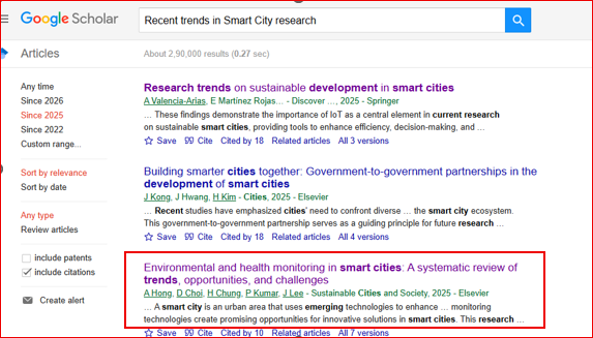
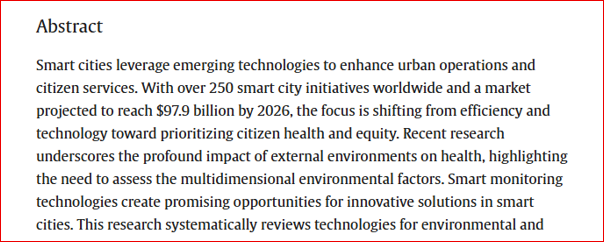
Three figures illustrate current trends in smart city research. That article attributed them to a systematic review reporting a shift in smart city research from technology-centred approaches towards the well-being of citizens; we could not trace the review, so treat the figures as illustrations rather than evidence. The South African studies above, with their attention to governance and place, sit comfortably with such a shift (Enwereji & Uwizeyimana, 2022; Odendaal, 2021). When you use trend figures in your own thesis, cite the review they come from, state its search period and sources, and do not treat a trend in publications as evidence about cities themselves.

Worked example: planning the chapters of one thesis (illustrative)
The following example is hypothetical. A doctoral researcher in management wants to study how metropolitan municipalities in Gauteng decide whether to adopt smart mobility services.
- Problem and question: municipalities announce smart mobility plans but few are implemented. Question: how do municipal managers judge readiness for smart mobility, and what shapes their decisions?
- Literature review: brief definitions from the international reviews; a governance framework of capacity, stakeholder relations and funding; South African evidence on readiness and on everyday urban practices.
- Methods: a qualitative multiple-case design in three municipalities, with purposive interviews of officials and partners, document analysis of plans and budgets, ethics approval and municipal permission.
- Findings: one chapter per theme, each tied to a research question, with extracts and document evidence.
- Discussion: how the findings extend the framework, what differs from studies elsewhere, and what municipalities might do.
The researcher drafts Chapter 3 first, then Chapter 2, and writes Chapter 1 last. Each draft goes to the supervisor with a one-paragraph note on the chapter's job in the argument, which makes feedback more focused.
Revising chapters and preparing to publish
Revise each chapter against its job. Read the first and last paragraph of every section: together they should state the argument without the detail. Check that every concept in the framework appears in the methods and the findings, and that every finding is discussed. Examiners notice when a thesis promises more than it delivers (Golding et al., 2014).
If you plan to publish from the thesis, a structured revision programme can help you turn a chapter into an article (Belcher, 2019); our guide to turning a thesis into a manuscript covers the differences between the two genres, and the dissertation guidelines article covers formatting and structure. For chapter writing in a related setting, see writing individual chapters in UAE management.
Common mistakes
- Opening the literature review with pages of smart city definitions instead of the framework the study needs.
- Choosing a survey and structural equation modelling before deciding what the research question requires.
- Treating South African studies as an afterthought rather than as core evidence.
- Listing software instead of explaining analytic decisions.
- Ignoring common method bias in single-source surveys (Podsakoff et al., 2003).
- Leaving ethics and municipal permissions until data collection is due.
- Writing the introduction first and never revising it, so that it no longer matches the findings.
Key takeaways
- Give each chapter a clear job in one argument, and write the introduction last.
- South African smart city research has focused on municipal readiness and governance, often with qualitative designs (Enwereji & Uwizeyimana, 2022).
- Use international reviews to settle definitions, then build a governance or organisational framework (Albino et al., 2015; Peter & Meyer, 2023).
- Match the methods to the question and report design decisions, ethics and permissions fully (Saunders et al., 2023).
- Plan remedies for common method bias before collecting survey data (Podsakoff et al., 2003).