
How to Overcome PhD Data Analysis Challenges in South Africa Economics: Fixing Errors in Predictive Modelling and Econometric Research
- Home
- Academy
- PhD Data Analysis
- How to Overcome PhD Data Analysis Challenges in South Africa Economics: Fixing Errors in Predictive Modelling and Econometric Research
Sustainable Practices in Environmental Science
- Step 1: Identify Data Quality Issues and Research Challenges
- Step 2: Conduct Critical Evaluation of Previous Research and Methodological Errors
- Step 3: Apply Appropriate Economic Theories and Econometric Frameworks
- Step 4: Evaluate Econometric Methods and Predictive Models
- Step 5: Develop Research Questions and Robust Analytical Contributions
- Strategies for Overcoming Data Analysis Challenges in Economics Research
- Conclusion

Recent Post
Introduction
Economic research in South Africa is an active field, and several persistent problems (unemployment, poverty, income inequality, inflation and financial inclusion) still pose interesting challenges for economic researchers. The enhanced access to economic data, coupled with sophisticated analytical techniques available today, has given postgraduate and doctoral students a ground to apply prediction models and econometric methods to study these issues.
The conduct of quality empirical research is, however, still an obstacle. PhD students often encounter problems like data loss, wrong model specification, multicollinearity, endogeneity, heteroskedasticity and forecasting errors. The implications of these problems for the results can be quite substantial if not handled correctly.
This paper discusses how a researcher working on the South African economy can overcome a number of pitfalls encountered in empirical analysis. It presents various pragmatic ways to detect and correct mistakes; choosing the right econometric methodology; validation of forecasting models; robustness of the result. An expert PhD Data Analysis Services in South Africa can improve the accuracy of your economics data analysis significantly.
What you will learn?
Step 1: Identify Data Quality Issues and Research Challenges
The economics research project requires an assessment of the quality, trustworthiness and appropriateness of the data. South African economics researchers mostly use data that was generated from sources such as Statistics South Africa, the South African Reserve Bank (SARB), the National Income Dynamics Study (NIDS), the World Bank, etc. Despite these sources containing a wealth of information, economists often experience missing observations, measurement errors, outliers, different values across different time spans, etc..
Inaccurate forecasts and incorrect policy recommendations will be obtained if poor data quality is prevalent; biased estimates will result. To address this, researchers must first undertake EDA to get a sense of distributions, look for unusual observations and test data integrity. Descriptive statistics, correlations and visualisations can help detect problematic data before estimation. Researchers looking for Economics PhD Data Analysis Help South Africa primarily investigate these early diagnostic tests so as to make certain that their data is appropriate for heavy-duty econometric and predictive modelling.
It should also be assessed whether the existing data are sufficiently representative for the economic concept being analysed. Data deficiencies should be noted and any procedures of transformation, imputation or exclusion justified. Solving these issues at the early stage is beneficial for the validity and reliability of the later econometric analysis and forecast modelling.
Example:
Little and Rubin (2019) showed that the problem of missing data can bias empirical findings when ignored. They presented clear evidence of how multiple imputation methods are helpful for reducing the bias of estimated parameters.
Step 2: Conduct Critical Evaluation of Previous Research and Methodological Errors
A literature review ought not to just summarise past research but critically examine the strengths and weaknesses of the research methodology. An individual conducting a literature review ought to examine data sources, econometric procedures, assumptions, and research design used in previous research. By doing so, the limitations associated with the present research are revealed and influence the validity of the existing findings.
Nearly all economics papers I read have issues with omitted variable bias, endogeneity, multicollinearity, and poor robustness tests. Any of these issues will give spurious or incorrect estimates, so knowing how previous work solved these issues is important to the researcher. Studying the variety of approaches will also allow the comparison of differing results and what more evidence is necessary.
A critical analysis allows the researcher to justify the current study and show that it adds to the pool of knowledge. Discovering methodological inadequacies is often use the different techniques or introducing new methods of analysis.
Example: Leamer (1983) proposed that many of the existing results obtained using econometrics were not robust to the specification of models. He advocated the necessity of carrying out robustness checks and exploring alternate specification.
Step 3: Apply Appropriate Economic Theories and Econometric Frameworks
A strong theoretical framework supports empirical investigation, leading to the choice of variables and formulation of hypotheses. Economic theory underlies how relationships among variables come about and gives meaning to statistical results; otherwise, results will not have explanatory significance and relevance.
Depending on the specific area of research, South African economics researchers could be using the Human Capital Theory, Labour Market theory, Endogenous Growth Theory, Institutional Economics or Behavioural economics theory. The choice of the theory must reflect the goals of research and to justify anticipated relationship between variables. Researchers interested in econometric model specification and empirical testing can enlist the service of Expert Econometric Research Assistance South Africa, which is aimed at providing researchers with theoretically based frameworks.
Researchers must also propose a conceptual framework which relates theoretical assumptions to empirical investigation. A conceptual framework helps identify the key variables to include in the study, plausible causal paths to investigate, and appropriate econometrics to employ. Theory integrated into a review of existing literature helps deepen the analytical nature of a literature review and contributes to the overall research design.
Example: According to Wooldridge (2020), econometric models must be derived from theory and not simply correlational. This makes the results easier to interpret, decreasing the probability of specification error.
Step 4: Evaluate Econometric Methods and Predictive Models
One of the most important aspects of economic research is the appropriate choice of an econometric technique. Different research problems warrant different models, and prior careful consideration of each model’s advantages and disadvantages is paramount before proceeding.
The techniques still employed in much of the research conducted today include: Ordinary Least Squares (OLS), Fixed and Random Effects Models, Instrumental Variables estimation, and Vector Autoregression (VAR). Each of these can test causal effects and examine economic theories, but the researcher needs to consider the implications of assumptions about heteroskedasticity, serial correlation, endogeneity, and stationarity when examining the resulting coefficient estimates.
The adoption of methods such as Random Forests, Neural Networks, Support Vector Machines, and Gradient Boosting has become increasingly popular in recent years to develop predictive models for economic forecasting and policy evaluation. Despite their predictive accuracy, these methods may lead to potential concerns of overfitting, interpretability and complex models. Access to professional Predictive Modelling Help for PhD Economics can give the researcher the support they need to manage typical issues such as overfitting, parsimony of models and performance evaluation.
Example: The idea behind Random Forests, as shown by Breiman (2001), increases predictive accuracy by ensembling several decision trees, which becomes one of the leading machine learning algorithms for sophisticated forecasting purposes.
Step 5: Develop Research Questions and Robust Analytical Contributions
The last phase of literature review involves the identification of literature gaps, and the articulation of them into well-defined and measurable research questions. They should respond to questions in the literature and relate both to theory and practice in the South African economics discipline.
Research questions are the most crucial part and are well-founded if authors have critically evaluated findings from prior research, shortcomings of methods, and problems from policy contexts.
The contribution section. As researchers state their research question clearly, they also need to explain how their study contributes in the three specified areas, namely economic theory, methodology and policy application. A study could contribute by developing better models, proposing better econometric methods, providing new evidence for South Africa, or providing recommendations to policymakers and practitioners.
Example: Angrist and Pischke (2009) have convincingly demonstrated how the use of serious research designs and causal inference tools can lend credibility to empirical economics research, and this work has strongly influenced many recent policy evaluation and applied econometrics works.
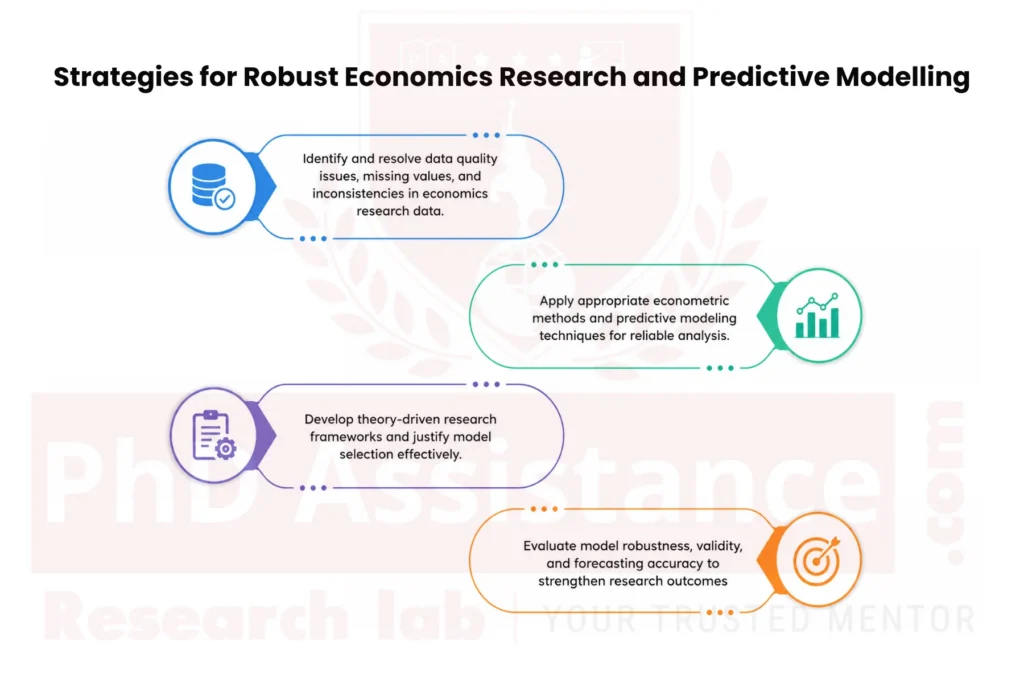
Strategies for Overcoming Data Analysis Challenges in Economics Research
Conclusion
The analysis of data is perhaps the hardest part of PhD research in the context of South African economics. Poor data quality, errors in model specification, endogeneity, and forecast mistakes Can impact your entire work.
An in-depth literature review together with careful choice of methods and stringent model validation allow researchers to overcome these obstacles. Critically analysing previous research using relevant economic theory and employing advanced econometric and predictive models, a doctoral student can provide significant contributions to economics and the formulation of economic policy in South Africa.
The systematic process of analysing data enhances academic performance and research outcomes, enabling researchers to produce studies consistent with global standards of scientific research.
Get professional Economics Dissertation Data Analysis Services support for your PhD Dissertation from experts at PhD Assistance Research Lab.
References
- Angrist, J. D., & Pischke, J. S. (2009). Mostly harmless econometrics: An empiricist’s companion. Princeton University Press.
- Breiman, L. (2001). Random forests. Machine Learning, 45(1), 5–32. https://doi.org/10.1023/A:1010933404324
- Hendry, D. F. (1980). Econometrics: Alchemy or science? Economica, 47(188), 387–406. https://doi.org/10.2307/2553385
- Leamer, E. E. (1983). Let’s take the con out of econometrics. American Economic Review, 73(1), 31–43.
- Little, R. J. A., & Rubin, D. B. (2019). Statistical analysis with missing data (3rd ed.). John Wiley & Sons.
- Stock, J. H., & Watson, M. W. (2019). Introduction to econometrics (4th ed.). Pearson.
- Wooldridge, J. M. (2020). Econometric analysis of cross section and panel data (2nd ed.). MIT Press.