

Critical review of Advancing management theory through interdisciplinary research: Challenges and opportunities
January 19, 2026
PhD Topic Selection in Law for UK research scholars: Developing an Original, Theoretically Grounded, and Publishable Doctoral Research Idea
January 21, 2026Selecting the Right PhD Topic in Law for Researchers in Qatar: Methodologically Rigorous Research Design for Doctoral Studies
- January 20, 2026
- Topic Selection
Introduction
The higher education and legal environment in Qatar, which are both rapidly changing, expect doctoral students to show rigorous methodology, original doctrinal thinking, and relevance to the policy throughout their research journey.
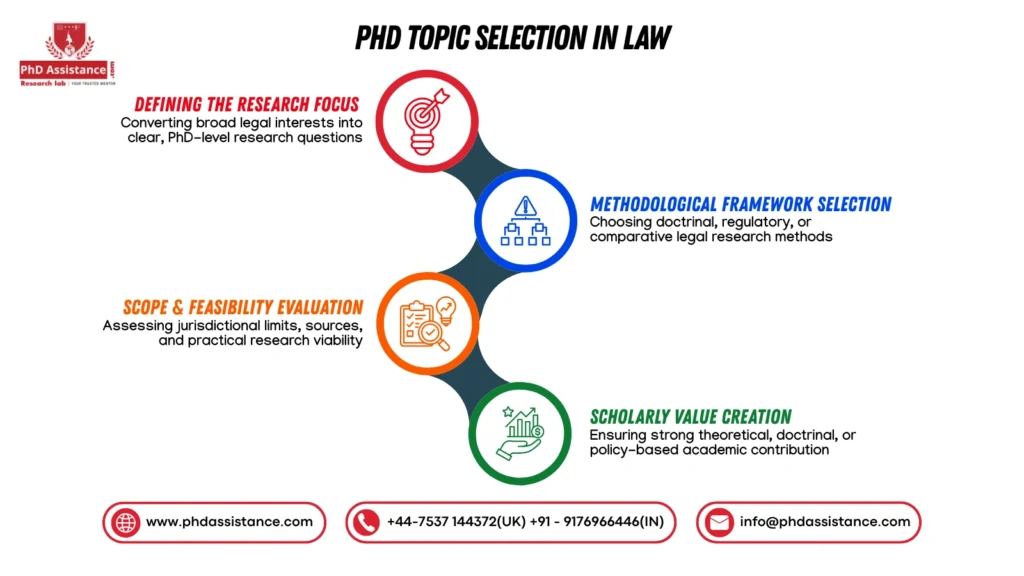
Selecting a PhD topic in law for researchers in Qatar has been the most essential step in the interaction with legal studies through the doctoral years. The poor conceptualisation of a research topic usually leads to rejection of the proposal, conflict between the supervisor and the student, longer timelines, and limited influence in the academic field.
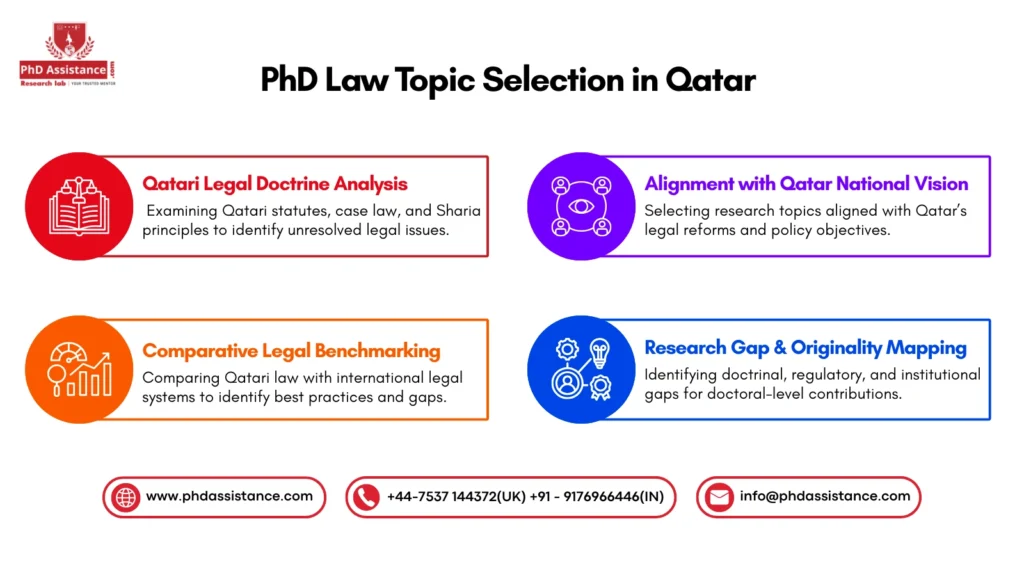
In the context of Qatar, where legal research is under the strong influence of civil law traditions, Islamic law (Sharia) and modern regulations all at once, the selection of a topic is not only personal but a matter of systematic examination.
The examination comprises legal doctrines, legislation, comparatives and institutional research priorities. With the help of structured guidance from PhD Assistance, researchers can turn broad legal interests into precise, researchable PhD problems that not only meet the international academic standards but also are contextually grounded in the legal system of Qatar.
The choice of an appropriate topic not only increases the chances of the proposal being approved but also lays a solid ground for long-term doctoral success, publication, and academic contribution.
Doctrinal Legal Research in Qatar: Building Analytical Precision
Doctrinal legal research is the main method for PhD law curricula in Qatar, even in the cases of constitutional law, commercial law, administrative law, and arbitration. Doctrinal research is the methodical interpretation of statute law, judicial pronouncements, legal maxims, and philosophical thinking to reveal and analyse ambiguities, contradictions or questions that remain unanswered in the law.
As an instance, a doctoral study on arbitration interpretation in the light of Qatar’s Law has played a major role in elucidating the judiciary’s perspectives on the doctrines of party autonomy and public policy restrictions. The positive side of such research is that it diminishes the amount of uncertainty in law, particularly in the case of international commercial disputes where Qatar is regarded as a regional arbitration centre.
The proper Law research topic selection Qatar relates to the fact that the doctrinal studies are no longer merely descriptive. Rather, they are critically analysing the reasoning of judges, tracking the developments in the interpretation of laws, and appraising the coherence of norms within the legal system. This degree of exploration is particularly important for doctoral-level originality and scholarly contribution.
Regulatory Legal Research and Policy-Oriented Inquiry
Legal regulatory research gained the spotlight and became the centre of interest for Qatar research topics for PhD scholars. This was mainly because of the country’s ambitious legal and economic reforms, which are in line with Qatar National Vision 2030. Besides, regulatory research investigates the laws’ response to the policy objectives, economic diversification, technology development, and governance changes.
An important instance is the case of a doctoral student doing research on data protection and cybersecurity regulation in Qatar after the coming into force of Law No. 13 of 2016 on Personal Data Protection. The researchers are taking a look at the regulatory framework of Qatar and comparing it with the global standards, like GDPR, considering the aspects of enforcement, compliance, and implications of transferring data across borders.
Example:
Journal: International Review of Law
Study: Mahmoud, Ahmed Sayed Ahmed (2017)
Mahmoud (2017) suggests a powerful doctrinal topic model for Qatar by analysing Qatar’s Arbitration Law No. 2 of 2017 from a critical point of view. The author reviews the objectives of law modernisation, its conformity with the UNCITRAL Model Law and at the same time, the practical implications for the areas of dispute resolution and investment confidence.
The research gives evidence of how a topic can integrate statutory interpretation with policy orientation—creating a nexus between legal reform goals and enforceability, procedural safeguards, and institutional readiness—thus making it a perfect reference point for the framing of doctoral-level topics in the context of arbitration and commercial law.
Comparative Legal Research in the Qatari Context
Given the country’s engagement with international legal systems, foreign investment regimes, and global governance norms, comparative legal research becomes increasingly important when it comes to selecting a PhD law research topic Qatar. Through comparative studies, researchers can easily position Qatari law next to other jurisdictions to point out the best practices, legal gaps, and opportunities for reforms.
As a case in point, a comparative study between Qatari company law and the UK corporate governance frameworks has revealed many aspects of shareholder protection, board accountability, and regulatory oversight. The studies reflect the manner in which international legal principles are adapted—rather than fully imported—into Qatar’s legal and cultural setting.
On the other hand, comparative research can be challenging if not rigorous in its methods. If the scope is not clearly defined, such studies may become too descriptive. PhD Assistance guarantees that comparative legal topics will stay analytically focused, theoretically sound, and practical for doctoral research.
Institutional Expectations and Supervisor Alignment
A hallmark of the PhD law programs in Qatar is the insistence on the matching of the research topic, supervisor’s expertise, and the institution’s research priorities. The universities consider doctoral proposals in terms of originality but also in terms of feasibility, ethical compliance, and potential impact on legal scholarship.
The primary researchers are often unable to specify the research gap in the literature or to indicate the place of the work in the legal debates. The Qatar PhD dissertation topics in law support help scholars to align their objectives, contributions, and methods with the assessment criteria.
Moreover, the alignment of the research topic with the supervisor’s expertise not only leads to an increase in the quality of the research guidance and reduction of revision cycles but also results in overall improvement of the duration of the doctoral process.
Example:
Journal: International Review of Law
Study: Sharar, Zain Al Abdin (2017)
Sharar (2017) offers a doctoral-level research route by examining the potential role of the Qatar Financial Centre (QFC) Court as a “competent court” in accordance with Law No. 2 of 2017, laying down its supportive and supervisory functions such as arbitrator appointment, tribunal jurisdiction review, evidence assistance, and award setting-aside.
This work is a good representation of a methodologically sound topic that combines doctrinal analysis with institutional design—demonstrating how procedural architecture and forum selection clauses can significantly influence arbitration outcomes in Qatar.
Overcoming Common PhD Topic Selection Challenges
Overly broad topics, non-existent legal gaps, and misconduct in methodologies are among the common problems that doctoral students have to deal with repeatedly. These situations usually push the candidates to submit their proposals again or wait for a long time before getting their approvals.
The professional PhD law topic selection for Qatar is provided through a systematic approach that significantly brings down these risks, and this approach consists of:
- Thorough Legal literature review
- Detailed analysis of statutory laws and case laws
- Evaluation of the research methodologies applied in assessing the legal gap
- Planning for the publication of research in the long run
- The process that is structured in this manner guarantees that the topic chosen will be of an original nature, suitable for the level of doctoral research and invincible for a years-long academic burden.
Conclusion
The law PhD theme selection in Qatar might not only be an academic activity in the competitive academic and legal research environment, but rather a strategic decision that needs doctrinal precision, regulatory awareness, and methodological clarity, besides academic research issues. Researchers must ensure that their questions are legally sound, policy-relevant, and institutionally aligned, no matter if they are using the doctrinal, regulatory, or comparative method.
By means of careful topic selection, PhD scholars, Master’s/MPhil students, and early-stage researchers can propose new research areas that are not just recognised by the local legal academia but also conform to the worldwide academic standards. An appropriately selected topic makes the doctoral adventure a demanding, noticeable, and professionally rewarding undertaking.
Contact us to select a PhD research topic that aligns with your research idea, clearly addresses the legal research gap, and meets the academic standards of institutions in Qatar.
References
- The new Qatar Arbitration Law No. (2) of the year 2017 (Pros and cons). International Review of Law, 2017(2). https://doi.org/10.5339/irl.2017.ADR.9
- The role of the Civil and Commercial Court of Qatar Financial Centre under the new Arbitration Law No. 2 of 2017. International Review of Law, 2017(2). https://doi.org/10.5339/irl.2017.ADR.12
