

How to Choose a High-Impact PhD Research Topic in Law for Scholars in the UAE: Doctrinal, Regulatory, and Comparative Approaches
January 17, 2026
Critical review of Advancing management theory through interdisciplinary research: Challenges and opportunities
January 19, 2026PhD Topic Selection in Law for Saudi Arabian Research Students: Identifying Original, Policy-Relevant, and Sharia-Informed Research Problems
- January 19, 2026
- Topic Selection
Introduction
The decision of a doctoral research topic is the most critical step in the PhD process, especially for those doing legal research in Saudi Arabia. The PhD law topic selection in Saudi Arabia is not just a matter of personal academic interests but also requires novelty, policy relevance, doctrinal clarity, and a solid understanding of Sharia-based legal principles.
A poorly defined topic can result in proposal rejection, difficulties with supervisors and, consequently, limited academic impact within the context of the changing legal and regulatory environment of Saudi Arabia.
Supervised by PhD Assistance, researchers will be able to develop their general legal interests into precise, practical, and significant research questions that will not only meet the requirements of Saudi universities but also make a valuable contribution to the national and international legal scholarship.
The effective selection of law research topics in Saudi Arabia not only increases proposal approval rates but also guarantees a stable base for the long-term success of the doctor and his or her publication.
Understanding the Saudi Arabian Legal Research Context
The legal system of Saudi Arabia is a one-of-a-kind system that combines Islamic Sharia with statutory law, royal decrees, and the regulatory schemes of Vision 2030. It is a double-edged sword for the PhD candidates, as it is both a responsibility as well as the opportunity to perform research in this context.
The topics of research must be strong in their doctrine, comply with Sharia, be relevant to the policy, and be very close to the judicial and legislative activities that are going on. The effective PhD law topic guidance Saudi Arabia should be able to bridge the fine line between classical Islamic jurisprudence and modern statutory evolution.
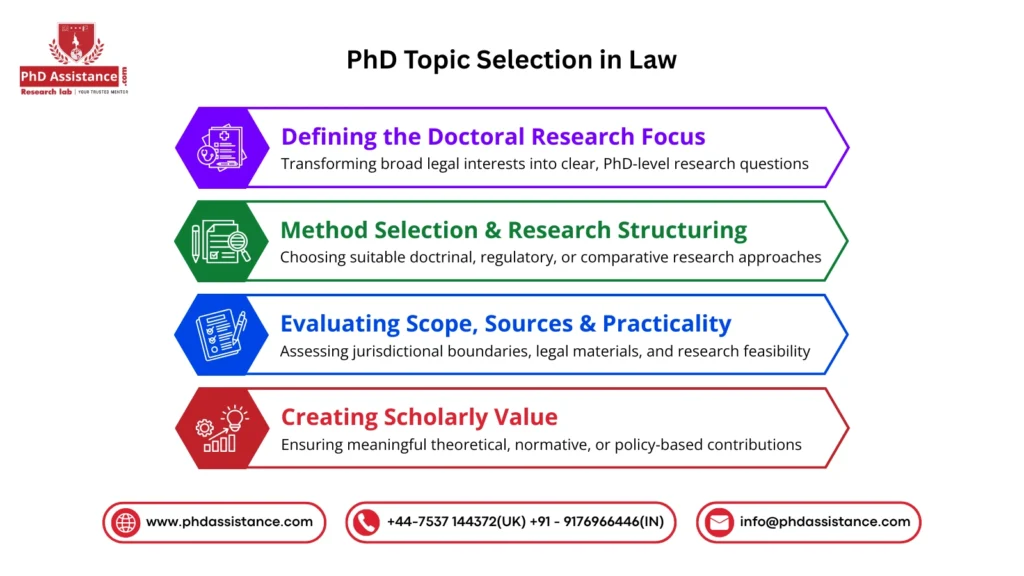
Doctrinal Legal Research: Strengthening Legal Foundations
Legal research based on doctrine is still the main method in Saudi legal studies. The process consists of a thorough analysis of the statute, case law, and religious law to uncover any lack of clarity, contradiction, or underdevelopment in the legal system.
The areas of Islamic commercial and contract law, Saudi arbitration law and enforcement practices, administrative and constitutional law, and criminal law, where special interpretation of Hudood is a significant concern, are frequently the sources of doctrinal PhD topics with a heavy impact in Saudi Arabia.
For example, the doctrinal research that has investigated the compatibility of Saudi arbitration law with Sharia principles has been very instrumental in enhancing investor confidence and judicial consistency. Such studies do not limit themselves to textual analysis; instead, they assess how courts balance Sharia requirements with international commercial practices and, thus, dip into the IP of the law.
Professional Law research topic selection Saudi Arabia is influenced by the application of the doctrinal method, which means that the topics do not merely reflect the existing legal provisions but are actually interpreted as critiques of case law, judicial reasoning is assessed, and doctrinal development is proposed coherently.
Example:
Journal: The International Journal of Arbitration, Mediation and Dispute Management
A recent paper published in Arbitration: The International Journal of Arbitration, Mediation, and Dispute Management (2025) provides an insightful study into the difficulties of executing foreign arbitration awards in the UAE. The scholarly work scrutinises the statutory provisions, judges’ practices, and public policy limitations that influence the enforcement of the New York Convention.
The study not only points out the doctrinal gaps but also suggests legal solutions, thereby showing the potential of focused doctrinal research to increase legal certainty in international arbitration, and at the same time, it acts as a useful model for PhD scholars working on arbitration and enforcement issues in jurisdictions with changing legal systems.
Sharia-Informed Legal Research: Core to Saudi PhD Scholarship
A Sharia-centric approach is one of the main characteristics of Saudi doctoral legal research. The selection of Sharia-informed legal research topics obliges the researchers to not only illustrate their deep knowledge of Islamic jurisprudence through the conduct of contemporary and classical debates but also to possess the ability to apply Sharia principles to the legal problems of the present.
The impact of Sharia research is in the areas of Islamic finance regulation and compliance, Sharia in company law, Islamic views on data protection and privacy, and the application of human rights in the context of Sharia.
The enumeration of the above PhD research topics in Islamic law derives its value from academics if they can successfully connect the ancient jurisprudence with the contemporary needs of the regulatory environment. The research that is inspired by Sharia is not only theoretical but also plays an important role in the legal discussion of Saudi Arabia’s reforms and the policy that is based on Islamic grounds of legitimacy.
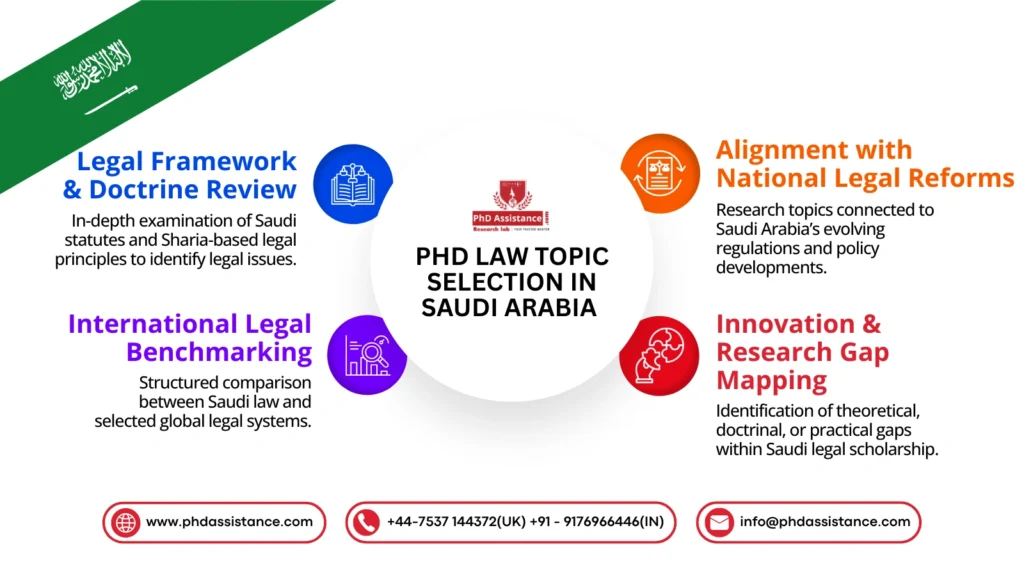
Example:
Journal: Islamic Studies
Kamali’s study that Sharia-based legal research by utilising the goals of Islamic law (Maqasid al-Sharia), such as justice and public welfare, to current legal and policy issues. The study, by connecting Islamic jurisprudence to modern legal challenges, shows how Sharia principles lead legal reform and rights protection in Muslim-majority countries, including Saudi Arabia.
Institutional Expectations and Supervisor Alignment
Saudi universities evaluate PhD proposals based on their originality, legal contribution, clear methodology, faculty alignment, and compliance with ethical and scholarly standards. Thus, it is difficult for many novice researchers to define their research gap or connect their topic with the research priorities of the institution.
The support of structured Islamic law PhD research topics ensures that scholars will have the ability to create precise research objectives, explain their contribution to the Saudi legal scholarship, and choose suitable doctrinal, regulatory, or comparative methods. This connection not only remarkably boosts the chances of proposal acceptance but also secures the sustainability of the research for a long time.
Overcoming Common PhD Topic Selection Challenges
In Saudi Arabia, legal research is often associated with difficulties and along with that comes a very broad topic selection, poor inclusion of Sharia principles, little connection with current issues, and a lack of fulfilment of doctorate-level standards.
The professional PhD law subject choice in Saudi Arabia manages to overcome these difficulties through a systematic literature review, feasibility assessment, statutory analysis, and methodological refinement. This orderly process guarantees that the chosen theme is fit for PhD-level inquiry, intellectually challenging, and also likely to attract future publications and research impact.
Conclusion
In Saudi Arabia’s competitive academic setting, the choice of a PhD research topic in law is not just an academic exercise, but rather a strategy that plays a decisive role in the relevance of the research, the acceptance of the academic institution, and the impact of the research in the domain.
Even if the scholars are to take up distinct doctrinal, regulatory, or comparative methods of study, they have to make sure that their topics are novel, policy-relevant, and deeply rooted in Sharia principles.
With the support of experts from PhD Assistance, it is the PhD scholars, Master’s/MPhil students, and early-stage researchers who can create high-impact, publication-ready legal research topics that not only contribute significantly to Saudi legal scholarship but also to global academic discourse through and with the collaboration of Saudi legal scholars.
Contact us to select a PhD research topic that aligns with your research idea, clearly addresses the legal research gap, and meets the academic standards of institutions in Saudi Arabia.
References
- Alhadhrami, K. A. (2025). Challenges and solutions in enforcing foreign arbitral awards: A case study of the UAE. Arbitration: The International Journal of Arbitration, Mediation and Dispute Management, 91(1), 98–119. https://doi.org/10.54648/AMDM2025007
- Kamali, M. H. (2002). Maqasid al-Shariah and human rights: A contemporary perspective. Islamic Studies, 41(1), 1–25.
