
Why data collection fails in computer science research
Doctoral projects in artificial intelligence, cybersecurity, the internet of things (IoT), cloud computing and smart city systems depend on data that are generated by machines rather than reported by people. Sensor streams, system logs, packet captures and API responses look objective, and that is the problem: researchers often collect them without the design discipline they would apply to a questionnaire. The result is data with gaps, drift, unsynchronised timestamps or hidden duplication, discovered only when a model performs strangely or an examiner asks how a dataset was built.
Most failures fall into four groups. The data do not match the research question (wrong variables, wrong sampling rate, wrong conditions). The pipeline loses or corrupts data (packet loss, API limits, storage failures). The data are not documented well enough to reuse or reproduce. Or the collection breaches ethical or legal requirements because it captured information about people. Each can be prevented at the design stage.
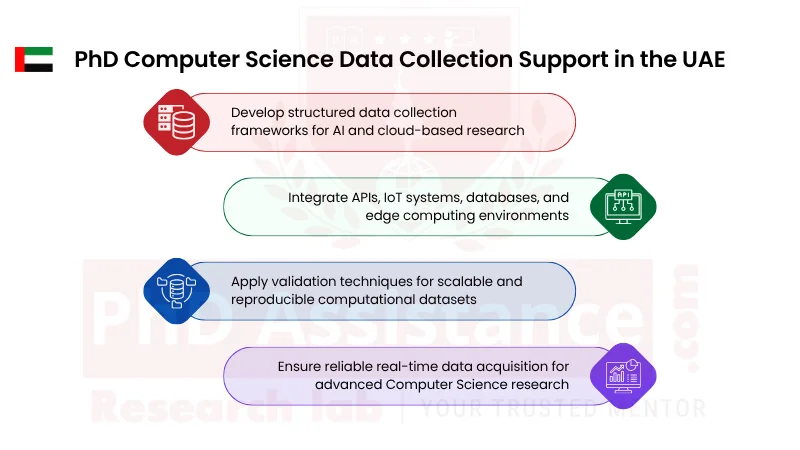
What UAE computing studies show about building data
Published work from UAE institutions illustrates the design choices behind credible machine-generated or purpose-built datasets. None of these studies is about doctoral students as such, and no verified study of how UAE computer science PhD researchers collect data was found, but each shows how the collection was planned and reported.
| Study | Data and how they were obtained | Design lesson |
|---|---|---|
| Koto et al. (2024) | A benchmark of 14,575 multiple-choice questions in Modern Standard Arabic across 40 tasks, built from school examinations in North Africa, the Levant and the Gulf | A new dataset needs a stated source, sampling across regions and a defined evaluation before results are produced |
| Almarzooqi et al. (2024) | Solar irradiance time series used to train and test a hybrid forecasting model, validated with a moving window | Time-ordered data need time-respecting validation and a naive baseline; variable (cloudy) conditions must be reported separately |
| Hassan et al. (2026) | Hydrodynamic simulation outputs for Abu Dhabi and San Francisco Bay used to train a convolutional neural network surrogate | Simulated training data inherit the limits of the simulations (few scenarios, short periods), which must be stated |
The ArabicMMLU benchmark by Koto et al. (2024), most of whose authors were at the Mohamed bin Zayed University of Artificial Intelligence, is a model of purposeful collection: the authors chose a population of items (school examination questions), covered several regions and subjects, and fixed the evaluation in advance. Almarzooqi et al. (2024), at Khalifa University, show the other side: with sensor-derived time series, the validation scheme must respect time order, and performance in difficult conditions must be reported rather than averaged away. Hassan et al. (2026) trained a deep learning surrogate on simulations covering Abu Dhabi and acknowledged that few sea-level scenarios and short simulation periods limit what the model can claim.
Failure modes and the controls that prevent them
Researchers meet several technical problems. They are real, and each has a design-stage control.
| Failure mode | What goes wrong | Control to build in |
|---|---|---|
| Clock and timestamp mismatch | Events from devices or services cannot be aligned, so sequences and latencies are wrong | Synchronise clocks, record time zone and source of each timestamp, log the offset |
| Sensor drift and calibration | Readings shift slowly, so trends reflect the device, not the phenomenon | Calibrate before and after collection, keep reference readings, record firmware versions |
| Packet loss and dropped events | Gaps are silent unless counted, and they are rarely random | Sequence numbers, heartbeat records and a missing-data log per source |
| API limits and changes | Rate limits, pagination and version changes alter what is returned | Record API version, query, date and limits; store raw responses before processing |
| Unrepresentative conditions | Data from a lab, a quiet period or one site do not match deployment | Plan collection across conditions that matter (load, weather, time of day, attack types) |
| Labelling errors | Ground truth in logs or traffic is assumed rather than verified | Document how labels were produced and check a sample by hand |
Network security research shows how much these choices matter. Surveys of intrusion detection datasets find that they differ in how traffic was generated, which attacks are included and how labels were assigned, and recommend evaluating on more than one dataset (Ring et al., 2019). IoT intrusion datasets also use incompatible feature sets and attack categories, which limits comparison across studies (Booij et al., 2022). Arp et al. (2022) list recurring pitfalls in machine learning for security, including sampling bias, label inaccuracy and unrealistic evaluation settings, most of which begin at collection.
Design the collection pipeline before collecting
Treat data collection as part of the research design and write it into the proposal. A reliable pipeline answers five questions: what is measured, from which sources, under which conditions, how it is stored, and how its quality is checked.
- Map variables to questions. List every variable the analysis needs, its unit, sampling rate and source.
- Keep the raw layer. Store raw data unchanged and process copies, so every cleaning step can be repeated.
- Capture metadata as you go. Device, firmware, software versions, configuration and collection dates.
- Run a pilot. Collect for a short period, analyse the gaps and drift, and revise before the main collection.
- Automate quality checks. Range checks, missing-data counts, duplicate detection and timestamp monotonicity.
- Document the dataset. Use a datasheet covering motivation, composition, collection process, labelling and intended uses (Gebru et al., 2021).
Make the data findable, accessible, interoperable and reusable where ethics and contracts allow, following the FAIR principles (Wilkinson et al., 2016). Even when data cannot be shared, the code and the description of the collection process usually can, and reproducibility checklists in machine learning ask for both (Pineau et al., 2021).
When the data feed a machine learning model
Collection decisions shape whether a model evaluation is valid. Kapoor and Narayanan (2023) reviewed leakage across machine-learning-based science and found it in many fields; common forms include duplicates across training and test sets, features that would not be available at prediction time, and random splits of time-ordered data. Plan the split when you plan collection: by time for streams, by device or site for sensor networks, and by session or host for network traffic.
Dataset shift is the related risk. A model trained on one season, one building or one network will meet different conditions in use. Collect a separate test period or site if you can, and report results for it separately, as the UAE forecasting study did for difficult conditions (Almarzooqi et al., 2024).
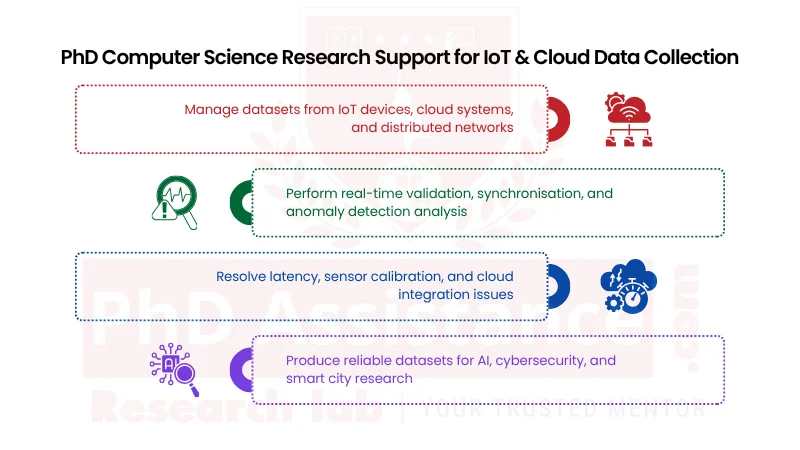
Ethics and data protection in the UAE
Machine-generated data frequently contain personal data: IP and MAC addresses, account names, location traces, wearable readings and camera images. The UAE's federal Personal Data Protection Law is Federal Decree-Law No. 45 of 2021, and some free zones and the health sector have their own rules (UAE Government, n.d.). Check which regime applies to your data, where your cloud services store them, and whether transfers outside the country are involved. The European GDPR is relevant only in the situations it defines, such as data about people in the EU, so do not assume it is the governing law.
Research involving human participants or their data needs review by your university's research ethics process (United Arab Emirates University, n.d.), and projects using hospital or health data need the relevant health authority approvals as well. In practice, minimise what you capture, pseudonymise identifiers at the point of collection, restrict access and set a retention period. Explain each step in your methods chapter.
Worked example (illustrative)
A hypothetical doctoral project develops an anomaly detection model for energy use in university buildings in Abu Dhabi. The researcher maps the variables needed (power, temperature, occupancy proxy) to three sources: smart meters, a building management system API and a weather feed. A two-week pilot reveals that the meters and the API use different clocks and that 4% of meter readings are missing at night; clocks are synchronised and a missing-data log is added. The main collection covers summer and winter, the test set is a later month in a different building, and Wi-Fi counts used for occupancy are aggregated per floor so that no individual is identifiable, as approved by the ethics committee. A datasheet records every source, version and known gap (Gebru et al., 2021).
What to report, and common mistakes
| Element | What to state |
|---|---|
| Sources | Devices, systems, APIs and datasets, with versions and configurations |
| Conditions | Sites, periods and operating conditions covered |
| Quality | Missing data, drift, synchronisation checks and how problems were handled |
| Labels | How ground truth was obtained and checked |
| Splits | How training, validation and test data were separated, and why |
| Ethics and law | Approvals, personal data handled, pseudonymisation, storage and retention |
| Availability | What data and code are shared, where, and under what conditions |
- Starting large-scale collection without a pilot.
- Cleaning data in place, so the raw record is lost.
- Splitting time-ordered or device-grouped data at random.
- Using one public benchmark and treating it as representative (Ring et al., 2019).
- Capturing personal identifiers that the analysis does not need.
For the wider design of machine learning studies, see methodology mistakes in machine learning PhDs and programming for AI research; for planning data collection in other fields, see how to collect data for your PhD thesis.
Key takeaways
- Machine-generated data fail through drift, gaps, clock mismatch and unrepresentative conditions, all of which can be designed against.
- UAE computing studies show the value of defined sources, regional coverage and time-respecting validation (Koto et al., 2024; Almarzooqi et al., 2024).
- Benchmark datasets have their own collection biases, so test on more than one where possible (Ring et al., 2019; Booij et al., 2022).
- Plan data splits during collection to avoid leakage (Kapoor & Narayanan, 2023).
- Document datasets with a datasheet and FAIR practices, and check UAE data protection rules before collecting data about people (Gebru et al., 2021; Wilkinson et al., 2016; UAE Government, n.d.).