

How to Complete a PhD Dissertation in UAE Engineering: Integrating AI Systems, Smart Infrastructure and Robotics
June 12, 2026
How to Fix a Weak PhD Research Proposal in Malaysia Management: Addressing Gap Identification and AI Framework Selection
June 16, 2026How to Avoid Costly Research Methodology Mistakes in AI PhD Studies in UAE
- June 15, 2026
- PhD Research Methodology
Introduction
AI is evolving as a strategic area of research in the UAE in many national initiatives such as the UAE Artificial Intelligence Strategy 2031, smart cities, autonomous systems, smart transport and the Industry 4.0 revolution. Therefore, researchers have conducted PhD-level work in machine learning, deep learning, computer vision, natural language processing, explainable AI, robotics and intelligent decision support systems.
Though research on AI grows exponentially, PhD students conduct methodologically weak research, which impacts the study quality and reliability. Frequent pitfalls in current AI PhD studies include inappropriate dataset selection, weak model validation, biased training data, flawed experimental design, lacking benchmark comparison, and weak evaluation of explainability. The described methodological shortcomings hinder thesis progress, reduce publication quality, and lessen AI application utility.
It is essential for AI scholars at UAE Universities to carefully select and adhere to a strong research methodology to conduct impactful and trustworthy doctoral studies. PhD Assistance Research Lab provides professional PhD research methodology writing services in UAE guides researchers to establish effective research frameworks, authenticate AI models, and align their investigations to global research trends.
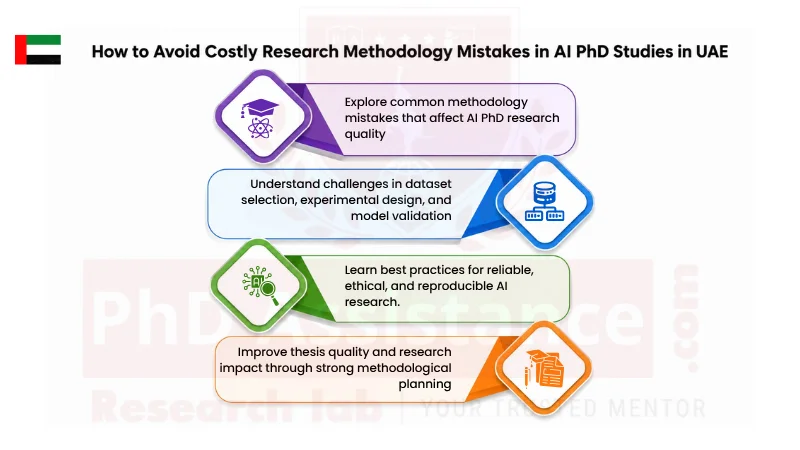
What you will learn from this blog?
- Common research methodology mistakes in AI PhD studies
- Challenges in dataset selection and model development
- Best practices for AI experimentation and validation
- AI ethics, bias mitigation, and reproducibility requirements
- Strategies for developing rigorous AI research methodologies
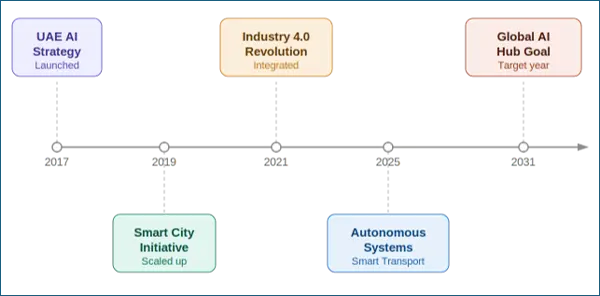
UAE National AI milestones- From strategy launch to 2031 vision
PhD dissertation methodology writing help in UAE for PhD Scholars
Data collection, data pre-processing, feature engineering, design of model architecture, training, testing, validation, optimisation, and implementation, these constitute an intricacy in AI research. Contrary to most of the traditional research, studies of AI require the application of computer science, mathematics, statistics, data science, and domain-specific expertise.
A method design can make an AI system trustworthy, understandable, scalable and reproducible. Hence, researchers often need PhD dissertation methodology writing help in UAE to enhance model assessment criteria and follow the methodology throughout their PhD.
1. Selecting Inappropriate Datasets and Data Collection Strategies
One of the most frequently made methodological errors in an AI PhD is the choice of datasets that are incomplete, biased, out-of-date or simply irrelevant for the goals of the research. AI algorithms are taught to learn trends directly from data; therefore, if the data chosen does not represent the true distribution, the resulting algorithms may fail. This includes issues of quantity of data as well as representational coverage of different states, types or classifications of data.
Data bias and imbalance are further challenges. Datasets available to the public may contain demographic, geographical, or behavioural bias that results in undesirable effects when used in an AI. Predictions may be inappropriate or unfair if not understood in the research design stage for sensitive fields such as healthcare, finance or public services.
Large datasets produced by smart cities, IoT networks, and digital government are also another area to be explored when it comes to AI research in the UAE. The researchers may need to examine privacy rules, ethics, and standards on data governance in this case to ensure research validity as well as legal compliance.
Example: The ‘Gender Shades’ research by Buolamwini and Gebru (2018) brought to light how commercial facial recognition systems were much less accurate when applied to darker-skinned females than to lighter-skinned males, on account of biased training datasets. This research also shows how bias in datasets can have a massive effect on AI system performance and equity.
2. Addressing Weak Experimental Design and Insufficient Model Validation with PhD research methodology writing help in UAE
Several PhD AI students spend most of their time designing and tuning highly complex algorithms and neglect adequate experimental setup and testing. It is possible for reported performance measures not to accurately reflect the model’s applicability to real-world tasks or even their scientific validity if experimental methods are not thorough.
A frequently encountered pitfall is incorrect training and test set utilisation. Researchers often neglect to employ cross-validation, benchmark comparisons, or test sets independent of training and validation, hence reporting over-fitted results and overstated performances. Proper validation techniques must be enforced to ensure generalizability. Students may consider professional PhD research methodology writing help in UAE to establish proper validation techniques.
Statistical significance testing and comparison against established baselines are another important aspect that must be incorporated into AI research to enhance method rigour.
Example: One extensively reported experiment involves replicating existing image classification benchmarks, using newer versions of the CIFAR-10 and ImageNet datasets, by Recht et al. (2019). The researchers showed significant drops in performance for state-of-the-art ML models.
3. Ignoring AI Bias, Fairness, and Explainability Requirements
With growing use of AI systems in fields such as healthcare, finance, public services, and autonomous systems, fairness, transparency and accountability, alongside predictive power, need to be considered by researchers. Numerous PhD research works are concentrated only on accuracy metrics while ignoring algorithmic bias and explainability, which can reduce the practical and ethical significance of research in AI.
The bias of a model may originate from the data it is trained on, the selection of features or even the way in which the model is designed, which consequently leads to undesirable outcomes for specific groups. Fairness assessment, bias detection methods and Responsible AI frameworks should thus be integral parts of a research methodology. These principles have quickly become requirements in both academic and industry research.
Explainability also allows researchers to understand how an AI model can make a prediction. Using explainable AI makes an AI model transparent, discovers which factors contributed most to its result and improves trust in the decision made by an AI model.
Example: LIME (Local Interpretable Model-Agnostic Explanations), one of the most popular frameworks for explainability, developed by Ribeiro, Singh, and Guestrin (2016), which is mainly focused on explaining the prediction of individual instances. Their research shows that using interpretability techniques can explore hidden bias and make machine learning more applicable for high-stakes environments.
4. Lack of Reproducibility and Research Transparency
Reproducibility is one of the most basic principles in science. Unfortunately, many AI research papers provide minimal information regarding the dataset, preprocessing steps, model settings, and evaluation processes. This is the major reason that most works can hardly be reproduced by others.
The sophistication of modern machine learning algorithms also exacerbates the issue of reproducibility. Seemingly trivial variations in data processing, parameterisation, and even computational settings could alter experimental outcomes dramatically. Consequently, experimenters are obligated to meticulously document all experimental steps.
The benefits of sharing source code, datasets, and experimental methodology further enhance the reliability of research and foster future scientific advancement.
Example: To promote better model transparency and responsible AI deployment in different domains, Mitchell et al. (2019) presented “Model Cards for Model Reporting,” a template for specifying how a machine learning model works and was trained, what is the expected outcome of the model is, performance limitations, the usage context, and any ethical implications.
Get the pricing details for the PhD research methodology service at PhD Assistance Research Lab, designed to assist researchers in developing strong research methodology.
5. Overlooking Real-World Deployment and Practical Impact
Most AI PhD theses produce good outcomes under very restrictive circumstances. Few studies focus on how to make the AI work when the system is put into use. AI systems must be developed for changing environments, where the user behaviour, the system’s operational environment, and the data distribution keep on changing.
While many researchers aim for prediction accuracy, other factors such as scalability, computation time, robustness and implementation feasibility are frequently overlooked. The latter are crucial for applications such as smart cities, smart health, intelligent transport systems, and intelligent industry.
By considering the need for implementation when designing the methodology, AI models provide academic as well as practical results.
Example: According to Sculley et al. (2015), in a groundbreaking article titled “Hidden Technical Debt in Machine Learning Systems”, the major cause of many failures in machine learning projects was the deployment, and not the algorithms, for example “The cost of the system complexity and maintenance, the data dependencies, and the limitations of the infrastructure.
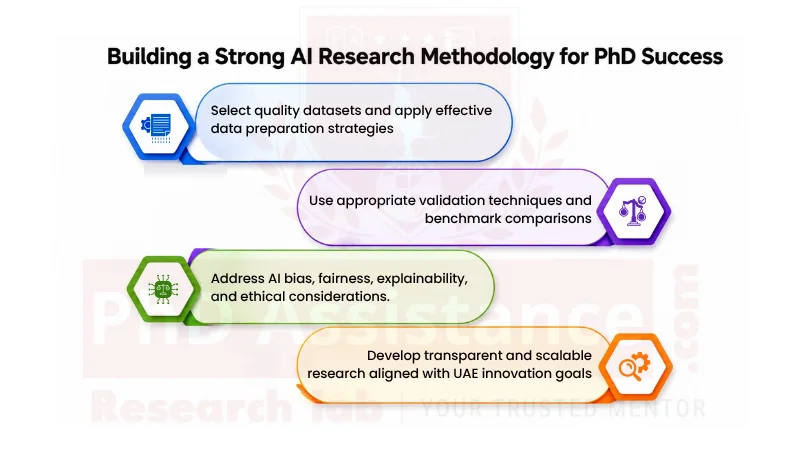
Strategies for Developing a Strong AI Research Methodology
- Clearly state your research goals and hypotheses.
- Choose high-quality and representative datasets.
- Design robust experiments.
- Use adequate validation techniques and benchmarks.
- Analyse fairness, bias and interpretability.
- Enable replicability through explicit reporting.
- Integrate principles of ethical AI and governance.
- Take into consideration factors for scalability and deployment.
- Keep pace with methodologies used by other researchers.
- Ask for guidance from methodologists when necessary.
Conclusion
AI provides huge opportunities for researchers within health care, intelligent infrastructure, autonomous agents, information security and intelligent decision-making systems. Methodological problems pose a great risk to the scientific merit and applicability of doctoral research.
Through the adoption of appropriate experimental procedures, credible validation measures, ethical AI principles, and reproducible research, PhD students in UAE universities will be able to enhance the overall quality and integrity of their AI research. Not only does this prevent expenditure on flawed research methods, but it also improves the publication and wider application within academia and industry.
The PhD Assistance Research Lab in the UAE offers specialised AI methodology writing help in UAE that guides PhD scholars in designing, validating and refining their research methodologies following a scholarly and scientific approach.
Book a Free Expert Consultation to get mentoring on developing research methodology.
References
- Buolamwini, J., & Gebru, T. (2018). Gender shades: Intersectional accuracy disparities in commercial gender classification. In S. A. Friedler & C. Wilson (Eds.), Proceedings of the 1st Conference on Fairness, Accountability and Transparency (Vol. 81, pp. 77–91). Proceedings of Machine Learning Research. https://proceedings.mlr.press/v81/buolamwini18a.html
- Mitchell, M., Wu, S., Zaldivar, A., Barnes, P., Vasserman, L., Hutchinson, B., Spitzer, E., Raji, I. D., & Gebru, T. (2019). Model cards for model reporting. In Proceedings of the Conference on Fairness, Accountability, and Transparency (pp. 220–229). Association for Computing Machinery. https://doi.org/10.1145/3287560.3287596
- Recht, B., Roelofs, R., Schmidt, L., & Shankar, V. (2019). Do ImageNet classifiers generalize to ImageNet? In Proceedings of the 36th International Conference on Machine Learning (Vol. 97, pp. 5389–5400). Proceedings of Machine Learning Research. https://proceedings.mlr.press/v97/recht19a.html
- Ribeiro, M. T., Singh, S., & Guestrin, C. (2016). “Why should I trust you?”: Explaining the predictions of any classifier. In Proceedings of the 22nd ACM SIGKDD International Conference on Knowledge Discovery and Data Mining (pp. 1135–1144). Association for Computing Machinery. https://doi.org/10.1145/2939672.2939778
- Sculley, D., Holt, G., Golovin, D., Davydov, E., Phillips, T., Ebner, D., Chaudhary, V., Young, M., Crespo, J. F., & Dennison, D. (2015). Hidden technical debt in machine learning systems. In C. Cortes, N. D. Lawrence, D. D. Lee, M. Sugiyama, & R. Garnett (Eds.), Advances in Neural Information Processing Systems (Vol. 28). Curran Associates, Inc. https://papers.nips.cc/paper/5656-hidden-technical-debt-in-machine-learning-systems
