
How to Complete a PhD Dissertation in UAE Engineering: Integrating AI Systems, Smart Infrastructure and Robotics
- Home
- Academy
- PhD Dissertation
- How to Complete a PhD Dissertation in UAE Engineering: Integrating AI Systems, Smart Infrastructure and Robotics
Sustainable Practices in Environmental Science
- Step 1: Identify Research Problems in AI Systems, Smart Infrastructure and Robotics
- Step 2: Conduct Literature Review and Gap Analysis
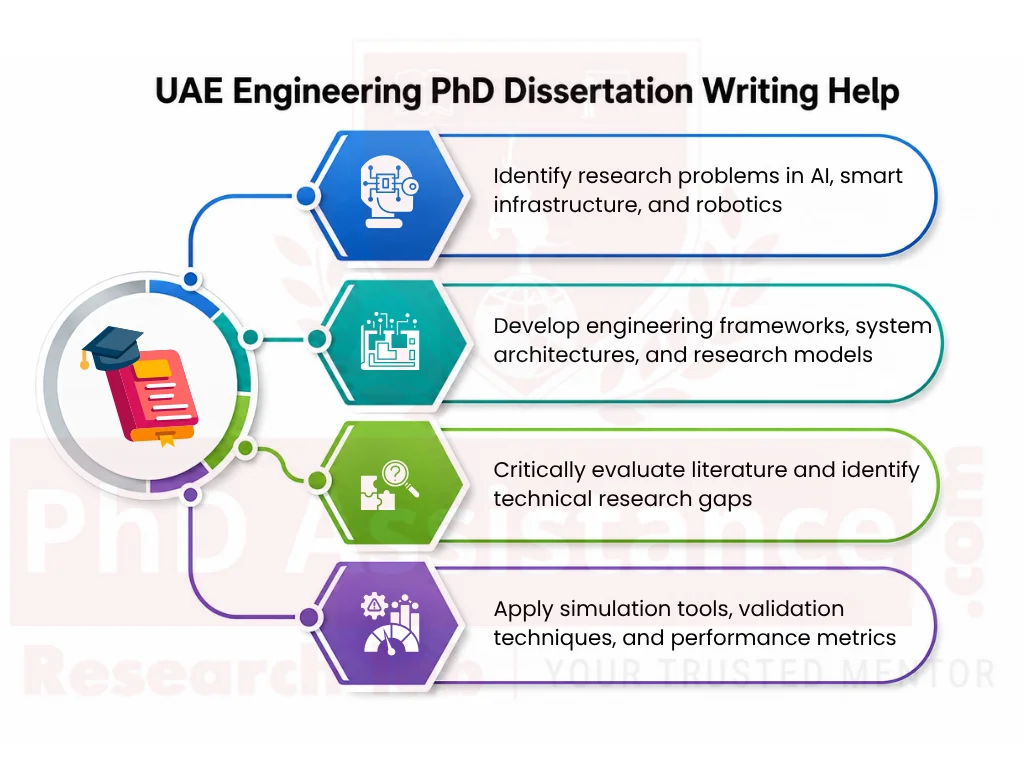
- Step 3: Develop Engineering Frameworks and System Architecture
- Step 4: Select Methodologies, Simulation Tools and Validation Techniques
- Step 5: Evaluate Results and Dissertation Contributions
- Strategies for Writing a Strong Economics Literature Review
- Conclusion

Recent Post
Introduction
AI, smart infrastructure, autonomous systems, robotics, digital twin, and Industry 4.0 solutions are fuelling the acceleration of the engineering landscape of the UAE. Smart City programs and the UAE Artificial Intelligence Strategy are among national programs that have fostered the implementation of intelligent engineering in transportation, construction, energy, manufacturing and urban infrastructure domains.
AI-based decision systems, smart infrastructure monitoring, autonomous robots, cyber-physical systems, digital twins, and intelligent asset management are topics increasingly explored by engineering researchers. They represent technologies that are changing how we design, operate, maintain and optimise the urban infrastructure in contemporary cities.
Nevertheless, pursuing a PhD Thesis in those multi-disciplinary fields requires more than technical knowledge. A researcher is expected to discover the engineering problems involved, analyse critically new literature, design proper system architectures, propose proper methods, prove the engineering solutions, and prove the theoretical as well as practical significance.
In this article, a roadmap has been presented for researchers in UAE to complete the PhD dissertation by utilising the systems of Artificial Intelligence, intelligent systems and robotics. Professional PhD Dissertation Help in UAE providers could be a useful guide in developing a dissertation.
What you will learn?
Step 1: Identify Research Problems in AI Systems, Smart Infrastructure and Robotics
An important first step toward a successful engineering thesis is the choice of an engineering problem of significance and technical relevance. The engineer should explore authentic engineering problems that are amenable to improvements in terms of efficiency, sustainability, resilience, safety and/or automation through the application of AI, smart infrastructure and robotics.
Possible research areas are: Predictive maintenance for infrastructure assets, Robotic autonomous inspection systems, Digital Twin-based infrastructure management, AI-driven traffic management, Robotic construction systems, Intelligent energy systems management, Smart manufacturing, Cyber-Physical Systems. The problem chosen must fill a clearly distinguishable gap in engineering knowledge and have potential practical benefits for industry and society.
The researchers should perform an initial survey of the recent literature to identify if there are any existing works that solve the problem, and to show novelty for the dissertation proposal.
Example:
A review in 2024 regarding the use of AI in smart cities considered the use of machine learning, computer vision, IoT sensors, and predictive analytics in the context of Smart Infrastructure Research UAE, infrastructure, environment and smart decision-making (Wolniak et al., 2024).
Step 2: Conduct Literature Review and Gap Analysis
A literature survey is crucial to provide the scientific underpinning for an engineering thesis. The work on the application of artificial intelligence, robotics, smart infrastructure, digital twins, edge computing, IoT-enabled smart infrastructure, and smart autonomous engineering must be thoroughly assessed, including recently published studies. The purpose of the literature survey is to identify the issues that are not resolved yet, limitations of present methodologies and potential for innovation.
A robotics engineering PhD research ought to compare different approaches, analyse algorithmic performance, evaluate implementation difficulties, test the robustness and scalability of a proposed method and consider real-time operations, reliability and cybersecurity requirements. With such rigorous analysis, researchers will be in a position to see areas where a certain research gap exists and hence argue for originality and contribution to the research field.
Even though modern advancements of robotics and artificial intelligence have resulted in a tremendous gain towards automating infrastructure, significant research gaps exist for intelligent systems’ interoperability between heterogeneous systems, transparency in AI techniques, learning capabilities and integration with massive urban networks.
Example
According to Cabrera et al. (2024), who studied digital twins for smart cities, there is a clear increasing interest in AI-integrated digital infrastructure platforms enabling monitoring, predictive maintenance and decision-making capabilities in real-time, but large research gaps on data fusion from multiple sources, scaling up over all city components, as well as automatic adaptation of infrastructure were observed.
Step 3: Develop Engineering Frameworks and System Architecture
Once research gaps have been recognised, engineers should identify a comprehensive engineering framework to resolve the chosen problem. Smart City Engineering Dissertation demands well-structured system architectures that define the interoperation between the AI algorithms, sensors, networks, robots, cloud services and infrastructure.
The proposed architecture should be clearly specified with respect to system components, data flows, control procedures and decisions making elements and performance parameters. The rationale for adopting specific AI algorithms, robotics platforms, communication protocols and computational structures should also be clearly outlined based on engineering requirements.
Theoretical and conceptual engineering models are essential to support research hypotheses verification and evaluate system performance. A sound framework improves the reproducibility, the technical soundness and the industrial relevance of research. s
Example: Intelligent Transportation Systems Research has focused on integrated architectures where IoT sensors, computer vision systems, edge computing and deep learning algorithms are integrated together in a system that efficiently manages city mobility. The proposed intelligent architectures were able to predict traffic congestion with good accuracy.
Step 4: Select Methodologies, Simulation Tools and Validation Techniques
The reliability of an engineering thesis is determined by its methodological strength. The investigator must determine and choose suitable experimental designs, simulation environments, analysis methodologies and validation techniques to suit the research purposes.
Experimental designs adopted in AI-based engineering studies can be in the form of machine learning, deep learning, reinforcement learning, computer vision, optimisation algorithms or prediction analytics. Robotics-based research can be applied on robotic simulations such as ROS, Gazebo, MATLAB Simulink or CoppeliaSim, or digital twin systems. Smart infrastructure-based studies can be adopted on IoT testbeds, sensing networks, cloud and edge computing, or infrastructure datasets.
The system evaluation is equally important. Scientists and engineers are required to examine system performance by employing quantitative engineering measurements such as prediction accuracy, precision, recall, latency, robustness, energy consumption, failure tolerability, and computational complexity. Benchmarking against existing techniques provides a good means of strengthening the scientific credibility of the research.
Example: A lot of engineering studies show that reinforcement learning approaches are promising in autonomous mobile robots’ navigation in dynamic environments. A great progress has been made from 2023 to 2025 in the research of obstacle avoidance, optimization of paths and adaptive decision making (Ogunsina et al.,2024).
Step 5: Evaluate Results and Dissertation Contributions
The final stage of writing a dissertation is about evaluating and describing the scholarly contribution. The researcher must show what is so special and improved about the proposed Artificial Intelligence in engineering dissertation, intelligent infrastructure and robotics systems.
The scholarly contribution must focus on both theoretical and practical contributions. The theoretical contribution might consist of algorithms, frameworks or models and the engineering techniques; the practical contribution might focus on infrastructure management, automation, operational efficiency, reduced maintenance costs and decision support systems.
The authors must discuss the advantages and disadvantages of their work and suggest future research areas. An engineering dissertation should prove itself with demonstrable performance gains and be relevant to a practical application for significant academic or industrial influence.
Example: An AI-embedded digital twin framework was designed for smart infrastructure systems by Yang et al. (2024). They confirmed that the use of machine learning algorithms together with sensor data has greatly enhanced the performance of predictive maintenance, infrastructure condition assessment and asset lifecycle management. They found out that AI based monitoring system could reduce unexpected failures, optimise maintenance plans and increase the reliability of the infrastructure system.
Strategies for Writing a Strong Economics Literature Review
Conclusion
The engineering research landscape in the UAE is going to witness a revolutionary shift with the integration of artificial intelligence, smart structures and robotics, which will open new avenues for innovations in areas like transportation, manufacturing, construction, power generation and infrastructure planning, as well as provide numerous new prospects to PhD students.
The success of a PhD dissertation can be assured by systematically defining research problems, critically reviewing the existing literature, developing a sound conceptual model, methodology selection and implementation, and verifying the research. In this systematic research process, students studying engineering could submit an effective research dissertation with significant knowledge contributions to the fields of science and engineering.
PhD Assistance Research Lab provides professionally written PhD dissertation writing services that enhance a researcher’s research design, technical analysis, dissertation structure, and academic writing, thereby ensuring successful completion of PhD research.
References
- Yang, Z., Tang, C., Zhang, T., Zhang, Z., & Doan, D. T. (2024). Digital Twins in Construction: Architecture, Applications, Trends and Challenges. Buildings, 14(9), 2616. https://doi.org/10.3390/buildings14092616
- Sacoto-Cabrera, E. J., Perez-Torres, A., Tello-Oquendo, L., & Cerrada, M. (2025). IoT, AI, and Digital Twins in Smart Cities: A Systematic Review for a Thematic Mapping and Research Agenda. Smart Cities, 8(5), 175. https://doi.org/10.3390/smartcities8050175
- Wolniak, R., & Stecuła, K. (2024). Artificial Intelligence in Smart Cities—Applications, Barriers, and Future Directions: A Review. Smart Cities, 7(3), 1346-1389. https://doi.org/10.3390/smartcities7030057
- Ogunsina, Morayo & Efunniyi, Christianah & Osundare, Olajide & Folorunsho, Samuel & Akwawa, Lucy. (2024). Reinforcement Learning in Autonomous Navigation: Overcoming Challenges in Dynamic and Unstructured Environments. Engineering Science & Technology Journal. 5. 2724-2736. 10.51594/estj.v5i9.1547.