

Deep Learning-Based Early Detection of Sepsis Using Electronic Health Record Time-Series Data
August 14, 2026
Natural Language Processing of Clinical Notes for Automated ICD-10 Coding Accuracy
August 17, 2026Why Germany PhD Researchers Struggle With Programming for AI Research?
- August 17, 2026
- PhD Computer Programming
Summary:
This blog explores the reasons behind the challenges faced by PhD students in Germany while programming AI, such as algorithm coding, debugging, data manipulation, repeatability, and experimentation for research. It further analyses the programming requirements expected from PhD students working in AI research institutes in Germany.
Introduction
Programming for conducting AI research poses difficulties for PhD students who face problems with research implementation, debugging, datasets, proper framework selection, or replication of experiments. This problem becomes even more complicated when programming is required to support a new research contribution.
German research universities like TUM, RWTH Aachen, Saarland University, and Max Planck institutes often require good programming skills along with mathematical knowledge and research ability. As such, PhD students should be able to go beyond basic programming and write reliable code for conducting experiments with AI, developing models, and doing research (Saarland University, n.d.).
German PhD students struggling with programming for AI, machine learning, conducting research, debugging, and repeatable experiments can get support from tailored PhD Dissertation Support in Computer Programming at PhD Assistance Research Lab.
What you will learn from this blog?
- Why programming for AI research is different from conventional software development.
- What programming skills German AI PhD researchers are expected to demonstrate.
- How to translate mathematical and theoretical AI concepts into working code.
- How to manage datasets, experiments, model training, and computational resources.
Importance of PhD Dissertation Coding and Implementation Services in Germany:
Before starting any AI programming project, you must know the research problem, the algorithm, the dataset, the experiment, and the evaluation procedure. The actual programming is not the aim of your research, but merely a means to it.
Researchers should therefore develop skills in
- Python and research-oriented programming.
- Machine learning frameworks such as PyTorch or TensorFlow.
- Data preprocessing and experiment management.
- Algorithm implementation and computational optimisation.
- Version control, documentation, and reproducibility.
Scholars looking to improve their programming skills can get professional PhD Dissertation Coding and Implementation Services.
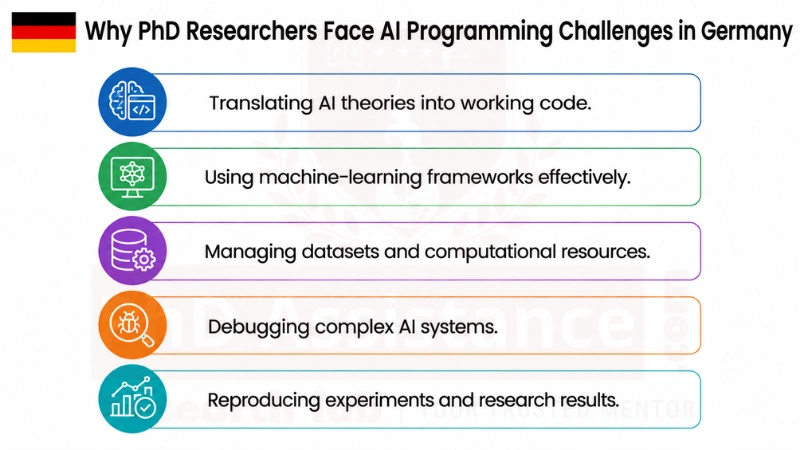
What Makes AI Programming Difficult for German PhD Researchers?
1. Difficulty Translating AI Theory into Working Code
PhD work in AI is frequently about turning math, algorithms, or published techniques into something that can be implemented. Simply understanding what a paper is talking about doesn’t always mean you can implement its approach.
You need to:
- Understand the mathematical assumptions behind the proposed method.
- Translate algorithms into modular and testable code.
- Understand how model parameters affect computational behaviour.
- Compare your implementation with established methods.
This is apparent in German research settings where AI research groups blend theory with practice. At TUM, positions in machine learning research clearly state that knowledge of mathematics and coding is highly preferred for doctoral researchers (Technical University of Munich, n.d.).
2. Meeting Research-Grade Programming Expectations with PhD Thesis Assistance in Computer Programming
There is a difference between code that works and code that is good enough to contribute to research for a PhD project. Code for research needs to be reliable enough to do the experiments that are then analysed and possibly published.
At the Institute for Machine Learning and Reasoning at RWTH Aachen University, the process of doing research involves problem identification, state-of-the-art, approach, research, and presentation of results. Professional PhD Thesis Assistance in Computer Programming can improve your research grade at programming (RWTH Aachen University, n.d.)
You need to:
- Write modular and understandable research code.
- Keep experimental configurations reproducible.
- Record datasets, parameters, environments, and results.
- Test implementations before large-scale experiments.
3. Difficulty Working With AI Frameworks and Computational Tools
Modern studies on artificial intelligence often need to use deep learning frameworks, GPU computing, experiments, and massive data processing. People who have just started learning programming basics might face certain difficulties in dealing with research frameworks.
For instance, the current TUM machine learning PhD position includes as desirable skills Python as well as PyTorch, TensorFlow or a similar framework. Saarland University additionally offers research-based computing resources like AI/ML resources, GPU resources, PyTorch workshops, and HPC courses for programming.
You need to:
- Understand tensors, datasets, models, and training pipelines.
- Work effectively with GPU-based computation.
- Manage dependencies and computational environments.
- Understand memory and computational constraints.
4. Difficulty Reproducing AI Research Experiments
Reproducing research results is especially crucial in AI doctoral studies since conclusions need to be backed up by credible experimental evidence. When a model performs once but cannot be replicated under the same circumstances, it presents issues at the doctoral level.
Research in German universities is greatly focused on thorough research and publication. According to Saarland University, doctoral students are frequent presenters of their research at major international computer science conferences.
You need to:
- Maintain version-controlled research code.
- Record datasets and preprocessing steps.
- Fix random seeds where appropriate.
- Track model configurations and experimental parameters.
- Preserve results and evaluation procedures.
Explore the guidance at PhD Assistance Research Lab to get customised PhD Computer Programming Services.
5. Difficulty Debugging Complex AI Systems
Problems can be encountered on multiple levels in artificial intelligence research code in the form of programming errors, wrong data processing, incorrect model setup, mathematical errors, or faulty experimental assumptions.
This creates an especially difficult situation for PhD students since a perfectly valid program does not necessarily yield scientifically valid results.
You need to:
- Separate software bugs from methodological problems.
- Test individual components before full model training.
- Validate data preprocessing independently.
- Check model outputs at different stages.
- Compare implementation results against baselines.
This is particularly pertinent in research teams dealing with complex AI systems. The ecosystem of computer science in Saarland, for instance, includes the fields of AI, machine learning, software systems, formal methods, language processing, and many others.
6. Difficulty Aligning Programming with the PhD Research Contribution
One of the critical issues here is realising that complicated coding does not necessarily equal good PhD research.
The coding should be done for the purpose of answering a question, testing a hypothesis, evaluating a novel approach, or proving some science-related idea.
Current TUM’s AI/ML research ecosystem comprises various domains like robust machine learning, uncertainty, sequential data processing, efficient machine learning, graph learning, and machine learning for science, which shows that programming is used alongside research questions instead of being considered a separate technical task (Technical University of Munich, n.d.).
You need to:
- Define the research hypothesis before implementing the model.
- Explain why a particular algorithm or architecture is needed.
- Establish meaningful baseline methods.
- Design experiments that test the research hypothesis.
- Analyse negative as well as positive results.
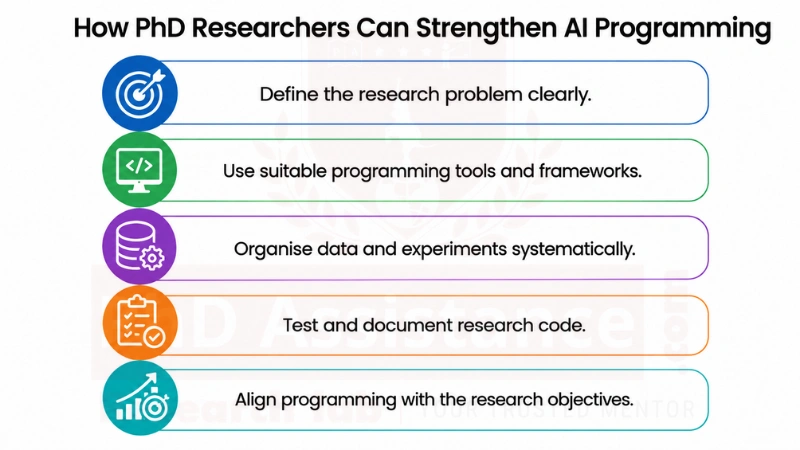
Quick Self-Check for Saudi PhD Researchers
- Is my AI research problem clearly defined?
- Does my programming approach match the research question?
- Have I selected suitable AI tools and frameworks?
- Is my code tested, documented, and reproducible?
- Do my experiments support my research objectives?
Conclusion
PhD students conducting AI research in Germany frequently find that programming problems in AI research do not only involve coding. Issues related to implementing papers, choosing frameworks, handling data sets, debugging models, replicating experiments, and linking code with the research problem are potential problems that can impact their studies.
Addressing these problems involves good programming, research methodology, and experimentation skills. Matching code to the research problem ensures that you get credible AI experiments and make better PhD contributions.
Facing challenges with AI programming for your PhD in Germany? Connect with our experts for professional guidance on research coding, machine learning implementation, debugging, reproducibility, and computational research.
Book a Free Expert Consultation and receive structured PhD Computer Programming Support in Germany
FAQs:
- How can PhD students get help with research programming? PhD students can seek expert support with algorithm implementation, coding, debugging, data processing, and research experiments. The support should remain aligned with their research objectives, methodology, and university requirements.
- What programming languages are used in PhD research? Python is widely used in AI, machine learning, data science, and computational research, while R, MATLAB, Java, and C++ may be used for specialised projects. The appropriate language depends on the research field, computational requirements, and selected methods.
- How can coding support improve a PhD dissertation? Well-structured research code can improve the reliability, reproducibility, and evaluation of computational experiments. It can also help researchers implement proposed methods and generate evidence to support their research contributions.
- What programming support is needed for PhD research? Common needs include algorithm development, model implementation, debugging, data preprocessing, testing, optimisation, and experiment management. Researchers may also require support with documentation, reproducibility, and integrating code with their research methodology.
- What does specialize coding assistance offer for PhD Computer Science dissertations? It provides expert support with research programming, algorithm implementation, debugging, testing, and computational experiments. The support helps align the coding work with the dissertation objectives, methodology, and research contribution.
References
- Max Planck Institute for Intelligent Systems. (n.d.). International Max Planck Research School for Intelligent Systems (IMPRS-IS). https://imprs.is.mpg.de/
- Saarland University. (n.d.). Positions – Machine Learning. https://machinelearning.uni-saarland.de/positions/
- Technical University of Munich. (n.d.). Hiring: Data Analytics and Machine Learning – PhD and Postdoc positions in machine learning. https://www.cs.cit.tum.de/daml/offene-stellen/hiring/
- Technical University of Munich. (n.d.). Openings: Machine Learning – Doctoral and postdoctoral positions. https://www.ce.cit.tum.de/mli/openings/
- Technical University of Munich. (2026). PhD position in computer science – Institute for AI and Informatics in Medicine (AIIM). https://portal.mytum.de/jobs/wissenschaftler/NewsArticle_20260428_005523
- RWTH Aachen University. (n.d.). Guidelines. Chair of Machine Learning and Reasoning. Official RWTH thesis guidelines
