
- / Title
GDPR vs. UAE Data Protection Law: A Comparative Study of Cross-Border Data Transfer Compliance
Info: GDPR vs. UAE Data Protection Law: A Comparative Study of Cross-Border Data Transfer Compliance | phdassistance.com
Published: 11th August 2026 inGDPR vs. UAE Data Protection Law: A Comparative Study of Cross-Border Data Transfer Compliance | phdassistance.com
Share this:
Related Services
Introduction
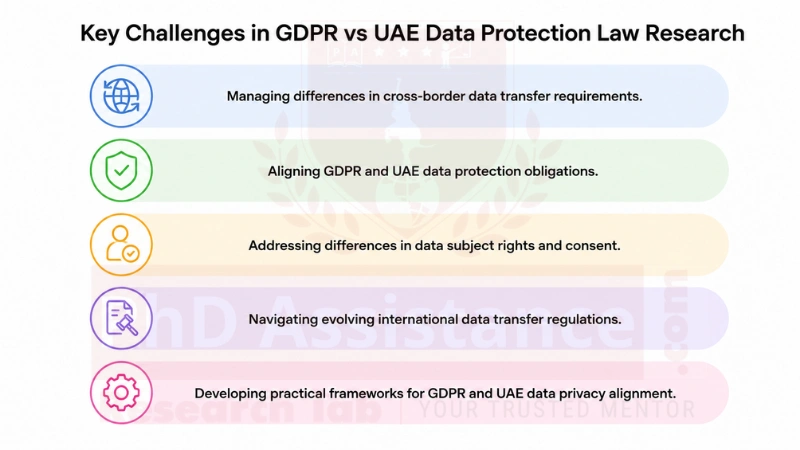
Digital transformation and cross-border data exchange have increased concerns about the protection of personal data from a legal and regulatory perspective for organisations operating internationally. The introduction of regulatory frameworks such as the GDPR and the UAE Personal Data Protection Law has established specific requirements for personal-data processing, individual rights and international transfers, data processing, rights and freedoms of individuals, and international data transfers. Differences between these legal frameworks can create compliance challenges for organizations which seek to ensure uniform privacy standards across different jurisdictions. Therefore, more research is being conducted to provide a comparison of GDPR vs UAE Data Protection Law in terms of regulatory scope, compliance requirements, international data transfers, enforcement provisions, and rights of the data subjects. Despite the existence of many comparative studies, Key challenges include identifying the applicable transfer mechanism, assessing safeguards, allocating controller/processor responsibilities and managing differences between the two legal frameworks in implementing these legal distinctions in practice.
Proposed PhD Title 1: A Comparative Compliance Architecture for Cross-Border Personal Data Transfers Between the EU and UAE: Integrating GDPR Requirements, UAE Data Protection Law, and International Transfer Safeguards
The growing globalisation of digital services has rendered international personal data transfers critical for multinational companies, cloud service providers, financial institutions, healthcare organisations, and IT firms. According to Alhababi (2024), there are substantial divergences between the GCC Data Protection legislation and the GDPR in relation to adequacy determinations, appropriate measures, and principles that apply to international data transfers. Thus, organisations conducting operations in the EU-UAE should be aware of the different regulations applicable to issues of privacy, transfer methodologies, security measures, and accountability. This study focuses specifically on Federal Decree-Law No. 45 of 2021, while recognising that the UAE also contains sectoral and free-zone data-protection regimes that may require separate analysis. Cross-Border Data Transfer Compliance therefore requires more than a comparison of statutory provisions; it requires analysis of how the relevant requirements operate in practice under relevant statutes, but rather a structured understanding of how GDPR Requirements are related to UAE Protection Law and International Transfer Regulations.
Problem Statement:
When organisations transfer personal data from the EU to recipients in the UAE, they may face difficulties in assessing whether the applicable transfer safeguards satisfy the relevant legal requirements. The discrepancies between GDPR and the Data Protection Law could complicate compliance assessment, especially for companies working within several jurisdictions. Prior studies have revealed these discrepancies, although little guidance has been provided on Cross-Border Data Compliance.
Research Gap:
However, there is still a need for developing a unified approach to implementing comparative GDPR and UAE requirements to allow companies to evaluate the legality, safeguards, accountability, and regulatory risk of transfers.
Research Question:
In what way can GDPR Compliance and UAE Data Protection Legislation be incorporated within a viable framework for Cross-Border Transfer Compliance in the context of the EU-UAE region?
Outcome:
The study shall produce a comparative compliance framework highlighting the legal transfer procedures, measures, responsibilities, and risk assessment considerations of UAE Data Privacy legislation.
Reference:
Alhababi, H. H. (2024), Cross-Border Data Transfer between the GCC Data Protection Laws and the GDPR. The study compares GCC and EU transfer requirements and identifies scope for further legislative development.
Proposed PhD Title 2. GDPR and UAE Data Privacy in Healthcare: A Cross-Border Data Transfer Compliance Framework for Hospital Management Systems
Healthcare organisations have become more reliant on the international transfer of data for their cloud services, medical research, specialist consultations, digital health platforms, and collaborations with international partners. The healthcare study on GDPR Compliance in Hospital Management Systems (2024) mentions cross-border transfer, third-party vendor management, consent, data subject rights, and regulatory complexities as compliance issues that organisations may face. Due to the sensitivity of health data, Data Transfer Compliance becomes even more complicated since healthcare organisations are supposed to both ensure patient privacy and support the legal transfer of data. Still, despite its importance, the relationship between all these issues and the UAE Data Protection Law has not been elaborated on in the context of the healthcare sector. This study is going to analyse the possibility of implementing GDPR Requirements together with the Data Protection Law into a healthcare-related transfer model.
Problem Statement:
Healthcare professionals moving patients’ information from one EU or UAE jurisdiction to another will have to handle very sensitive information and will have to adhere to diverse requirements of privacy, consent, security, and transfer. Hospitals, cloud service providers, research organisations, and third-party processors also add to the complications related to compliance. Previous literature has indicated cross-border data transfer and vendor management to be some of the important GDPR compliance issues but fails to develop a comprehensive healthcare perspective for such requirements.
Research Gap:
While previous research has suggested the need for better healthcare transfer systems and frameworks, very few pieces of research have managed to implement these suggestions through a UAE Data Privacy framework.
Research question:
How do healthcare organisations ensure Cross-Border Data Compliance in line with GDPR Compliance and Data Protection Law requirements?
Outcome:
The research will deliver a specific healthcare cross-border data compliance framework that includes data classification, lawful transfer, contract management, liability for vendors, consent, risk assessment, and governance.
Reference:
Al Khatib, I., Ahmed, N., & Ndyiaye, M. (2024), GDPR Compliance of Hospital Management Systems in the UAE. The study highlights cross-border transfers and calls for clearer transfer mechanisms and standardised healthcare frameworks.
Proposed PhD Title 3. Assessing SME Readiness for GDPR and UAE Data Privacy Obligations: A Compliance Maturity Model for International Data Operations
The growth of online commerce has facilitated the functioning of small and medium-sized enterprises in international markets where personal data is collected, processed, stored and transferred continuously across borders. According to Brodin (2019), SMEs have to deal with several difficulties in meeting GDPR Requirements due to their limited resources, competences, procedures and compliance. The author suggests a framework for GDPR compliance but recognises the necessity of further validating his framework using other organisations. For SMEs operating between the European Union and the United Arab Emirates, it results in a set of difficulties related to regulatory requirements, organisational duties, personal data governance and International Data Transfer regulations. It can be regarded as an area for investigation of compliance as an organisational capability based on its maturity. Thus, the study aims to research SME compliance maturity in the context of UAE Protection Law, GDPR, and UAE Data Privacy.
Problem Statement:
SMEs may lack the necessary resources, skills, and governance structures to sustain their compliance with the GDPR and Data Protection Law. This issue becomes more pronounced when firms operate in multiple regulatory jurisdictions. Although literature on GDPR compliance is extensive, there is insufficient literature on measuring SME maturity concerning International Data Regulations.
Research Gap:
Previous research offers structured compliance guidelines for GDPR for SMEs, but there is insufficient evaluation regarding compliance readiness and maturity to manage GDPR and Data Protection Law together with International Data Regulations.
Research Question:
How can SME readiness and compliance maturity be assessed against GDPR and UAE personal-data protection requirements for international data operations?
Outcome:
The study is anticipated to develop and validate a compliance maturity model that can assess SME readiness for GDPR and UAE data-protection obligations in international data operations.
Reference:
Brodin, M. (2019). Approaches to GDPR compliance: A systematic review and framework for SMEs.
Proposed PhD Title 4. Enforcement, Accountability and Remedies in EU–UAE Cross-Border Data Transfers: Evaluating the Effectiveness of GDPR and UAE Data Protection Law
Effective Cross-Border Transfer Compliance involves not only the use of transfer mechanisms but also their enforcement, accountability, regulatory oversight, and remedies when there is mishandling of personal data. According to AlQodsi et al. (2026), the UAE framework lacks practical assessments of enforcement mechanisms and has unanswered questions regarding civil liability and compensation for personal data breaches. There are Federal Decree-Law No. 45 of 2021, which is one of the main frameworks in place for protecting personal data in the UAE, while the GDPR has more mature systems regarding data subject rights, regulatory enforcement, and compensation. Through comparative analysis, there are some differences between the UAE and international frameworks with respect to data subject rights, cross-border transfers, enforcement, and remedies. Such differences provide a good chance for research about how organisations should demonstrate compliance in relation to the movement of personal data from one jurisdiction to another.
Problem Statement:
The factors that affect enforcement, accountability, regulation, and remedies have created ambiguity for the organisation and data subjects engaged in transferring information from EU to UAE. There are studies on how there are differences between the laws of the UAE and those of an international nature; however, there is very little on the impact of enforcement effectiveness and accountability on compliance.
Research Gap:
Research on the UAE has yet to provide sufficient information on the practical enforcement of the law and any form of compensation, especially where the Data Protection Law co-exists with the GDPR.
Research Question:
What impact do enforcement, accountability, and remedial differences have on Cross-Border Compliance with GDPR and Data Protection Laws?
Outcome:
The research will provide a comparative analysis of enforcement and accountability, and come up with a set of regulatory obligations, organizational responsibilities, remedies, and risks in cross-border data transfer between the EU and the UAE.
Reference:
AlQodsi, E. M., Al Shawabkeh, I., Shouaib, M., & Ibrahim, A. (2026), The Legal Framework Governing Personal Data Protection: Challenges and Mechanisms for Enhancing Security in the Digital Age—An Analytical Study. The study identifies gaps in practical effectiveness, enforcement, and civil remedies under the UAE framework.
Proposed PhD Title 5. Extraterritoriality, Regulatory Sovereignty and GDPR–UAE Data Privacy: A Layered Governance Model for Cross-Border Data Transfer Compliance
Extraterritorial implications of privacy law result in complex conflicts arising due to organisations processing data of people residing in different jurisdictions with distinct regulatory practices. The study by Alnimer (2026) proves that cross-jurisdiction privacy regulation may create conflicts among extraterritorial privacy obligations, state sovereignty, freedom of speech, and different attitudes toward data governance. GDPR Requirements may go beyond Europe, and the Data Protection Law sets its own extraterritorial and regulatory requirements for organisations working with personal data related to residents of the UAE. The study by Alnimer (2026) offers a good perspective of layered governance taking into account regulators, data subjects, digital intermediaries, and foreign legal systems. Although the work focuses mainly on privacy and erasure, it has a very important jurisdictional issue relevant to the International Data Transfer Regulation. Thus, the research aims to study how the layered governance model can solve conflicts between GDPR and UAE Data Privacy and improve Data Transfer Compliance.
Problem Statement:
Organisations that operate in both the EU and the UAE jurisdictions may encounter overlapping jurisdiction, conflicting obligations of privacy, and lack of clarity regarding the territorial scope of data protection legislation. Literature acknowledges the conflict of extraterritorial privacy protection and regulatory sovereignty, although the problem is not adequately applied to EU–UAE International Data Regulations and corporate compliance.
Research Gap:
The literature offers multi-layered approaches to resolving extraterritorial privacy conflicts, but the application of these theories to the issue of EU-UAE International Data Regulations is underdeveloped.
Research Question:
Can a layered governance approach be designed that satisfies GDPR Compliance and Data Protection Law to enhance Data Transfer Compliance?
Outcome:
The study will propose a layered governance approach involving the regulator, organisation, data subject, intermediary, and foreign legal order. It will offer ways of resolving issues of jurisdiction as well as ensuring compliance with the GDPR Data Privacy.
Reference:
Alnimer, R. (2026), Digital Privacy in a Fragmented World: Comparative Perspectives on the Right to Be Forgotten. The study identifies conflicts between extraterritorial privacy requirements, national sovereignty, and cross-border data governance and applies a layered jurisdictional approach.
Need assistance finalising your dissertation topic in GDPR and UAE Data Privacy? Developing a strong, researchable topic around cross-border data transfer compliance and data protection can be challenging — but you don’t have to do it alone.
Our research consultants can help refine your ideas, identify literature gaps, and guide you toward a topic that aligns with current academic trends and your programme requirements.
Contact us to begin one-on-one topic development and refinement with PhdAssistance.com Research Lab.
Share this:
Cite this work
PhDAssistance. (n.d.). Virtual Influencers Dissertation Titles Retrieved 30th January 2026, from https://phdassistance.com/title/virtual-influencers/
“Virtual Influencers Dissertation Titles, https://phdassistance.com/title/virtual-influencers/
“Virtual Influencers Dissertation Titles” PhDAssistance, PhDAssistance, Tuesday, January 30th,2026.
PhDAssistance, n.d. Virtual Influencers Dissertation Titles[Online]. Available at: https://phdassistance.com/title/virtual-influencers/ [Accessed January 30th, 2026].
PhDAssistance. Virtual Influencers Dissertation Titles[Internet]. PhDAssistance; [cited 2026 January 30th]. Available from: https://phdassistance.com/title/virtual-influencers/
PhDAssistance (n.d.).
Virtual Influencers Dissertation Titles. Retrieved January 30th, 2026, from https://phdassistance.com/title/virtual-influencers/
PhDAssistance, Virtual Influencers Dissertation Titles(PhDAssistance, n.d. January 30th accessed 2026.
Study Resources
Free resources to assist you with your university studies!