
Why topic choice is harder in a fast-moving field
Generative AI leadership and digital transformation attract many management doctoral candidates in the UAE, and for good reason. The UAE National Strategy for Artificial Intelligence 2031 sets objectives that include adopting AI across government services, attracting and training talent for AI-enabled jobs and ensuring strong governance and regulation (UAE Government, n.d.). Organisations are experimenting at the same time, so there is no shortage of practical problems to study.
The difficulty is that a fashionable area is not yet a topic. Reviews of the field show how broad it is: Vial (2019) defines digital transformation as a process that aims to improve an entity by triggering significant changes to its properties through combinations of information, computing, communication and connectivity technologies, while Raisch and Krakowski (2021) argue that management research on AI is caught between automation and augmentation of managerial work. For human resource management alone, Budhwar et al. (2023) set out a long agenda of open questions raised by generative AI. A doctoral topic has to carve one answerable question out of this space.
Weak topics also cost time later. In a qualitative study of master's proposals at one Zambian university, supervisors and students described titles that were too broad, problem statements that were descriptive rather than analytical, gaps that were never stated and methods that did not match the objectives (Manchishi et al., 2015). The setting differs from a UAE doctorate, but the same faults are what doctoral committees look for when they review a proposal.
How UAE-based studies have approached the area
We found no verified peer-reviewed study of how UAE doctoral candidates choose management topics. The studies below are UAE-based or use UAE data on AI adoption, leadership and digital transformation. Reading them as a set shows which questions have been asked, which designs dominate and where the openings are.
A survey by the Mohammed Bin Rashid School of Government collected 1,531 complete responses from employees of 34 Dubai Government entities between October 2023 and November 2024 and interviewed Chief AI Officers from five departments. It reported that 64% of senior managers used generative AI tools weekly, that 63% of current users had no formal training and that 59% were unaware of AI ethics guidelines (Shaer et al., 2025). As a policy report it is descriptive, but it points to questions about training, governance and trust that a doctoral study could test.
Thomas et al. (2025) surveyed 315 managers of small and medium-sized hospitality firms across the seven emirates and analysed the data with partial least squares structural equation modelling (PLS-SEM), combining the technology-organisation-environment framework with the technology acceptance model. Top management support had the strongest association with intention to adopt AI. The authors note the cross-sectional design, self-reported data, a mostly male sample and a single sector.
In the public sector, Almazrouei and Alnahhal (2026) surveyed 233 employees and used PLS-SEM to show that transformational leadership was positively related to employee performance, with digital transformation and organisational agility as mediators and agility the stronger of the two. They recommend longitudinal designs and private-sector samples. Sakka (2026) surveyed mid-to-senior managers (600 valid responses from 1,000 invited) and used covariance-based SEM in AMOS to relate leadership, organisational flexibility and strategic planning to digital transformation success.
| Study | Data and design | Problem reported or visible | Opening for a new topic |
|---|---|---|---|
| Shaer et al. (2025), Dubai Government | Survey of 1,531 employees in 34 entities plus interviews | Descriptive; usage and attitudes, not causes | Explain why training or ethics awareness shapes use or trust |
| Thomas et al. (2025), UAE hospitality SMEs | 315 managers; PLS-SEM; TOE with TAM | Cross-sectional, self-report, one sector, mostly male | Test adoption in other sectors or follow actual use over time |
| Almazrouei & Alnahhal (2026), UAE public sector | 233 employees; PLS-SEM; mediation | Public sector only; self-report | Private-sector or longitudinal test; generative AI as the technology |
| Sakka (2026), UAE organisations | 600 managers; SEM in AMOS | Single-source survey of managers | Multi-source data (leaders and staff) or objective outcome measures |
Two patterns stand out. First, almost every study is a cross-sectional survey analysed with SEM, so a longitudinal, qualitative or multi-source design would itself be a contribution. Second, "generative AI leadership" is rarely measured directly: most studies examine AI adoption or general leadership styles, which leaves room for work that defines and theorises what leading with generative AI involves.
From area to researchable topic: a step-by-step approach
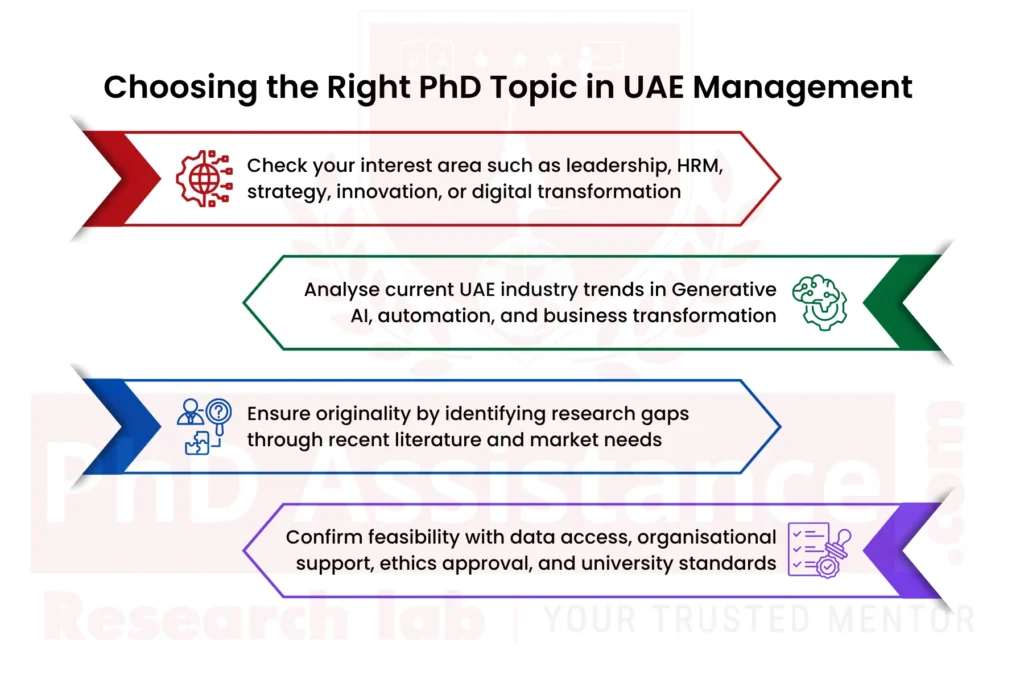
- Choose the area for a reason you can defend. Interest sustains a long project, but also ask what you already know, which data you can reach and who can supervise it. Generative AI leadership, digital transformation leadership and HR automation are areas, not topics.
- Map the practical problem. Talk to practitioners and read sector reports to find a concrete difficulty, such as managers using generative AI without training (Shaer et al., 2025).
- Read the scholarly literature systematically. Use journal articles, conference papers and theses to see what has been studied, with what theory and design, and with what results.
- Locate the gap. Gaps include missing contexts, contradictory findings, untested mechanisms, new technologies and weak theory. Ask also whether a shared assumption in the literature deserves challenge, which is what Alvesson and Sandberg (2011) call problematisation.
- Narrow the scope. Fix one population, one setting, a small set of constructs and a clear unit of analysis.
- Test feasibility. Check data access, organisational consent, time and ethics approval before you commit.
- Check it against your regulations and supervisor. Confirm the topic fits the programme and that a qualified supervisor can guide it.
Finding a gap that is worth a doctorate
Most candidates look for gaps by spotting what is missing: a sector, a country or a variable no one has studied. Sandberg and Alvesson (2011) found that gap-spotting dominates published management research, and warn that it tends to produce incremental contributions. A contextual gap ("not yet studied in the UAE") is legitimate only when you can say why the context should matter, for example because of a multinational workforce, the role of government entities in the economy or a distinctive regulatory environment.
Problematisation asks a different question: which assumption do existing studies share, and what happens if it is wrong? Many adoption studies, including those above, assume that intention to adopt is the outcome that matters. A doctoral topic could instead ask how managers decide when not to use generative AI output, or how leaders keep accountability for decisions that AI tools have shaped, which links to the augmentation side of the paradox described by Raisch and Krakowski (2021).
| Type of gap | Question to ask yourself | Example in this area |
|---|---|---|
| Contextual | Why would the UAE setting change the result? | Does a multinational workforce alter how leadership affects AI use? |
| Empirical | Which relationship has not been tested, or tested only once? | Generative AI training and trust in outputs among public employees |
| Methodological | Which design has the field not used? | Longitudinal or multi-source follow-up of adoption studies |
| Theoretical | Which assumption or mechanism is untheorised? | What "leading with generative AI" means beyond general leadership styles |
| Contradictory evidence | Where do results disagree, and why? | Leadership effects that differ between public and private organisations |
Check feasibility, theory and regulations
The FINER criteria ask whether a question is feasible, interesting, novel, ethical and relevant (Hulley et al., 2013). In management research in the UAE, feasibility usually decides the matter: surveys of employees need organisational permission, studies of government entities may need formal approval, and sensitive topics such as job displacement need careful ethics planning. Ask for access in principle before you finalise the topic.
Theory is the second filter. A topic that names only a technology ("ChatGPT in banks") is not yet a management topic. The studies above draw on the technology acceptance model, the technology-organisation-environment framework and transformational leadership theory (Thomas et al., 2025; Almazrouei & Alnahhal, 2026); your topic should name the theory it will extend or test.
Regulations are the third. The Commission for Academic Accreditation requires accredited doctoral programmes to include a comprehensive examination with a defence of the research proposal, and restricts principal supervision to qualified full-time faculty of the awarding institution (Commission for Academic Accreditation, 2019). At UAE University, for example, the proposal follows the comprehensive examination and must be approved by the PhD Advisory Committee (United Arab Emirates University, 2018). Choose a topic that a supervisor in your own university can guide, and read your own graduate studies policy.
| Test | Question | Evidence that it passes |
|---|---|---|
| Feasible | Can you reach the data within the programme timeline? | Agreement in principle from an organisation or a public dataset |
| Theoretical | Which theory does it extend or test? | A named framework and the constructs it implies |
| Novel | What will be known afterwards that is not known now? | A gap statement supported by recent literature |
| Ethical | Are there risks to participants or organisations? | An outline of consent, confidentiality and approvals |
| Relevant | Who will use the findings? | A named audience: managers, regulators, researchers |
| Supervisable | Can someone in your university supervise it? | A supervisor who has agreed to discuss it |
Once the topic passes these checks, the next task is the proposal; see How to develop a PhD research proposal in UAE management and the general guide to dissertation proposals for UAE researchers.
Worked example: narrowing an interest (illustrative)
A hypothetical candidate working in a Dubai government entity is interested in "generative AI leadership". The steps below show how the interest might become a topic; no results are implied.
- Area: generative AI in public-sector management.
- Practical problem: employees use generative AI tools, often without training or awareness of ethics guidelines (Shaer et al., 2025).
- Literature: UAE studies link leadership to digital transformation and performance (Almazrouei & Alnahhal, 2026) but do not examine generative AI or trust in its outputs.
- Gap: empirical and theoretical: how leaders' behaviour shapes employees' calibrated trust in generative AI outputs.
- Topic: "Leadership, training and calibrated trust in generative AI outputs among UAE public-sector employees."
- Feasibility: access through two entities agreed in principle; a two-wave survey to reduce reliance on a single cross-sectional snapshot.
Common mistakes to avoid
- Choosing an AI topic without a management theory to extend or test.
- Choosing a fashionable AI topic for which no data can be obtained.
- Keeping the topic as broad as "digital transformation in the UAE".
- Claiming a UAE gap without explaining why the context matters.
- Re-running a published adoption model in a new sector with nothing else added.
- Copying an earlier thesis idea instead of building on it.
- Finalising the topic before your supervisor and potential data holders have seen it.
For related stages in the same field, see writing individual chapters, structuring and completing the whole thesis, writing a journal manuscript and formatting it to journal standards. Broader advice is in How to choose a PhD topic and management topic directions; country context is on the UAE page.
Key takeaways
- Generative AI leadership and digital transformation are areas; a doctoral topic is one answerable question within them (Vial, 2019; Raisch & Krakowski, 2021).
- UAE-based studies rely heavily on cross-sectional surveys and SEM, so design choices can themselves create a contribution (Thomas et al., 2025; Almazrouei & Alnahhal, 2026).
- A contextual gap counts only when you can explain why the UAE setting should change the answer (Sandberg & Alvesson, 2011).
- Test feasibility, theory, novelty, ethics and relevance before you commit (Hulley et al., 2013).
- Your university's regulations and supervisors shape what topic is workable (Commission for Academic Accreditation, 2019; United Arab Emirates University, 2018).