
Two rulebooks: thesis guidelines and the journal's guide for authors
Doctoral researchers in UAE management often write for two readers at once: the university, which examines the thesis, and the journal, which reviews articles drawn from it. They follow different rules. A dissertation follows the university's graduate studies guidelines; at UAE University, for example, the policy requires the dissertation to follow the College of Graduate Studies preparation guidelines (United Arab Emirates University, 2018). A manuscript follows the target journal's guide for authors, which sets the reference style, word limit, abstract format, anonymisation, file types and declarations. When the two differ, each document follows its own rulebook.
Formatting does not make a weak paper strong, but poor formatting signals carelessness and can lead to a manuscript being returned before review. This guide covers presentation only; for building the argument see writing a UAE management journal manuscript, and for the thesis as a whole see completing a UAE management dissertation. Country context is on the UAE study page.
What UAE-based studies show about reporting in the AI era
We found no verified study by UAE-affiliated authors of how management researchers format or cite. Published UAE-based studies do, however, show the reporting habits that formatting must support: naming software and versions, describing review procedures, and recognising how widely generative AI is already used.
| Study | What it reports | Formatting lesson |
|---|---|---|
| Sallam et al. (2024), 608 university students in the UAE | Most respondents had heard of ChatGPT and 85.4% had used it | Assume reviewers will ask about AI use; prepare a disclosure statement |
| Ahmed et al. (2024), American University of Sharjah review | PRISMA screening counts and the version of VOSviewer used for mapping | Report search counts and cite tools with version numbers |
| Al Hammadi et al. (2024), nine UAE Islamic banks | PLS-SEM run in SmartPLS 3 with bootstrapping | Name the software, version and settings that produced each result |
These details look minor but allow readers to check and reproduce the analysis, which is the purpose behind most formatting rules (Sallam et al., 2024; Ahmed et al., 2024; Al Hammadi et al., 2024).
Title page, abstract and keywords
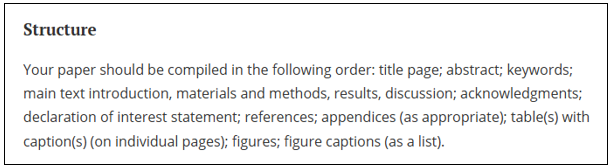
Journals usually ask for a title page with the title, all authors and affiliations, the corresponding author, and declarations such as funding, conflicts of interest and data availability. Many management journals use anonymised review, so these details go in a separate file and the main manuscript must not identify the authors. Degree and submission details belong to a thesis, not to a journal title page.
| Element | What journals usually ask for | Common error |
|---|---|---|
| Title | Concise statement of the topic, setting and, where helpful, the design | Listing every technology studied; vague phrases such as "a study of" |
| Abstract | Purpose, design and data, findings, and contribution, in the journal's format and length | Background only, with no findings; exceeding the word limit |
| Keywords | Terms readers would search for, often chosen from the journal's list | Repeating title words; generic terms that do not help indexing |
| Declarations | Funding, conflicts of interest, ethics approval, data availability, AI use | Omitted, or placed in the anonymised main file |
Some management journals require a structured abstract with fixed headings; others want a single paragraph. Check the format and the word limit before writing, not after.
Citations and references: APA 7 and reference managers
Many management journals use APA style or an author-date variant of it. The seventh edition of the APA manual sets out the essentials (American Psychological Association, 2020):
- In-text citations give author and year; for three or more authors, use the first author's surname and "et al." from the first citation.
- Reference list entries include up to 20 authors, with article titles in sentence case and the journal title and volume in italics.
- DOIs are written as links in the form https://doi.org/ followed by the identifier.
- Every in-text citation appears in the reference list and every reference is cited in the text.
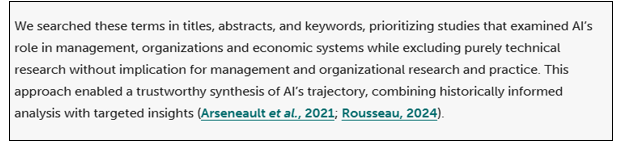
"Harvard" is a family of author-date styles with many local variants, and numeric styles such as IEEE are rarely used in management journals, so follow the journal's instructions exactly rather than a generic version. A reference manager such as Zotero stores records once and formats them in any style; Pearce (2018) shows how a full literature review can be run with free and open-source tools. Reference managers format what you give them, so check imported records for missing DOIs, wrong capitalisation and duplicate entries. Never take references from a chatbot without finding the source: a study of ChatGPT-generated citations found that many were fabricated or contained errors (Walters & Wilder, 2023).
Worked example: correcting a reference entry (illustrative)
Reference errors are usually small and repeated many times. The example below takes a real article cited in this guide and shows a typical draft entry, the problems in it, and the APA 7 version (American Psychological Association, 2020). The draft is invented for illustration.
| Version | Entry | What is wrong or right |
|---|---|---|
| Draft | Ahmed V. et al. (2024) "Enhancing Work Productivity Through Generative Artificial Intelligence: A Comprehensive Literature Review", Sustainability, 16(3). | "et al." in the reference list; title in title case and quotation marks; journal not italicised; article number and DOI missing |
| APA 7 | Ahmed, V., Al Naqbi, H., & Bahroun, Z. (2024). Enhancing work productivity through generative artificial intelligence: A comprehensive literature review. Sustainability, 16(3), 1166. https://doi.org/10.3390/su16031166 | All authors listed; sentence-case title; journal and volume italicised; article number and DOI link given |
Fix the record once in your reference manager rather than in the document, so the correction carries into every later manuscript and into the thesis.
Citing software and data, and disclosing generative AI
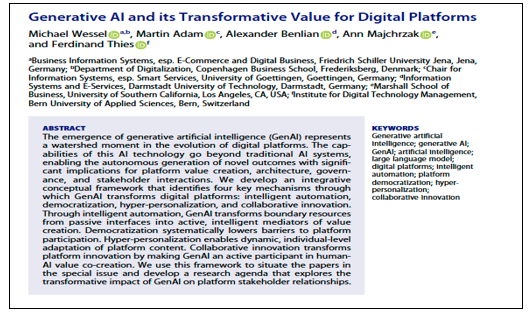
Distinguish two uses of AI. Machine-learning libraries, statistical software and datasets used to produce results are part of the method: name them, give versions and settings, and cite them as the journal requires. Generative AI used for drafting, editing or translating is a matter of disclosure. COPE's position is that AI tools cannot be authors and that authors must disclose how they used them and remain responsible for the content (Committee on Publication Ethics, 2023); some publishers have set stricter limits, such as the Science journals' 2023 policy on AI-generated text and images (Thorp, 2023). Papers about generative AI, such as Wessel et al. (2025) on digital platforms, are cited like any other source; the disclosure rule concerns the tools you used, not the topic you study.
An illustrative disclosure statement, to be adapted to the journal's wording: "During the preparation of this manuscript the authors used [tool, version] to improve the readability of the English in sections 1 and 5. The authors reviewed and edited all output and take full responsibility for the content." Place it where the journal asks, often in the acknowledgements or a dedicated declaration, and keep your own record of the prompts and edits in case an editor asks.
Tables, figures and equations
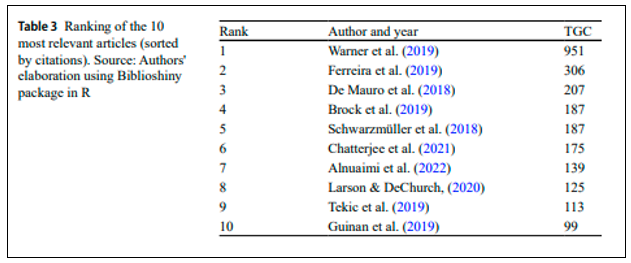
Reviewers often read tables and figures before the text, so each should be understandable on its own. In APA style, tables and figures are numbered in the order they are first mentioned, with a bold number and an italic title above, notes below to define abbreviations and symbols, and no vertical rules in tables (American Psychological Association, 2020). Report the statistics your design requires (for example, coefficients with standard errors or intervals, reliability and validity indices, model fit) in the journal's format.
- Figures. Label axes with units, define every symbol, state what error bars show and supply files at the resolution and format the journal specifies.
- Model diagrams. Use the same construct names as the text and tables, and show only paths you test.
- Equations. Number them consecutively, define every variable at first use and keep notation identical across equations, tables and text.
- Machine-learning results. State the data split, the evaluation metric and the baseline in the table note, so that performance figures can be interpreted.
Final checks before submission
| Check | What to confirm |
|---|---|
| Guide for authors | Word limit, abstract format, heading levels, reference style and file types match |
| Anonymisation | No author names, affiliations or identifying self-citations in the main file |
| References | Every citation and reference matches; DOIs present; style applied consistently |
| Software and data | Names, versions and data sources reported; data availability statement included |
| AI disclosure | Generative AI use disclosed as the journal requires, or confirmed as not used |
| Tables and figures | Numbered in order of mention, self-explanatory, consistent with the text |
| Declarations | Funding, conflicts of interest and ethics approval stated |
If the article is drawn from your thesis, check whether the journal treats a deposited thesis as prior publication and say so in the cover letter; see how to convert a PhD thesis into a journal manuscript. Wider evidence on AI-assisted writing is in AI tools in academic writing.
Common mistakes
- Formatting a manuscript to thesis rules instead of the journal's guide for authors.
- Mixing citation styles, or using a generic "Harvard" style when the journal specifies APA.
- Copying references from a chatbot or a secondary source without checking the original.
- Leaving author names in the anonymised file, document properties or self-citations.
- Omitting software names, versions and settings that produced the results.
- Not disclosing generative AI use, or citing an AI tool as if it were an author.
- Tables and figures that cannot be understood without the text, or that use different construct names.
Key takeaways
- A thesis follows university rules and a manuscript follows the journal's guide for authors (United Arab Emirates University, 2018).
- APA 7 sets clear rules for citations, references, tables and figures; apply them consistently (American Psychological Association, 2020).
- Reference managers save time but need checking, and chatbot-generated references must never be used unchecked (Pearce, 2018; Walters & Wilder, 2023).
- Cite the software and data behind results, and disclose generative AI used in writing (Committee on Publication Ethics, 2023).
- UAE-based studies show the reporting detail reviewers expect, from software versions to review procedures (Ahmed et al., 2024; Al Hammadi et al., 2024).