
Critical Review: Perceptions of effectiveness and ethical use of AI tools in academic writing: A study among PhD scholars in India
Introduction
Artificial intelligence technologies are rapidly transforming academic writing practices across universities and research institutions. Doctoral scholars now use AI-enabled platforms, which provide paraphrasing and citation management and grammar enhancement, and plagiarism detection tools that change how they write scholarly documents. The integration of digital writing technologies into research workflows requires examining perceptions of AI tools in academic writing because those tools determine research output, research quality and scholarly integrity.
Researchers use artificial intelligence tools to conduct their research work, which creates discussion about original work, research ethics and the necessity for researchers to keep their research work independent. The evaluation shows how doctoral students perceive AI writing tools because of their ability to identify both positive and negative aspects of these technological tools. The present critical analysis evaluates an empirical research study, Effectiveness of AI tools for academic writing for academic use through assessment of its theoretical framework, research methods and study results and their consequences for academic research in India.
Summary of the Article
The investigation of how doctoral researchers view AI writing tools as institutional academic resources, because researchers assess their effectiveness and reliability, and their ethical consequences. The study analyses AI applications because they help with paraphrasing and citation formatting and plagiarism detection, while the study examines issues about originality and dependency. By evaluating PhD scholars AI perceptions India, the study investigates how PhD scholars in India perceive AI technology because it shows how emerging technologies develop new academic writing methods used in doctoral programs.
A structured quantitative design to investigate how doctoral students experience AI-assisted writing technologies was used. The research studied 184 PhD scholars at a top Indian university who answered surveys based on established measurement scales. The researchers evaluated data to measure three aspects, which included how well people perceived the system operated, its capacity to be used in different academic fields, and its associated ethical issues with AI writing tools.
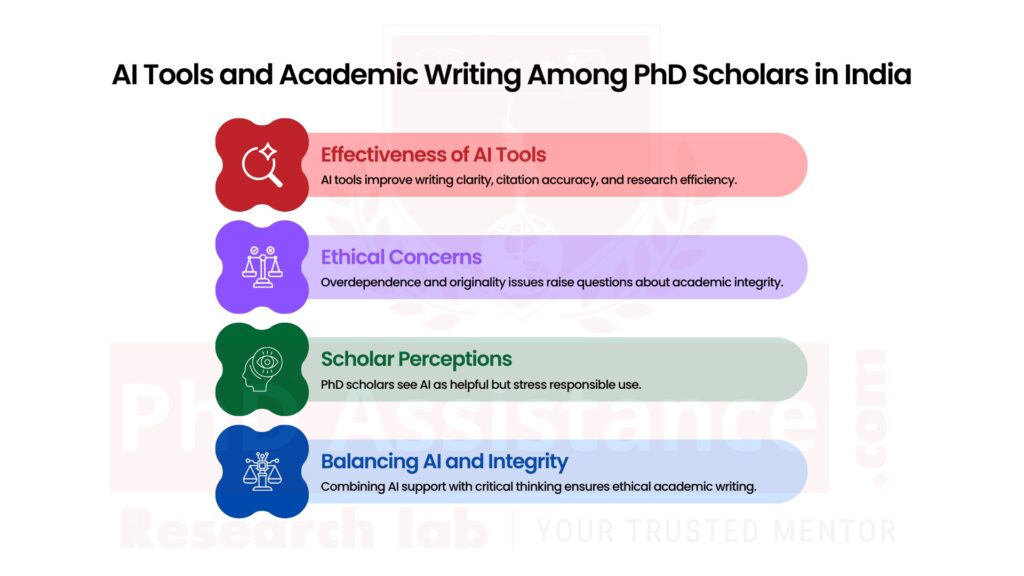
The findings show that academic writing shows better clarity, and better coherence, and better efficiency through the use of AI technologies. The respondents showed better citation accuracy and better language improvement abilities when they worked under time constraints. The study showed three main issues, which included people using automated systems too much, systems decreasing unique ideas and scholars lacking the ability to see through research work. Doctoral candidates who worked toward their final degree showed more doubt about AI effects on their academic freedom, which showed the need for Ethical use of AI in research writing in their work. The analysis shows that AI works best as a tool that helps people develop creative and analytical skills without taking away their ability to create.
Critique
Significance and Contribution to the Field
It contributes to expanding knowledge on Academic writing tools among PhD students through its investigation of functional benefits and ethical challenges that researchers face when they use AI technology for their writing tasks. The study demonstrates technological advantages through its existence, yet it maintains academic integrity standards that protect original work from being improperly used.
The examination of doctoral students who conduct research in Indian educational institutions to understand their attitudes toward artificial intelligence and academic integrity in contemporary digital educational environments. The researchers investigate how academic scholars learn to use new technologies while they uphold their research standards. The study results support Indian universities that work to create rules and training programs for AI use in academic research India.
The findings provide important insights, yet their application remains restricted to one educational institution. Theoretical frameworks will benefit from broader research that studies multiple universities in different countries to investigate global doctoral education patterns.
Methodology and Research Design
A quantitative survey-based design was employed, which enables researchers to study how doctoral students view AI writing tools. The study uses validated instruments, which provide reliable results and enable researchers to measure essential variables that determine academic writing tool perception.
The sample size provides sufficient data for meaningful statistical analysis and supports the interpretation of patterns across different stages of doctoral study. The research framework assesses doctoral students’ AI technology experiences through its three evaluation methods, which include adaptability, efficiency and ethical comprehension assessment.
The participants demonstrated response bias through their self-reported answers because they used their actual usage patterns to estimate their personal usage. The study design needs to use cross-sectional analysis because researchers cannot observe how attitudes shift between different time periods. The upcoming research will utilise longitudinal data and qualitative interviews to provide a deeper understanding of how AI-based academic writing tools impact learning outcomes and student behavioural changes.
Argumentation and Use of Evidence
The discussion shows a logical structure that successfully connects its research results to wider academic discussions about technology use in higher education. The statistical evidence presents clear information that shows how perceived effectiveness connects to ethical concerns.
The narrative shows how responsible AI adoption needs to remain important because it shows that technological tools help people work better while maintaining their mental involvement. Evidence is used consistently to support arguments regarding balanced integration of AI into scholarly writing practices.
The analysis would benefit from incorporating more qualitative insights, which would lead to improved results. The study needs case-based examples or narrative reflections, which will help determine how doctoral scholars handle ethical dilemmas and use AI technology throughout their research process.
Ethical Considerations and Omissions
Ethical research methods involve two main elements, which are informed consent and proper data management procedures. The discussion also addresses broader ethical concerns such as originality, transparency, and responsible technology usage.
Doctoral education institutions show insufficient focus on their institutional policies, which control AI deployment. A more detailed examination of university guidelines, disciplinary norms, and AI and academic integrity perceptions would enhance understanding of how ethical AI practices are implemented within research environments.
Writing Style and Structure
The presentation delivers clear information through its organised structure, which leads readers to understand basic concepts before they learn about the research methods and study results and their resulting impacts. The content becomes understandable to people from different fields because technical terms receive proper explanations.
The text becomes easier to read and understand because of its visual elements and structural components. The text needs practical writing examples that demonstrate AI support to increase accessibility while showing readers how to apply the content.
Conclusion
The research shows how doctoral writing methods have changed because of artificial intelligence-based technologies. The study shows that AI tools improve three writing areas, which include better clarity, faster work and improved citation handling, but they create essential challenges for maintaining originality and showing ethical research practices. The discussion shows how AI tools improve academic writing, while research writing needs ethical AI use through digital writing technology adoption, which should be handled with responsibility and balance.
Artificial Intelligence serves as an academic tool that helps students develop their creative abilities and critical thinking skills. The future research should use comparative and longitudinal studies because they will provide better insights into how artificial intelligence affects academic writing practices in different academic fields and geographic areas.
It advances technology-enhanced scholarship through its substantial contributions while offering essential guidance to universities and doctoral researchers who need to implement artificial intelligence in their academic writing procedures.
Reference:
Subaveerapandiyan, A., Kalbande, D., & Ahmad, N. (2025). Perceptions of effectiveness and ethical use of AI tools in academic writing: A study among PhD scholars in India. Information Development, 41(3). https://doi.org/10.1177/02666669251314840
Methodology and Research Design