
What a completed UAE management dissertation must show
Doctoral programmes in the UAE are accredited by the Commission for Academic Accreditation (CAA). Its Standards require a comprehensive examination that includes a defence of the research proposal and of the completed thesis or dissertation, and they place principal supervision with qualified full-time faculty of the awarding institution (Commission for Academic Accreditation, 2019). Universities then set their own procedures. At UAE University, for example, the dissertation must follow the College of Graduate Studies preparation guidelines and is defended before an examination committee (United Arab Emirates University, 2018). Your own graduate studies regulations, not a general template, decide the format, length and examination steps.
Whatever the rules, examiners look for the same thing: a single, defensible contribution. In interviews with experienced examiners, Mullins and Kiley (2002) found that they expect a thesis to be coherent, to show that the candidate understands the field and the limits of the work, and to read as the work of an independent researcher; they also form an early impression from the abstract, introduction, conclusion and references. Trafford and Leshem (2009) describe this quality as doctorateness: the visible links between question, theory, method, findings and conclusions. For a thesis that combines FinTech, ESG and AI analytics, the main risk to doctorateness is fragmentation.
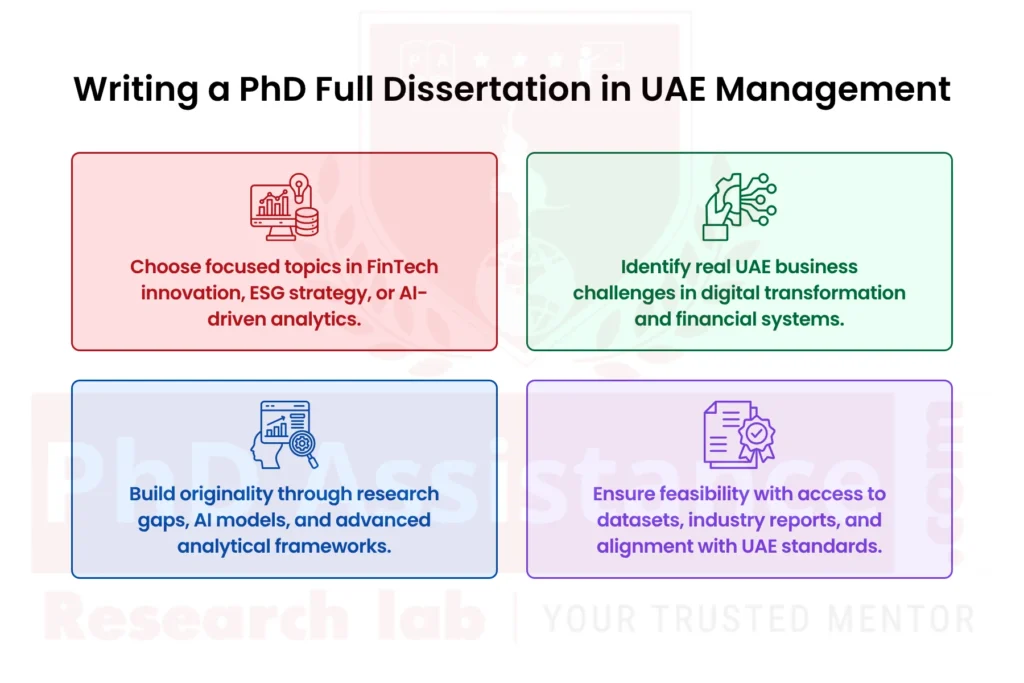
This guide covers the whole thesis. For earlier stages see choosing a UAE management topic and writing the proposal; for drafting individual chapters see writing the literature review and methods chapters. General UAE context is on the UAE study page.
How UAE-based studies have handled FinTech and banking data
Few peer-reviewed management studies by UAE-affiliated authors on FinTech, ESG and AI analytics could be verified for this guide, so the evidence below is limited to two banking studies. They are useful because they show, in a UAE setting, the design choices and limitations that examiners will also probe in a doctoral thesis.
Researchers at Al Ain University and a financial services firm in Abu Dhabi surveyed commercial banks listed in Abu Dhabi and Amman and related three FinTech dimensions (financial inclusion, alternative payment methods and automation) to deposits and net profits using multiple regression (Baker et al., 2023). They reported positive associations in both markets, but the sample was 86 usable responses (45 from the UAE) collected by convenience sampling, and the authors called for larger samples. A second study surveyed 300 managers across all nine UAE-licensed Islamic banks and used PLS-SEM to relate FinTech adoption, IT security and digital maturity to risk-management effectiveness (Al Hammadi et al., 2024). FinTech adoption and security capabilities were positively related to risk management, digital maturity alone was not, and the expected moderating effect of the regulatory environment was not supported; the authors noted the cross-sectional design and limited generalisability. Its authors are affiliated with universities outside the UAE, so it is UAE-data research rather than UAE-affiliated research.
| Study | Data and method | Problem reported | Lesson for a full thesis |
|---|---|---|---|
| Baker et al. (2023) | Bank questionnaires, Abu Dhabi and Amman listed banks; multiple regression | Small convenience sample; perceptions used to explain financial outcomes | Justify the sampling frame and, where possible, pair survey measures with archival financial data |
| Al Hammadi et al. (2024) | 300 managers in nine UAE Islamic banks; PLS-SEM | Cross-sectional design; a hypothesised moderator not supported | Report unsupported hypotheses honestly and discuss them as findings, not failures |
Both studies rely on self-reported survey data from one respondent per organisation at one time point. That design is exposed to common method bias, which can inflate relationships between constructs measured in the same instrument; procedural remedies (separating predictor and outcome sources, protecting anonymity, varying scale formats) are stronger than statistical corrections applied afterwards (Podsakoff et al., 2003). A doctoral thesis that builds on this literature should plan those remedies at the design stage and report them in the methods chapter.
Build one architecture for the whole thesis
Published advice on thesis structure describes several forms: the traditional thesis with one study, the complex traditional thesis reporting several linked studies, the topic-based thesis, and the compilation of published papers (Paltridge, 2002). A thesis with FinTech, ESG and AI strands is usually a complex traditional thesis or a compilation. In either form the strands must serve one research problem. Start by writing a single paragraph that states the problem, the overarching question, the framework and the claimed contribution, and test every chapter against it.
Theory selection is where many management theses fragment. The Technology Acceptance Model explains individual intention to use a technology; the technology-organisation-environment (TOE) framework explains adoption by organisations; the resource-based view (RBV) explains how firm resources and capabilities relate to performance. They operate at different levels of analysis and cannot simply be listed together. Choose the theory that matches the unit you sample and the outcome you measure, and explain why. Dwivedi et al. (2021) set out a broad research agenda on AI in organisations, which is a good place to locate questions; it is not a substitute for a theory chosen to fit your own question.
| Chapter | What it must do | Common problem in FinTech, ESG and AI theses |
|---|---|---|
| Introduction | State the problem, questions, context (UAE sector and regulation) and contribution | Lists technologies instead of stating a problem |
| Literature review | Synthesise prior work and show the gap the questions address | Separate mini-reviews of FinTech, ESG and AI that never meet |
| Framework and hypotheses | Derive each hypothesis from theory at one level of analysis | TAM, TOE and RBV combined without explaining how |
| Methodology | Justify design, sample, measures, analysis and ethics for every strand | Methods chosen for novelty rather than fit to the question |
| Results | Report measurement checks, then tests of each question in order | Model outputs without links to hypotheses |
| Discussion and conclusion | Interpret findings against the literature; state contribution and limits | Repeats results; claims causal effects from cross-sectional data |
Match each analytic method to the question it answers
A multi-strand thesis often uses several analytic families. Each answers a different kind of question, and the methodology chapter should say which question each method serves.
- Explaining relationships (FinTech adoption, ESG and performance). Survey-based models such as PLS-SEM or covariance-based SEM test hypothesised paths. Report the measurement model first, with composite reliability alongside or instead of Cronbach's alpha and the heterotrait-monotrait ratio for discriminant validity (Hair et al., 2019; Henseler et al., 2015); if you also claim predictive relevance, assess it out of sample, for example with PLSpredict (Shmueli et al., 2019). Chapter-level detail is in writing the methods chapter.
- Firm-level ESG data. Panel data on listed firms allow fixed-effects or random-effects models that control for stable firm characteristics. Treat the ESG measure itself as a choice to justify: ratings from different agencies diverge substantially, mainly because they measure different attributes in different ways (Berg et al., 2022). Use a robustness check with an alternative measure where you can. Disclosure standards such as GRI and SASB describe what firms report; they are not scores.
- Forecasting and risk (FinTech markets). ARIMA, VAR and LSTM models forecast series; Monte Carlo simulation and value-at-risk explore distributions of outcomes. They support predictive or scenario questions, not tests of causal hypotheses, and should be evaluated on held-out data.
- Ranking alternatives. AHP and TOPSIS rank options from weighted criteria. Report how weights were elicited and how stable the ranking is when they change.
- AI analytics. Machine-learning models (tree ensembles, support vector machines, neural networks, clustering) can classify, predict or segment. If the thesis must also explain what drives a prediction, use and report an explanation method such as SHAP values, which attribute each prediction to input features (Lundberg et al., 2020), and avoid presenting feature importance as causal effect.
Worked example: integrating three strands (illustrative)
The following case is hypothetical and shows structure only; it reports no results.
A doctoral researcher in Abu Dhabi studies digital banking. Her first draft had a FinTech chapter on customer adoption (TAM survey), an ESG chapter on bank disclosure and profitability (panel data) and an AI chapter on predicting customer churn (machine learning). Her supervisor observed that the chapters answered three unrelated questions.
- One problem. She reframes the thesis around a single problem: how UAE banks' digital capabilities relate to their sustainability and risk outcomes.
- One level of analysis. She keeps the bank as the unit, replaces the customer TAM survey with a TOE survey of bank managers and keeps RBV to link capabilities to outcomes.
- Methods by question. PLS-SEM tests the capability model; a bank-year panel tests whether digital investment is associated with disclosure and profitability, with an alternative ESG measure as a robustness check; the machine-learning work becomes a short predictive study of risk indicators, evaluated on held-out years and explained with SHAP values.
- One discussion. The final chapter interprets the three sets of findings against the same framework and states one contribution, with limits for each strand.
The thesis now has fewer techniques than the first draft, but each is defensible, and the examiners can follow one argument from the first page to the last.
Integrate, check and prepare for the defence
Plan the final stage as a project of its own. Integration means rewriting the introduction and conclusion last, so that they promise exactly what the thesis delivers, and checking that terms, variable names, hypothesis numbers and abbreviations are identical across chapters. Because examiners form early impressions from the abstract, introduction, conclusion and reference list (Mullins & Kiley, 2002), give those parts the most careful revision.
| Check | What to confirm before submission |
|---|---|
| Golden thread | Every research question is answered in the results and discussed in the conclusion |
| Consistency | Construct names, hypothesis numbers, abbreviations and units match in every chapter |
| Measurement | Reliability and validity are reported before any structural or predictive result |
| Claims | Language matches the design: association for cross-sectional data, prediction for forecasting models |
| Ethics and data | Approval references, consent procedures and data-access permissions are stated |
| Regulations | Format, word limit, declaration of originality and AI-use statements follow your university rules |
| References | Every citation is in the list and every listed item is cited, in one style |
For the defence, prepare a short account of the thesis in your own words: the problem, the contribution, why each method was chosen and what you would do differently. Expect questions on the choice of theory, the measurement of ESG and digital constructs, the limits of cross-sectional data and the practical meaning of the findings for UAE organisations. If parts of the thesis are being prepared as journal articles, see writing the journal manuscript, formatting it to journal standards and turning a thesis into a manuscript.
Common mistakes
- Choosing a topic without measurable constructs or accessible data, then discovering the gap during analysis.
- Deriving hypotheses from a list of theories rather than from one framework at one level of analysis.
- Using forecasting, ranking or machine-learning models to make causal claims they cannot support.
- Treating an ESG rating as an objective fact instead of a measurement choice that needs justification.
- Reporting structural results without first establishing reliability and validity.
- Relying on small, single-respondent surveys without planning remedies for common method bias.
- Leaving ethics approvals, data permissions and university format rules until the final month.
- Writing the introduction first and never revising it, so that it promises more than the thesis delivers.
Key takeaways
- UAE doctoral dissertations are defended under CAA Standards and university rules, so your own graduate regulations set format and procedure (Commission for Academic Accreditation, 2019; United Arab Emirates University, 2018).
- Examiners look for one coherent contribution; fragmentation is the main risk in a multi-strand FinTech, ESG and AI thesis (Mullins & Kiley, 2002; Trafford & Leshem, 2009).
- UAE banking studies show recurring limits of small, cross-sectional, self-reported samples, which a doctoral design should anticipate (Baker et al., 2023; Al Hammadi et al., 2024; Podsakoff et al., 2003).
- Each analytic method should answer a stated question, and measurement quality must be shown before structural results (Hair et al., 2019; Henseler et al., 2015).
- ESG ratings diverge across agencies, so the ESG measure is a choice to justify and test for robustness (Berg et al., 2022).