
From thesis chapter to journal article
Management research in the UAE on generative AI, ESG leadership and digital innovation is growing, and many doctoral researchers aim to publish during candidature. Publishing from a thesis is a different writing task: Kamler (2008) showed that doctoral publication depends on learning to write for a journal community, often through co-authorship with supervisors, rather than on extracting text from the thesis. An article answers one question for a defined readership, within a word limit, in conversation with the papers that journal has already published.
Belcher (2019) makes the same point practically: an article is accepted for its argument, so the first task is to state that argument and test whether the evidence supports it. This guide follows that order. For the structure of the full thesis see completing a UAE management dissertation; for layout, referencing and AI-use statements see the companion guide formatting a UAE management manuscript; for chapter drafting see writing individual chapters; and for general advice on converting a thesis see how to convert a PhD thesis into a journal manuscript.
How UAE-based authors have published in the area
We could not verify a peer-reviewed study of ESG leadership by UAE-affiliated authors within this review, so the examples below cover generative AI and digital leadership. Read them as models: what question each paper asks, how it reports its design, and how it states its limits.
Researchers at the American University of Sharjah reviewed 159 Scopus-indexed publications on generative AI and work productivity using a PRISMA screening process and bibliometric mapping (Ahmed et al., 2024). They found applications across sectors from academia to government, rapid growth in 2023, and a literature dominated by conference papers, and they acknowledged a gap on finance that emerged after their search closed. A team with six of nine authors at UAE institutions surveyed 608 university students in the UAE with an instrument based on the technology acceptance model; perceived usefulness, lower perceived risk and ease of use were associated with ChatGPT use, and the authors reported convenience sampling and self-report bias as limits (Sallam et al., 2024). In the public sector, Almazrouei and Alnahhal (2026) used PLS-SEM on data from 233 employees to show that digital transformation and agility mediated the relationship between transformational leadership and performance.
| Study | Design | What the manuscript does well | What to borrow |
|---|---|---|---|
| Ahmed et al. (2024) | Systematic review with PRISMA and bibliometric mapping | Reports search, screening and counts transparently | A reproducible search description for any review section |
| Sallam et al. (2024) | Cross-sectional survey; TAM-based instrument; regression | Separates predictors of use from predictors of attitude | Distinct dependent variables, each with its own explanation |
| Almazrouei and Alnahhal (2026) | Survey; PLS-SEM; mediation | One theoretical mechanism tested through two mediators | A focused model rather than every possible path |
All three are cross-sectional or review designs. A manuscript that adds longitudinal, multi-source or objective outcome data on these topics in the UAE would therefore offer a methodological as well as a substantive contribution.
Find the contribution and build the theory section
Write the contribution as one sentence before drafting anything else: what the field believed, what your study shows, and why that matters. Generative AI offers many possible questions; Dwivedi et al. (2023) set out a multidisciplinary agenda covering research, practice and policy, and Vial (2019) reviewed how digital transformation creates value and the barriers it meets. Use such reviews to locate your gap, then narrow it to a question your data can answer. The live example of a topic, the influence of AI-based ESG models on sustainability reporting in the UAE, would become a manuscript only once it names the firms, the outcome and the mechanism.
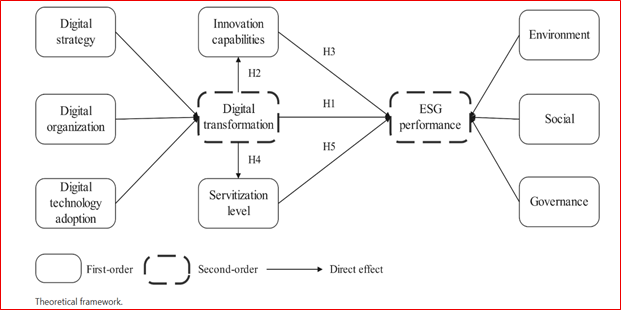
The theory section should explain why the relationships you test should exist. Choose a primary lens, such as the resource-based view for firm capabilities or stakeholder theory for ESG pressures, and derive each hypothesis from it. George et al. (2021) illustrate how digital innovations can be theorised as means of addressing sustainability problems, and Chen and Wang (2024) model digital transformation as improving ESG performance through innovation capability and servitization (Figure 1). A clear diagram helps reviewers, but only if every arrow is explained in the text.
Write an introduction that creates a research space
Reviewers and editors decide early whether a manuscript makes a contribution, and they decide largely on the introduction. Swales (1990) described how research article introductions typically move through three steps: establishing the territory (why the topic matters and what is known), establishing a niche (the gap, contradiction or unanswered question) and occupying the niche (what this study does and what it adds). The pattern is a description of common practice rather than a rule, but it is a useful test of a draft.
- Territory. One or two paragraphs on why generative AI, ESG leadership or digital innovation matters for management, citing the most relevant recent work rather than general statistics.
- Niche. A precise statement of what prior studies have not explained, for example that UAE studies rely on cross-sectional surveys or treat AI adoption and ESG separately.
- Occupying the niche. The question, the setting, the design in one sentence, and the contribution sentence written earlier.
Keep the UAE context purposeful: explain what about the national setting (sector structure, regulation, workforce composition or policy priorities) makes the question interesting or the findings different, instead of opening with general descriptions of national strategies.
Report methods and results the way reviewers read them
Management reviewers check whether the design can support the claims. Justify the sample and data source, show that measures are reliable and valid before reporting structural results, and match the language of your conclusions to the design. For PLS-SEM, the reporting sequence and thresholds in Hair et al. (2022) are widely used. Where predictor and outcome come from the same respondents at the same time, explain the procedural remedies you used against common method bias and any statistical checks, since reviewers increasingly ask about it (Podsakoff et al., 2003).
| Section | What to include | Note for generative AI and ESG studies |
|---|---|---|
| Sample and data | Population, sampling frame, response rate, respondent role | State whether ESG data are disclosures, ratings or survey perceptions |
| Measures | Source of each scale, adaptation, translation and pilot | Define "generative AI use" or "ESG leadership" precisely; avoid one-item proxies |
| Measurement model | Loadings, reliability, convergent and discriminant validity | Report before any path or prediction result |
| Structural or regression results | Coefficients, intervals, effect sizes, controls | Separate supported from unsupported hypotheses clearly |
| Discussion | Meaning of each finding against prior studies; contribution; limits | Avoid causal language for cross-sectional data |
In the discussion, link each result back to the theory and to the papers you cited in the introduction. This is where the advice to interpret statistics "in terms of their relationship to the theoretical assumptions, the management implications and the scholarly debate" belongs.
Using generative AI tools while you write
Many researchers now use generative AI for language editing, summarising or coding, and the UAE survey above found that most students had already used ChatGPT (Sallam et al., 2024). Publication ethics rules are clear on the essentials. The Committee on Publication Ethics states that AI tools cannot be listed as authors because they cannot take responsibility for the work, and that authors who use them must disclose how they were used and remain fully responsible for the content (Committee on Publication Ethics, 2023). Some journals go further: in 2023 the Science journals announced that text, figures and images generated by AI tools could not be used in their papers (Thorp, 2023). Policies differ between publishers and change over time, so the current policy of your target journal is the one that applies.
Contributors to Dwivedi et al. (2023) also warned of fabricated references and plausible but wrong text. In practice, check every reference and statement a tool suggests against the original source, keep a record of how you used it, and read your target journal's policy before submission. How to word the disclosure is covered in the formatting guide; wider evidence is reviewed in generative AI in academic writing.
From chapter to submission: a worked example (illustrative)
This case is hypothetical and reports no results. A doctoral researcher in Dubai has a 20,000-word thesis chapter on ESG leadership, generative AI use and innovation in UAE firms, with six hypotheses and three theories.
- Contribution sentence. "Prior work treats AI adoption and ESG leadership separately; we show how leaders' ESG commitment shapes whether generative AI use is associated with innovation outcomes."
- Scope. She keeps the three hypotheses that test this mechanism and saves the others for a second paper.
- Theory. She keeps stakeholder theory as the primary lens and removes the other two from the theory section, mentioning one briefly in the discussion.
- Methods. She reports the measurement model, the common method bias remedies and the structural model, following the PLS-SEM reporting sequence.
- Journal. She reads recent issues of two target journals, chooses the one that has published related work, and writes the introduction to join that conversation.
Submit, revise and respond to reviewers
Choose a journal whose recent articles address related questions with similar methods; this shapes the literature you cite and the contribution you claim. Read the guide for authors before the final draft, and agree authorship order and responsibilities with co-authors, including supervisors, early. When reviews arrive, respond to every point, in a self-contained, courteous letter that quotes each comment and states exactly what changed and where (Noble, 2017). A rejection with reviews is useful feedback for the next submission.
Common mistakes
- Submitting a shortened thesis chapter with the thesis's literature review and every hypothesis intact.
- Claiming several contributions instead of stating one clearly.
- Listing theories without deriving hypotheses from any of them.
- Reporting structural results before establishing measurement quality.
- Using causal language for cross-sectional survey data.
- Relying on generative AI for references or claims without checking the sources, or not disclosing its use.
- Choosing a journal for its metrics rather than its fit with the paper's conversation.
- Answering reviewers defensively or ignoring comments that seem minor.
Key takeaways
- A journal article makes one argument for a specific audience and is rebuilt from the thesis, not cut from it (Kamler, 2008; Belcher, 2019).
- UAE-based studies on generative AI and digital leadership are mostly cross-sectional or review designs, which leaves room for longitudinal or multi-source contributions (Ahmed et al., 2024; Sallam et al., 2024; Almazrouei & Alnahhal, 2026).
- A clear theoretical lens and a diagram explained arrow by arrow make the contribution visible (George et al., 2021; Chen & Wang, 2024).
- Report measurement quality first and plan remedies for common method bias (Hair et al., 2022; Podsakoff et al., 2003).
- Generative AI tools cannot be authors; disclose their use and verify everything they produce (Committee on Publication Ethics, 2023; Dwivedi et al., 2023).