
The source and why it matters
The paper under review is Wu et al. (2026), "Exploring PhD students' utilization of generative AI in academic writing for publication purposes: Insights for EAP", published open access in the Journal of English for Academic Purposes (volume 79, article 101612; online in December 2025). The authors are based at Hong Kong Baptist University and City University of Hong Kong and write from the perspective of English for Academic Purposes (EAP), the field that teaches academic English to university students and researchers.
Its premise is that generative AI is creating new processes for writing for publication, while the appropriate use of these tools is under-researched, so EAP curricula may not prepare doctoral students to use them well (Wu et al., 2026). The question matters because doctoral students in many systems are expected to publish before or soon after submission, often in English when it is not their first language.
What the study reports
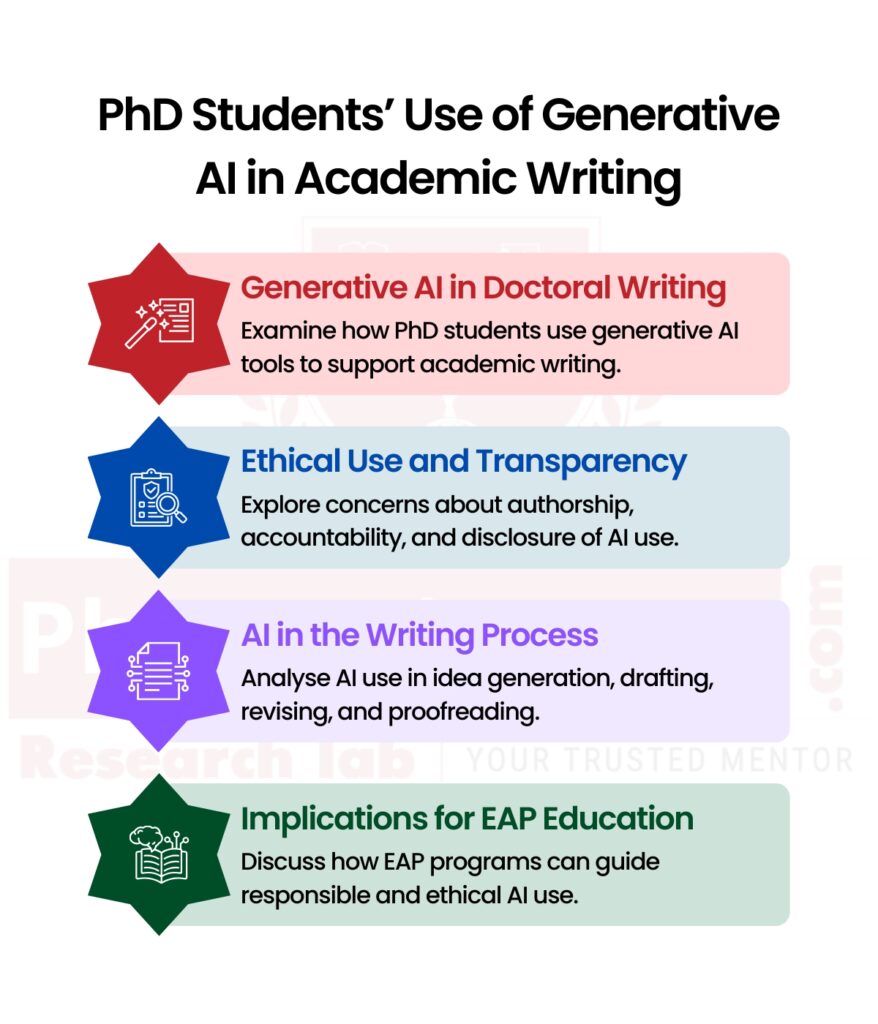
The study explored how L2 PhD students understand the appropriateness of using generative AI when writing for publication, and why. It used a two-stage design: a survey with 63 responses, followed by 22 semi-structured interviews, among L2 doctoral students in the arts, humanities and social sciences at a Hong Kong university (Wu et al., 2026).
| Element | What the published abstract reports |
|---|---|
| Participants | L2 PhD students in arts, humanities and social sciences at one Hong Kong university |
| Design | Two stages: survey, then follow-up semi-structured interviews |
| Data | 63 survey responses; 22 interviews |
| Perceptions by stage | Divergent views on the appropriateness of AI use at each stage of academic writing |
| Transparency | Most stressed transparency and accepted the need for AI declaration |
| Practice | About sixty per cent opted not to declare their AI use in actual publishing practice |
| Output | Six recommendations for EAP instructors and course organisers |
Two findings stand out. First, the participants did not treat AI use as uniformly acceptable or unacceptable; their judgements depended on the stage of writing at which a tool was used. Second, there was a marked gap between principle and practice: endorsement of transparency was widespread, but most participants did not declare their use when publishing. The authors draw on these findings to propose recommendations to help L2 doctoral students use generative AI transparently (Wu et al., 2026).
Strengths
- A stage-sensitive view. Asking about appropriateness stage by stage treats writing for publication as a process, which is closer to how doctoral writers work than a single yes-or-no question about AI.
- Explanation as well as prevalence. The follow-up interviews allow the authors to explore the reasons behind survey responses, which is where a disclosure gap can begin to be understood.
- An uncomfortable, useful finding. Reporting that most participants did not declare their use, despite endorsing transparency, gives editors and educators a concrete problem to address rather than a general concern.
- Oriented to teaching. The paper ends with recommendations for EAP practice, building on earlier work by one of the authors on the affordances of ChatGPT for language learning (Kohnke et al., 2023) and on university guidelines for AI in assessment (Moorhouse et al., 2023).
Limitations and methodological issues
- Small, single-site sample. Sixty-three survey responses from one university and three broad disciplinary areas cannot support estimates for doctoral students in general. The sixty per cent figure describes this sample, not a population.
- Self-selection. Students with strong views on AI may be more likely to take part, in either direction, which affects both prevalence and the range of reasons heard.
- Self-report about a sensitive behaviour. Non-disclosure may be under-reported, so the true gap could be larger; equally, some participants may have used AI in ways their journals did not require them to declare. The finding needs to be read alongside the policies participants actually faced.
- Disciplinary scope. Arts, humanities and social sciences have particular relationships between language and argument. Science and engineering students, who often publish in multi-author teams, may reason differently.
- A fast-moving object. Tools and journal rules have changed rapidly; perceptions recorded at one point may not hold for long, which argues for repeated or longitudinal studies.
A further question is what counts as "declaring". Journal requirements vary in whether language editing with AI must be disclosed, and where (Ganjavi et al., 2024). A student who used AI only for grammar and submitted to a journal that did not require disclosure of such use would appear in the non-declaring group without having breached any rule. Distinguishing non-disclosure that breaches a policy from non-disclosure that does not would sharpen the finding considerably.
How the study sits in the wider literature
L2 writers and publishing
The study enters a long-running debate. Hyland (2016) argued that the idea of a systematic linguistic injustice against non-native English authors is overstated, because academic writing is learned by all researchers and other factors explain many disparities. Flowerdew (2019) responded that writers who use English as an additional language do face real extra burdens. Generative AI adds a new twist: it may ease language work for L2 writers, but it also exposes them to new suspicion, since GPT detectors have been found to misclassify non-native English writing as AI generated (Liang et al., 2023), and detection tools in general have proved neither accurate nor reliable (Weber-Wulff et al., 2023). Fear of being wrongly flagged is one plausible reason, untested here, why some writers avoid declaring AI use.
Journal and publisher rules
The rules that participants face are themselves unsettled. Publication ethics guidance is consistent on two points: AI tools cannot be listed as authors, and authors who use them must disclose how and which tool was used and remain responsible for the content (Committee on Publication Ethics, 2023). The ICMJE recommendations add that use should be described in the cover letter and the submitted work, and that AI-generated material should not be referenced as a primary source (International Committee of Medical Journal Editors, 2024). Some editors have taken a firm line on generated text (Thorp, 2023), following early cases in which chatbots were listed as authors (Stokel-Walker, 2023). Yet a bibliometric analysis found that guidance from publishers and journals was often inconsistent, and that some journals conflicted with their own publishers' policies (Ganjavi et al., 2024). Inconsistent rules make consistent disclosure harder.
Doctoral writers elsewhere
A survey of 184 PhD scholars at an Indian university, reviewed separately on this site as AI writing tools and PhD scholars in India, found that scholars perceived gains in clarity and efficiency but worried about over-reliance and originality (Subaveerapandiyan et al., 2025). The two studies are complementary: one measures perceived effectiveness of specific functions in thesis writing, the other examines judgements of appropriateness and disclosure in writing for publication.
| Feature | Subaveerapandiyan et al. (2025) | Wu et al. (2026) |
|---|---|---|
| Setting | University of Mumbai, India | One Hong Kong university |
| Participants | 184 PhD scholars | 63 survey respondents and 22 interviewees, L2 PhD students in arts, humanities and social sciences |
| Design | Structured quantitative survey | Survey followed by semi-structured interviews |
| Focus | Effectiveness and ethics of paraphrasing, similarity detection and citation tools | Appropriateness of generative AI by writing stage, and disclosure |
| Headline finding | Gains in clarity and efficiency; concerns about over-reliance and originality | Transparency endorsed, but about sixty per cent did not declare use |
Broader commentary points the same way. van Dis et al. (2023) listed human verification and rules for accountability among the research priorities for conversational AI, and correlational evidence linking heavy AI use to weaker critical thinking through cognitive offloading (Gerlich, 2025) suggests that how doctoral writers use these tools may matter as much as whether they declare them.
What it means for doctoral researchers and EAP teachers
For doctoral writers, the practical lesson is to make disclosure routine rather than a decision taken under pressure at submission. That requires knowing what was used, for what, and what the target journal requires.
Worked example (illustrative)
A hypothetical second-year PhD student in education, writing in English as an additional language, prepares an article from her thesis. She used a chatbot to suggest alternative titles and to correct grammar in her discussion section, and nothing else. She checks the journal's instructions, which ask for a statement in the methods or acknowledgements. Her statement reads: "The author used [tool name and version] to suggest alternative titles and to correct grammar and wording in the Discussion. All suggestions were reviewed and edited by the author, who takes full responsibility for the content." She repeats the information in her cover letter, keeps her prompts and the versions before and after editing, and tells her supervisor and co-author before submission. If the editor queries her text, she can show exactly what the tool did.
For EAP teachers and doctoral programmes, the gap between endorsing and practising disclosure suggests that knowing the rule is not enough. The following elements are our suggestions, informed by the study and the wider literature; they are not the authors' six recommendations.
| Element of teaching | What it involves | Why it helps |
|---|---|---|
| Stage-by-stage discussion | Students judge examples of AI use at each writing stage and justify their view | Builds the stage-sensitive judgement the study found to vary |
| Reading real policies | Compare AI statements in target journals and the publisher's policy | Rules are inconsistent and must be checked case by case (Ganjavi et al., 2024) |
| Drafting disclosure statements | Write and peer-review statements for a real manuscript | Turns endorsement of transparency into a practised skill |
| Discussing detection | Examine why detectors misfire, especially on L2 writing | Addresses fears that may discourage honest disclosure (Liang et al., 2023) |
| Keeping an AI-use log | Record tool, task, prompt and what was kept | Makes later disclosure accurate and easy |
Further reading on this site covers ChatGPT in higher education and teaching responsible AI use.
Common mistakes when using AI to write for publication
- Assuming that language polishing never needs disclosure without reading the target journal's policy.
- Disclosing in the cover letter but not in the manuscript, or the reverse, when the journal asks for both.
- Writing a vague statement ("AI tools were used") that does not name the tool or the task.
- Listing an AI tool as an author or citing generated text as a primary source.
- Letting AI paraphrase other authors' arguments, which risks misrepresentation even when cited.
- Keeping no record of prompts and edits, so that questions from co-authors or editors cannot be answered.
Questions for further research
The study points to questions for researchers in doctoral education and EAP: whether the disclosure gap holds in larger, multi-institution and cross-national samples; how it differs between the humanities and laboratory sciences; how far it reflects ignorance of rules, fear of judgement or disagreement with the rules; and whether teaching that practises disclosure, rather than simply explaining it, changes what students do when they submit.
Key takeaways
- Wu et al. (2026) surveyed 63 and interviewed 22 L2 PhD students in the arts, humanities and social sciences at a Hong Kong university.
- Perceptions of appropriate AI use diverged by writing stage, and about sixty per cent did not declare AI use in publishing despite endorsing transparency.
- The small single-site sample and self-report limit generalisation; the finding is a signal, not a population estimate.
- AI cannot be an author, and authors remain responsible for AI-assisted content, but journal rules on disclosure vary (Committee on Publication Ethics, 2023; Ganjavi et al., 2024).
- Keep an AI-use log and write specific disclosure statements for each manuscript, checked against the journal's policy (International Committee of Medical Journal Editors, 2024).