
Management ideas have lifecycles
Doctoral researchers in business and management often start by asking which topics are current. The question is reasonable, because management knowledge moves in visible waves. Abrahamson (1996) defined a management fashion as a relatively transitory collective belief, spread by fashion setters, that a management technique leads to rational management progress. He identified consulting firms, management gurus, business media and business schools as the main fashion setters. Business schools, and therefore their doctoral and master's theses, are part of the system that creates and spreads management ideas.
Empirical studies have traced these waves. Abrahamson and Fairchild (1999) followed the rise and fall of quality circles and found that enthusiastic, emotionally charged discourse characterised the upswing of the fashion, while more measured, qualified discourse characterised the downswing. Madsen and Slåtten (2015) examined the diffusion of the balanced scorecard, first set out by Kaplan and Norton (1992), in Scandinavia, and argued that fashion theory explains its initial spread, while its later, varied implementation inside organisations is better understood through other lenses.
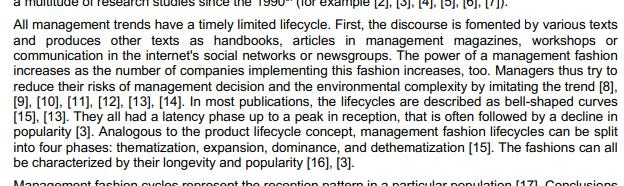
A useful simplification describes four phases in the attention a concept receives: emergence, when a few authors introduce it; growth, as adoption and discussion accelerate; a peak; and decline, when attention falls or the idea is absorbed into others. Real curves are rarely this clean, but the model gives a vocabulary for asking where a concept stands.
- 1Emergence: a concept gains initial attention
- 2Growth: adoption and discussion increase
- 3Peak: attention reaches its highest point
- 4Decline: the concept fades or is absorbed into others
Methods for tracking a concept over time
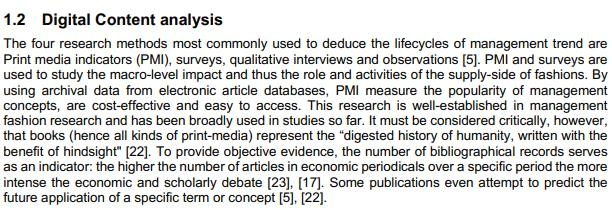
Bibliometric methods offer the main tools. Zupic and Čater (2015) review citation, co-citation, bibliographic coupling, co-author and co-word analysis in management research, and Donthu et al. (2021) give step-by-step guidance for performance analysis and science mapping. For tracking a single concept, three techniques are especially useful.
- Share of publications. Count records mentioning the concept in each year and divide by the total records in that year for the same database and subject categories. Shares remove the effect of overall growth in publishing.
- Pointwise mutual information (PMI). Church and Hanks (1990) introduced an association ratio based on mutual information to measure how strongly two words co-occur compared with chance. In trend work, PMI between a concept term and a time period, or between a concept and related terms, shows when the association is unusually strong.
- Topic models. Latent Dirichlet allocation (Blei et al., 2003) infers topics from word co-occurrence in a corpus, so that a concept can be tracked even when authors use different words for it.
An illustrative design
The following design is illustrative and reports no results. A researcher wants to know whether thesis topics at a business school follow the published literature. She collects all thesis titles from the school's repository for a defined period, and all Web of Science records in the management categories for the same years. For two concepts, such as "balanced scorecard" and "sustainability", she computes each concept's yearly share in both corpora, smooths the series and compares their timing and shape. If thesis interest consistently rises a year or two after the literature, theses are following; if it rises before, they may be signalling practitioner interest that research has yet to catch.
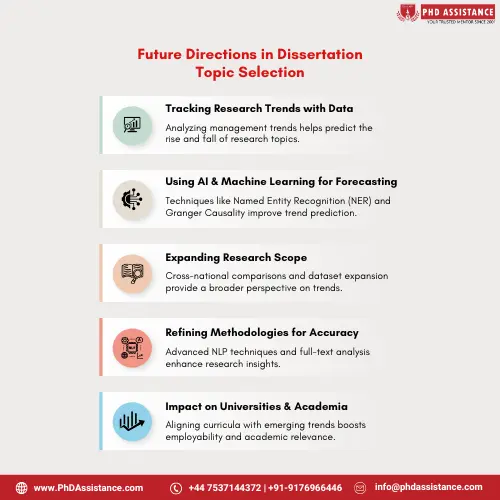
Directions for strengthening trend analyses
Studies of this kind share limitations that suggest clear directions for doctoral projects.
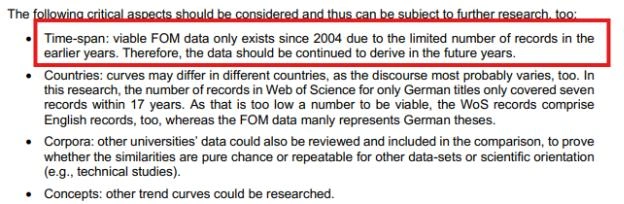
- Extend the period. Ten or fifteen years may capture only part of a lifecycle. Longer series show whether a concept is in decline or merely between peaks.
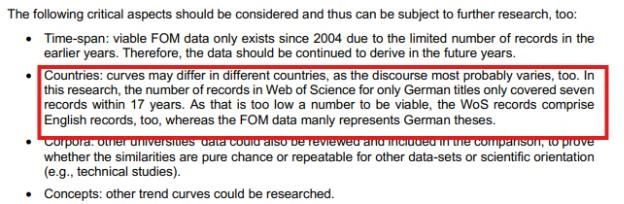
- Compare countries and languages. Theses written in one language and compared with an English-language database may lag or lead for linguistic rather than substantive reasons. Cross-national comparison tests whether trends are global or local.
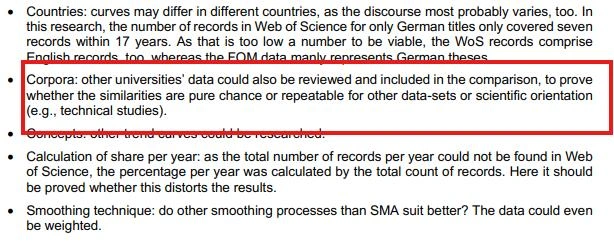
- Include several institutions. One institution's theses reflect its programmes and student body. Including public and private universities, and generalist and specialist schools, tests how far a pattern generalises.
- Test more concepts. Agile management, digital transformation and behavioural economics are candidates for the same analysis.
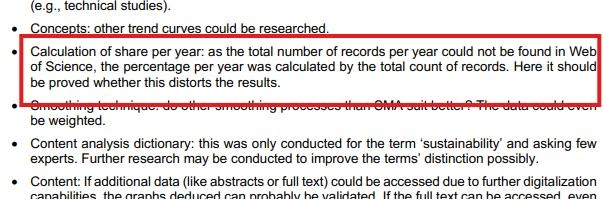
- Measure shares properly. Where the database does not report yearly totals for the relevant categories, the denominator must be constructed carefully and documented.
- Compare smoothing methods. Simple moving averages are easy but lag turning points. Weighted moving averages and exponential smoothing weight recent years more heavily (Hyndman & Athanasopoulos, 2021).
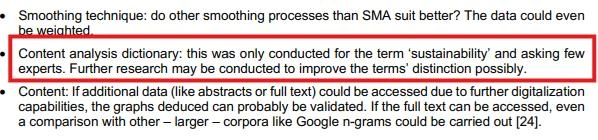
- Automate term identification. Expert coding of which phrases count as the same concept is slow and subjective. Keyphrase extraction, topic models and named entity recognition (for organisations, standards and frameworks) can support it, with expert validation of a sample.
- Use abstracts and full texts. Titles are short and sometimes misleading. Abstracts and full texts give a richer signal, at the cost of more processing.
Bias, testing and what to report
Two sources of bias deserve attention. First, databases classify records into subject categories in their own ways, and changes in classification or coverage can create apparent trends. Second, institutions with particular strengths attract students with matching interests, so a school's theses may reflect its specialisms more than wider management practice.
To ask whether thesis trends lead or follow the literature, researchers sometimes use the test proposed by Granger (1969): one series is said to Granger-cause another if its past values improve prediction of the other beyond the other's own past. The test assumes suitably stationary series and adequate length, and it establishes predictive precedence, not causation. A short annual series of fifteen points gives little power, which is another reason to extend the period.
| Item | What to report |
|---|---|
| Corpora | Sources, coverage, period, subject categories and how theses were obtained |
| Concept definition | Search terms or phrase lists, how variants were grouped and who validated them |
| Measure | Counts, shares or PMI, with the denominator for shares |
| Smoothing | Method and window or smoothing parameter, with unsmoothed series available |
| Comparison | Correlation, lag analysis or Granger tests, with assumptions checked |
| Limitations | Language, institution, classification and coverage biases |
Current research agendas in management
Trend analysis tells you where attention is; peer-reviewed reviews tell you what remains unresolved. Several recent reviews set out agendas relevant to doctoral topics.
- Corporate sustainability. Bansal and Song (2017) show that corporate sustainability and corporate responsibility grew from different traditions, the first from a systems view of business and the natural environment, the second from a normative critique of business conduct, and argue that conflating them obscures distinct questions. A bibliometric analysis of 11,954 articles from 1994 to 2021 found that, as the field grew, its focus on the natural environment diminished, and called for researchers to re-centre environmental problems (Burbano et al., 2024).
- ESG. Gillan et al. (2021) review corporate finance research on environmental, social and governance activity and find conflicting hypotheses and results on how ESG relates to risk, performance and value, leaving clear room for careful empirical work.
- Artificial intelligence. Raisch and Krakowski (2021) argue that automation and augmentation of managerial work by AI are interdependent rather than alternatives, a tension that raises questions about how organisations should design human and machine roles. For human resource management, Budhwar et al. (2023) set out research directions on generative AI, including bias, privacy and ethical risks.
- Digital transformation. From a review of 282 works, Vial (2019) built a framework of digital transformation as a process in which digital technologies create disruptions that trigger strategic responses, and identified dynamic capabilities and ethics as priorities for further research.
Read through the lens of fashion theory, these agendas carry a warning as well as an opportunity. A concept near its peak attracts many studies, so the contribution must come from a sharp question, a new setting or a better method, not from the topic's popularity. A concept past its peak may still offer important questions about long-term implementation and effects.
Implications for choosing a topic and for programmes
For a doctoral researcher, trend evidence is most useful at the start of topic selection, to locate where attention is growing and where debates are unresolved. It then needs to be narrowed into a specific, answerable question with available data, as set out in How to choose a PhD topic. For programme leaders, the same analyses can show whether teaching keeps pace with research and practice, and where students' interests are moving ahead of the curriculum.
Common mistakes
- Choosing a topic because it is fashionable, without identifying a specific unanswered question.
- Reporting raw publication counts instead of shares of the relevant literature.
- Relying on titles alone and missing studies that use different terms for the same concept.
- Smoothing a series heavily and then interpreting the smoothed turning points as exact dates.
- Describing Granger causality results as proof that one trend causes another.
- Generalising from one institution, language or database without testing the pattern elsewhere.
Key takeaways
- Management ideas follow fashion-like lifecycles, and business schools are among the actors that spread them (Abrahamson, 1996; Abrahamson & Fairchild, 1999).
- Shares of publications, pointwise mutual information and topic models can track a concept's lifecycle (Church & Hanks, 1990; Blei et al., 2003).
- Trend analyses are strengthened by longer periods, several institutions and languages, careful denominators and transparent smoothing (Hyndman & Athanasopoulos, 2021).
- Granger tests show predictive precedence between series, not causation (Granger, 1969).
- Recent reviews on sustainability, ESG, AI and digital transformation identify open questions, but a popular area still needs a sharp question (Burbano et al., 2024; Raisch & Krakowski, 2021).