
Why wearable sensor manuscripts need extra care
Wearable inertial sensors, electromyography and pressure insoles now allow movement to be measured outside the gait laboratory, and many biomedical engineering doctorates in the UK build an algorithm, a device or a rehabilitation model on such data. Turning that work into a journal article is difficult for a predictable reason: reviewers are less interested in the novelty of a signal-processing pipeline than in whether the measurement is valid for a defined population and purpose.
The field has learned this the hard way. In a study of wearables in the rehabilitation of people with multiple sclerosis, Daniore et al. (2024) distilled ten lessons on turning sensor data into digital biomarkers, from aligning devices with the research question to linking measures with actionable interventions, and proposed the DACIA framework (data, aggregation, contextualisation, interpretation and actions). A systematic review of 32 studies of wearable sensors with machine learning in rehabilitation training found that inertial measurement units (IMUs) and support vector machines were the most common choices and stroke the most common condition, but that many studies relied on simulated rather than real patients (Wei & Wu, 2023). A manuscript that ignores these weaknesses will struggle in review.
This guide shows how to write your own manuscript to the standard reviewers now expect. For the general process of converting a thesis chapter into a paper, see From thesis to journal manuscript; for the companion guide on AI diagnostic manuscripts, see developing a PhD manuscript in UK healthcare.
What UK-led validation studies have shown
Some of the most detailed evidence on validating wearable gait measurement comes from the Mobilise-D consortium, a European project in which Newcastle University and the University of Sheffield had leading roles. Its studies show what a rigorous validation looks like and what a manuscript needs to report.
Designing the validation
The technical validation protocol, published in advance in BMJ Open, set out laboratory assessments with IMUs followed by 2.5 hours of monitoring in daily life, with a multi-sensor reference system (INDIP) and stereophotogrammetry as comparators, in healthy older adults and people with chronic obstructive pulmonary disease, Parkinson's disease, multiple sclerosis, proximal femoral fracture or congestive heart failure (Mazzà et al., 2021). Publishing the protocol first, and committing to share data and algorithms, are practices a doctoral researcher can adopt on a smaller scale.
Real-world accuracy differs from laboratory accuracy
Using a single lower-back sensor in 108 participants across those six cohorts, Micó-Amigo et al. (2023) compared algorithms for detecting gait sequences and initial contacts and for estimating cadence and stride length. The best algorithms detected gait with sensitivity above 0.73 and accuracy above 0.94 and estimated cadence with relative errors below 8.5 per cent, but stride length was less accurate, and performance fell at walking speeds below 0.5 m/s and in short walking bouts. The authors recommended cohort-specific algorithms for people with severe gait impairment.
A later Newcastle-led analysis of walking speed in 97 participants found mean absolute errors of 0.06 to 0.12 m/s in the laboratory and 0.09 to 0.13 m/s in daily life, with intraclass correlation coefficients (ICCs) from 0.79 to 0.91 in the laboratory but from 0.57 to 0.88 in the real world (Kirk et al., 2024). The lesson for authors is that accuracy is condition-specific and setting-specific, and the manuscript must say which population and context a reported figure applies to.
Feedback systems in rehabilitation
Sensors are also used to deliver therapy. In a clinic-based study of 28 older adults with and without neurological disease, Silva-Batista et al. (2023) combined physical therapy with a system that gives real-time visual feedback on gait metrics from sensors on the wrists, feet and sternum, and reported improvements in gait speed and arm-swing range of motion, but no change in balance confidence. With only six participants in the comparison group, such a study is best reported as a feasibility step, which is how a doctoral manuscript should present a similar design.
Define the publishable unit
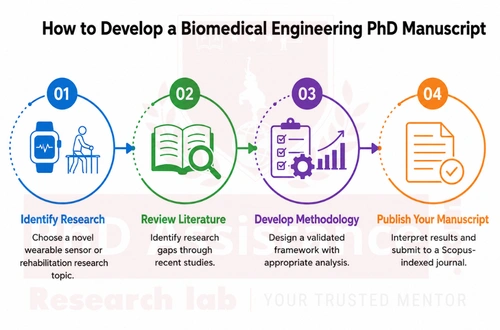
A thesis may contain a sensor validation, an algorithm, a rehabilitation model and a pilot intervention. A journal article usually reports one of these. Before drafting, write three sentences: the clinical or engineering problem, the gap in the evidence, and what your study adds. Then decide which chapter answers them.
- Narrow the literature. Search IEEE Xplore, PubMed, Scopus and Web of Science, but cite only the studies that define your gap, grouped by sensor type, outcome and population, rather than reproducing the thesis review.
- State the gap precisely. Typical gaps are the absence of real-world validation, of validation in a specific clinical population, of slow-walking or short-bout performance, or of evidence linking a measure to a rehabilitation decision.
- Match the contribution to the level of validation. An algorithm checked against a reference system contributes analytical validation; it does not show that the measure improves care.
- Choose the journal early. Read its scope, word limits and policies on reporting checklists, data and code sharing and AI tools before you draft.
Report validation at the right level
The V3 framework gives a vocabulary that reviewers in digital health increasingly use (Goldsack et al., 2020). Naming the level you have reached prevents the most common overstatement in sensor manuscripts.
| Level | Question it answers | Typical evidence in a doctoral study |
|---|---|---|
| Verification | Does the sensor capture raw data accurately and precisely at bench level? | Bench tests against a known signal or calibration rig |
| Analytical validation | Does the algorithm turn sensor data into the intended metric, in people, against a reference? | Comparison with motion capture, an instrumented walkway or a multi-sensor reference such as INDIP |
| Clinical validation | Does the metric identify, measure or predict the clinical or functional state in the intended population and context of use? | Association with clinical scales, discrimination between groups, responsiveness to change |
Choose agreement statistics that answer the question
When a new device is compared with a reference, correlation is not enough, because two methods can be highly correlated and still disagree systematically. Bland and Altman (1986) showed how to estimate the mean difference (bias) and the limits of agreement, and their plot remains the expected presentation. Report absolute or relative errors in the units clinicians use, ICCs with the model and type stated, and confidence intervals throughout. If you developed a prediction model from sensor features, for example to classify recovery, follow TRIPOD+AI (Collins et al., 2024); if you tested an AI-based intervention in a randomised trial, follow CONSORT-AI (Liu et al., 2020).
What to report in a wearable sensor manuscript
The following table maps the usual manuscript sections to the details that reviewers check most often in this field.
| Section | What to report | Why reviewers check it |
|---|---|---|
| Title and abstract | Population, setting (laboratory or daily life), reference system, main error metric with confidence interval | Accuracy depends on population and setting |
| Methods: participants | Inclusion criteria, condition, walking ability, sample size reasoning | Slow or impaired walkers change accuracy |
| Methods: sensors | Device, placement, sampling rate, firmware, synchronisation with the reference | Allows replication and explains error |
| Methods: algorithm | Processing steps, features, model, training and test split by participant | Splitting by window rather than person inflates results |
| Results | Bias and limits of agreement, absolute error, ICC, performance by subgroup and walking speed | Overall figures hide failure in some groups |
| Discussion | Validation level reached, limitations, next step towards clinical use | Prevents overstatement |
| Declarations | Ethics approval, data and code availability, funding, conflicts, authorship, AI-tool use | Required by journals and ICMJE |
Interpret findings against the studies that defined your gap, and say plainly where the device did not work well. A result showing that an algorithm fails below a given walking speed is useful to the field, as the Mobilise-D recommendations on cohort-specific algorithms illustrate (Micó-Amigo et al., 2023).
Ethics, regulation and authorship in the UK
Journals expect the ethics statement to name the approvals that applied. Studies with healthy volunteers may need only university ethics review, but project-based research involving NHS patients in England and Wales normally requires HRA Approval, applied for through the Integrated Research Application System (Health Research Authority, 2026). Check with your sponsor which approvals your study needed and report them accurately.
Biomedical engineers should also be precise about regulatory status. The Medicines and Healthcare products Regulatory Agency states that software, and AI as a subset of it, used for a medical purpose falls within the UK Medical Devices Regulations 2002 (Medicines and Healthcare products Regulatory Agency, 2024). A research prototype is not a marketed device, but describing its intended purpose clearly helps readers judge what further evidence would be needed.
Doctoral papers usually have several authors, including supervisors and clinical collaborators. Base the author list on the ICMJE criteria of substantial contribution, drafting or critical revision, approval of the final version and accountability (International Committee of Medical Journal Editors, 2024), and agree it early. If you used AI tools while writing, follow the journal's policy and disclose the use; AI tools cannot be authors, and the authors remain responsible for the content (Committee on Publication Ethics, 2023).
Worked example: from thesis chapter to manuscript (illustrative)
This example is hypothetical and shows how the steps above fit together.
- Thesis chapter. A doctoral researcher has developed an algorithm that estimates stride length from a shank-worn IMU in people recovering from stroke, tested in a laboratory against motion capture and during two hours of home monitoring against an instrumented insole.
- Publishable unit. She separates the validation from a later chapter on a rehabilitation feedback pilot, so the first paper reports analytical validation only.
- Statistics. Results give bias and limits of agreement, absolute error in centimetres and ICCs with confidence intervals, separately for laboratory and home and for participants walking below and above 0.5 m/s.
- Claims. The abstract states that the study is an analytical validation in a defined population and that clinical validation is the next step.
- Declarations. The ethics statement names the approvals, the code is shared, authorship follows ICMJE criteria, and the use of a grammar tool is disclosed.
Common mistakes
- Reporting laboratory accuracy as if it applied in daily life.
- Using correlation alone to claim agreement with a reference system.
- Splitting data by time window rather than by participant, so the same person appears in training and test sets.
- Pooling participants with very different walking ability and reporting a single overall error.
- Calling analytical validation clinical validation, or implying clinical benefit from a feasibility study.
- Giving a vague ethics statement or leaving authorship and AI-tool disclosure to the final submission step.
The UK companion guides cover related stages: common mistakes in an AI-in-healthcare dissertation, strengthening a proposal in genomics and precision medicine, developing a PhD proposal in UK engineering and reviewing engineering literature with UK examples. For the UK context more broadly, see PhD support in the United Kingdom.
Key takeaways
- Reviewers judge wearable sensor manuscripts mainly on validity for a defined population and purpose (Daniore et al., 2024; Wei & Wu, 2023).
- UK-led Mobilise-D work showed that real-world accuracy is lower than laboratory accuracy and depends on condition and walking speed (Micó-Amigo et al., 2023; Kirk et al., 2024).
- Name the validation level you reached, using the V3 framework, and report agreement with bias and limits of agreement (Goldsack et al., 2020; Bland & Altman, 1986).
- Use TRIPOD+AI or CONSORT-AI where your design calls for them (Collins et al., 2024; Liu et al., 2020).
- State UK approvals and regulatory context accurately, and follow ICMJE and COPE on authorship and AI tools (Health Research Authority, 2026; Medicines and Healthcare products Regulatory Agency, 2024; International Committee of Medical Journal Editors, 2024; Committee on Publication Ethics, 2023).