
Why AI-in-healthcare dissertations go wrong
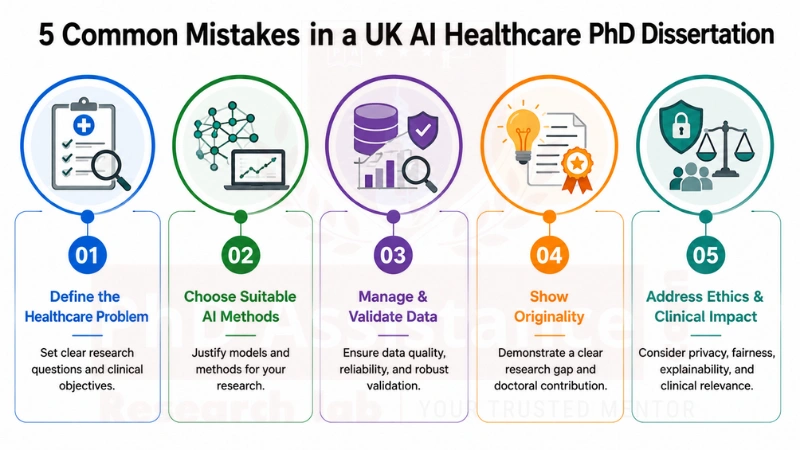
A doctoral dissertation on AI in healthcare is not just a report of a model that works. It has to show a clearly defined healthcare problem, a justified method, careful handling of data, credible validation and a contribution to knowledge. In the UK, examiners are looking for work that is original, makes a contribution to knowledge in the subject and is of publishable quality, defended at an oral examination (Quality Assurance Agency for Higher Education, 2020).
UK doctoral training in this area reflects the same expectations. At the University of Leeds, the UKRI Centre for Doctoral Training in Artificial Intelligence for Medical Diagnosis and Care has each project jointly supervised by AI and clinical researchers and includes training on ethics, responsible research and innovation, and impact (University of Leeds, n.d.). Oxford's Healthcare Data Science CDT, funded by the EPSRC, combines computational statistics, machine learning and data engineering within ethically responsible health research (University of Oxford, n.d.). The five mistakes below are the points at which dissertations most often fall short of that standard.
| Mistake | What examiners look for | How to fix it |
|---|---|---|
| 1. Weak research question | A defined clinical problem and gap | Start from the clinical decision, then justify AI |
| 2. Unjustified AI method | A method suited to the data and question, with baselines | Compare with simple and current methods |
| 3. Poor data handling and validation | Clean, documented data and honest validation | Split by patient, validate externally, report subgroups |
| 4. Unclear originality | An explicit contribution to knowledge | State what is new and compare with existing approaches |
| 5. Ethics and translation ignored | Fairness, privacy, explainability and real-world use | Build them into design and evaluation |
Mistake 1: a weak or poorly defined healthcare research question
The most common problem is starting from a technique rather than a clinical problem. The result may show good technical performance, yet it is unclear why it matters, for whom, or what decision it would change. A strong question names the patient group, the clinical task, the current pathway and the outcome that would improve.
A recent UK study shows the difference. Working with five NHS breast screening services, Kelly et al. (2026) evaluated Google's mammography AI system retrospectively on 115,973 mammograms and then deployed it prospectively at 12 screening sites. The question was defined by the screening pathway: could AI perform as well as the first human reader, fairly across groups, and work in practice? A companion study asked a different pathway question, whether AI could replace the second reader when arbitration is included (Warren et al., 2026).
- Define a focused healthcare problem and the decision it affects.
- Identify a specific gap in the evidence, not only in the algorithms.
- Write research questions or hypotheses that can be tested with your data.
- Explain why AI is a suitable approach for this problem.
Mistake 2: an inappropriate or unjustified AI method
A second weakness is choosing a model without explaining why it suits the question and the dataset. Examiners will ask why a deep network was needed, how it compares with a simpler model and with current practice, and how hyperparameters were chosen. A good accuracy figure does not answer those questions.
Evidence from UK reviews shows why. In a meta-analysis of deep learning in medical imaging, Liu et al. (2019) found that only 25 of 82 included studies reported external validation and only 14 compared the model with health professionals on the same sample. Reviewing deep learning studies that claimed to rival clinicians, Nagendran et al. (2020) found that most non-randomised studies were at high risk of bias, while many abstracts still claimed comparable or better performance.
- Select methods suited to the problem, data size and data type.
- Include meaningful baselines, such as logistic regression or the current clinical score.
- Document model development and evaluation so that it can be reproduced.
- If you develop a prediction model, use TRIPOD+AI as a checklist for the methods chapter (Collins et al., 2024).
Mistake 3: poor data management and validation
Healthcare data contain gaps, measurement error, bias and limited representativeness. Even an advanced model can mislead if these are not handled. A University of Cambridge-led review of 62 studies that used machine learning to detect or prognosticate COVID-19 from chest images found none of potential clinical use, citing problems such as poorly documented model selection and preprocessing, insufficient detail on training, and a lack of external validation (Roberts et al., 2021).
Data leakage is a frequent hidden cause of inflated results. Kapoor and Narayanan (2023) identified leakage in 294 papers across 17 fields and described eight types, from preprocessing on the full dataset before splitting to using information that would not be available at prediction time. In clinical data, a typical case is splitting by image or visit rather than by patient.
- Describe data sources, dates, inclusion criteria and how labels were obtained.
- Report missing data and how you handled them.
- Split by patient, and keep the test set untouched until the end.
- Seek external validation, and report performance by relevant subgroups.
Mistake 4: limited originality or healthcare contribution
Originality is hard to establish when an established algorithm is simply applied to a new dataset without an account of what new knowledge results. The UK framework allows originality through original research or the original application of existing knowledge (Quality Assurance Agency for Higher Education, 2020), but the thesis has to make that case explicitly.
In healthcare AI, a contribution can take several forms: a new method, a new application with evidence of value, a more rigorous evaluation, new clinical understanding or new knowledge about implementation. The breast screening studies above, for example, contribute evidence about fairness and workflow as well as accuracy (Kelly et al., 2026; Warren et al., 2026).
A useful test is to imagine the examiner asking, at the viva, what the field knows now that it did not know before your thesis. If the only answer is a slightly higher accuracy on a public dataset, the contribution is thin. If the answer includes why the model works or fails, for which patients, and what that means for a clinical pathway, it is much stronger.
- Summarise what is already known and the unresolved gap.
- State the original contribution in one or two sentences in the introduction and conclusion.
- Compare your findings directly with existing approaches.
- Explain the scientific and healthcare significance, and its limits.
Mistake 5: ignoring ethics, explainability and clinical translation
Healthcare AI uses sensitive data and may influence clinical decisions, so concentrating only on model performance leaves out privacy, fairness, transparency, safety and deployment. Kelly et al. (2026) analysed performance by age, deprivation, ethnicity and breast density, and during the prospective phase identified a distribution shift that required the operating threshold to be recalibrated. Both are the kind of analysis an examiner will look for.
Implementation is the second half of this mistake. In TRICORDER, a cluster-randomised implementation trial of an AI-enabled stethoscope across 205 NHS general practices, the intention-to-treat analysis did not show higher overall detection of heart failure, although detection was higher among patients actually examined with the device, and usage fell over time as clinicians met workflow and record-system barriers (Kelshiker et al., 2026). Good model performance does not by itself mean successful implementation.
If your project includes an early live evaluation of a decision-support tool, DECIDE-AI sets out what to report, including human factors (Vasey et al., 2022). Studies involving NHS patients in England and Wales normally need HRA Approval, so plan for it early (Health Research Authority, 2026).
What the UK examples show, and a quick self-check
Taken together, the UK programmes and studies above suggest that strong doctoral research on AI in healthcare shows clinical relevance, technical rigour, reliable and validated data, a clear original contribution and responsible use of AI throughout. Before submission, ask yourself:
- Is my healthcare research question clearly defined, and does it name a clinical decision?
- Is my AI method appropriate, justified and compared with sensible baselines?
- Are my data and validation procedures reliable, free of leakage and reported by subgroup?
- Have I stated a clear gap and an original contribution?
- Have I addressed ethics, privacy, fairness, explainability and how the tool would be used in practice?
Worked example (illustrative)
A hypothetical doctoral researcher has trained a model to predict hospital readmission from NHS records. Her first draft reports a high area under the curve. Applying the checks, she reframes the question around discharge planning on one ward type, adds logistic regression and the existing risk score as baselines, re-splits the data by patient after finding repeat admissions in both sets, reports calibration and performance by age and deprivation, and adds a chapter on how ward staff would act on the prediction. The headline accuracy falls, but the thesis now answers the questions an examiner will ask.
Frequently asked questions
What are the most common mistakes in an AI healthcare PhD dissertation?
Unclear research questions, unjustified AI methods, poor data management, weak validation and limited originality, together with neglect of ethics, explainability, reproducibility and clinical relevance.
How can I avoid them?
Define a clear healthcare problem, justify the method against baselines, use reliable and well-validated data, and treat ethics, reproducibility and implementation as part of the research design.
What general mistakes should I avoid in any PhD dissertation?
Weak research gaps, conclusions that go beyond the evidence, inadequate statistical analysis, poor documentation and insufficient validation. Each chapter should make clear how it supports the original contribution claimed in the introduction.
How can I improve a draft that is already written?
Return to the research question first and check that every chapter serves it. Then strengthen the methods justification, re-examine the data pipeline for leakage, add baselines or subgroup results where they are missing, and rewrite the contribution so that it states plainly what is new, for whom it matters and what its limits are. Discuss the revision plan with your supervisors before you start, because changes to the analysis can affect several chapters at once.
What research problems are typical in this field?
Poor-quality data, dataset bias, limited generalisability, inappropriate model selection and weak clinical validation, along with challenges of privacy, explainability and translation into practice.
When you are ready to publish from the thesis, see the UK companion guides on developing a PhD manuscript in UK healthcare and developing a manuscript in UK biomedical engineering. For earlier stages, see strengthening a proposal in genomics and precision medicine and fixing a flawed methodology in cybersecurity research, and for the UK context more broadly, PhD support in the United Kingdom.
Key takeaways
- UK doctorates require an original contribution of publishable quality, so accuracy alone does not make a thesis (Quality Assurance Agency for Higher Education, 2020).
- Frame the question around a clinical decision, as the NHS breast screening studies did (Kelly et al., 2026; Warren et al., 2026).
- Justify the method against baselines and validate externally; reviews found these steps often missing (Liu et al., 2019; Nagendran et al., 2020; Roberts et al., 2021).
- Prevent data leakage by splitting by patient and documenting every preprocessing step (Kapoor & Narayanan, 2023).
- Treat fairness and implementation as research questions; real-world benefit depends on use in practice (Kelshiker et al., 2026; Vasey et al., 2022).