
How to Strengthen a PhD Research Proposal in UK Life Sciences: Addressing Research Gaps in Genomics and Precision Medicine
Sustainable Practices in Environmental Science
- Step 1: Understand the Scope of FinTech Adoption and Digital Banking Research
- Step 2: Conduct a Systematic Literature Search
- Step 3: Identify Research Gaps in FinTech Adoption
- Step 4: Critically Evaluate Digital Banking Frameworks
- Step 5: Organise Literature into Themes
- Strategies for Effective Literature Review
- Conclusion

Recent Post
Introduction
In recent years, the UK has made great progress in the field of life sciences with regard to genomic medicine, precision medicine, and translational healthcare. Programs like the Genomic Medicine Service by the NHS and Genomics England have helped broaden the scope of whole-genome sequencing to aid in diagnosis and personalised treatment plans. Considering growing competition in the realm of doctoral research, it is necessary to propose an innovative idea.
The latest studies reveal the rising significance of genomics in healthcare. For instance, a study conducted in Nature Medicine in 2023 used the combination of whole-genome sequencing and clinical information to discover genomic alterations relevant for patient outcomes and prove the importance of genomic studies for the progress of precision oncology and personalised medicine (Sosinsky et al.,2024).
However, there is a problem with how many scientists fail to discover valuable Gaps in Genomics, create proper research goals and explain their scientific contribution. Professional PhD Research Proposal Support in UK will help you compose an efficient proposal corresponding to recent advancements in UK Life Sciences Proposal development.
What you will learn?
Step 1: Identify Research Problems in Genomics and Precision Medicine
Identifying a relevant research problem comes first in creating a good PhD Research Proposal in the UK. In life sciences, contemporary research is concentrated on genomic medicine, precision medicine, multi-omics, diagnostics for rare diseases, and personalised health care. A clear research problem should be important and meet the needs that have not been addressed previously but show relevance to contemporary healthcare.
Scientists should review the most recent articles published in scientific peer-reviewed journals and the most pressing issues in clinical practice and UK science and research projects to find the problem. Choosing a problem of practical and scientific importance helps make the proposal more unique and valuable. Many scientists want to get UK Life Sciences Research Proposal help.
What Research shows:
Findings by Sosinsky et al. (2024) on the 100,000 Genomes Project showed how the whole-genome sequencing approach helped diagnose rare conditions and the problems associated with interpreting rare genetic variants. The journal provided suggestions for further study and hence gave direction for doctoral research.
Tips
Step 2: Conduct Literature Review and Research Gap Analysis
A good research proposal entails more than just summarising past studies. Researchers need to analyse the evidence that has been found before, compare methodologies, detect conflicting results, and define the weaknesses of the available knowledge. Such an approach will help researchers to identify Research Gaps in Genomics and to explain the necessity of conducting their study.
These gaps may include methodological weaknesses, unrepresented groups, new technology, or undetermined mechanisms. A critical literature review is a sign of academic professionalism and the basis for formulating research objectives.
What Research shows:
As shown by Martin et al. (2019), most of the polygenic risk prediction models have been constructed based on individuals of European ancestry, which makes their applicability in a heterogeneous population clinically impractical. The key focus area highlighted by the authors is genomic diversity.
Tips
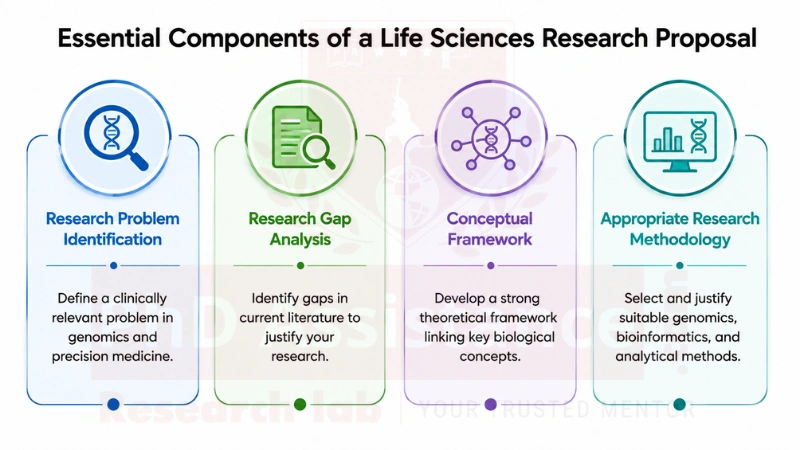
Step 3: Develop Conceptual Frameworks for Precision Medicine Research
A good proposal should provide a proper conceptual and theoretical framework of the relationship between research variables. In the field of life sciences, frameworks usually incorporate genomics, molecular biology, bioinformatics, systems biology, and clinical decision-making to explore the nature of diseases and their treatment.
The development of such a framework enhances the research hypothesis and clarifies why the proposed research is valuable in contributing to science. The Precision Medicine Research Proposal writers should justify why the proposed concepts are related to the proposed research.
What Research shows:
Integration of genomics, transcriptomics, proteomics, and metabolomics gives us a well-rounded understanding of the progression of the disease, thus allowing for better personalised treatment options. The study conducted by Hasin et al. (2024) proves the importance of incorporating multi-omics in precision medicine studies.
Tips
Step 4: Select Appropriate Research Methodologies and Analytical Techniques
A methodology will have to be chosen to ensure the validity of results. The methodologies that could be chosen by life scientists for different purposes are whole-genome sequencing, GWAS, functional studies with the help of CRISPR technology, bioinformatics, machine learning, and omics integration.
The methods chosen should be justified based on data, ethics, statistical validity, and reproducibility. A well-defined methodology adds more value to the proposal from a scientific perspective.
What Research shows:
Kourou et al. (2015) illustrated that with machine learning techniques, it is possible to make accurate predictions for cancer prognosis using both genomic and clinical information, indicating the usefulness of artificial intelligence in disease prediction.
Tips
Step 5: Define Research Contributions and Proposal Significance
This step entails providing an overview of how the research will contribute to the existing body of knowledge. The researcher ought to explain the contribution of their research based on its theory, methodology, clinical and policy implications, as well as its uniqueness.
A competitive PhD Research Proposal for Genomics should include an explanation on how the research outcomes can be used to diagnose diseases better, to enhance precision medicine, impact health care policies or genomic technology.
What Research shows:
According to The Genomics England Research Consortium (2023), there is an improvement in diagnoses and personalisation of medicine through the incorporation of genomic sequencing in daily clinical practice. Nevertheless, this study revealed gaps in genomic interpretation systems, providing future paths for doctoral studies.
Tips
Strategies for Writing a Strong Life Sciences Research Proposal
Conclusion
Recent developments in genomic and precision medicine have kept reshaping the landscape of scientific studies in the United Kingdom. Crafting an effective research proposal necessitates that researchers can determine important issues in scientific research, conduct a critical analysis of the available literature, determine research gaps and choose a suitable methodology. A theoretical framework combined with proper design improves the originality and academic value of the research proposal.
You can write a high-quality research proposal by using a structured method and addressing emerging issues critically. This structure ensures standards, methodology, and academic rigour in your UK Life Sciences Research Proposal.
Are you facing multiple rejections in a PhD research proposal? Consult experts from PhD Assistance Research Lab to get clarity and ensure proposal approval from supervisors.
References
- Sosinsky, A., Jones, W., Ashmore, R., et al. (2024). Insights for precision oncology from the integration of genomic and clinical data of 13,880 tumors from the 100,000 Genomes Project. Nature Medicine, 30, 181–191. https://doi.org/10.1038/s41591-023-02682-0
- Hasin, Y., Seldin, M., & Lusis, A. (2017). Multi-omics approaches to disease. Genome Biology, 18(1), 83. https://doi.org/10.1186/s13059-017-1215-1
- Kourou, K., Exarchos, T. P., Exarchos, K. P., Karamouzis, M. V., & Fotiadis, D. I. (2015). Machine learning applications in cancer prognosis and prediction. Computational and Structural Biotechnology Journal, 13, 8–17. https://doi.org/10.1016/j.csbj.2014.11.005
- Manolio, T. A., et al. (2024). Genomic medicine year in review: 2024. American Journal of Human Genetics, 111(12). https://pubmed.ncbi.nlm.nih.gov/39642866/
- Martin, A. R., Kanai, M., Kamatani, Y., Okada, Y., Neale, B. M., & Daly, M. J. (2019). Clinical use of current polygenic risk scores may exacerbate health disparities. Nature Genetics, 51(4), 584–591. https://doi.org/10.1038/s41588-019-0379-x
- Genomics England – National Genomic Research Library. (2024). National Genomic Research Library..