
What a UK engineering proposal has to show
A doctoral proposal in the United Kingdom is a short argument that a particular question is worth three to four years of work and that you can answer it. The national description of doctoral study sets the bar: doctoral graduates are expected to create and interpret new knowledge through original research of a quality that satisfies peer review, and to understand the techniques for research and advanced academic enquiry in their field (QAA, 2020). Your proposal should therefore show three things clearly: a specific problem, a credible route to an original contribution, and a method that a supervisor can recognise as feasible.
Engineering proposals that involve industrial data carry an extra expectation. UK research councils expect publicly funded research data to be managed and, where possible, shared (EPSRC, 2022). A proposal that relies on a company's production data should therefore say who owns the data, what can be published and how the data will be stored. Supervisors read these details as evidence that you understand the practical conditions of the project, not as administrative afterthoughts.
This guide uses three linked technologies, smart manufacturing, digital twins and agentic AI, because they are common in current engineering proposals and because each is easy to describe vaguely. The aim is to help you write about them precisely. For reviewing the literature in a UK engineering thesis, see How to conduct an engineering literature review in the UK.
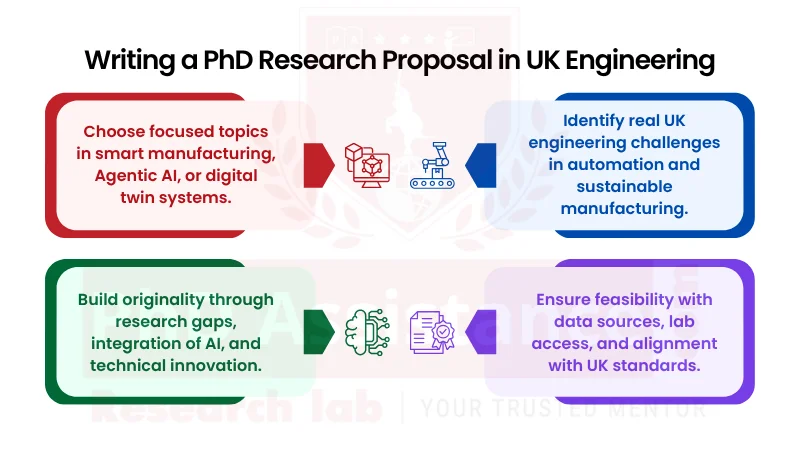
How UK researchers have framed digital twins and agents
A strong proposal positions itself against specific work. UK groups have contributed several of the reference points that engineering reviewers expect to see, and their findings show where the open problems lie.
Characterising the digital twin at Bristol
At the University of Bristol, Jones et al. (2020) carried out a systematic literature review of 92 digital twin publications. They identified 13 characteristics, including the physical and virtual entities, their environments, state, metrology and the connections between them, and seven knowledge gaps: perceived benefits, the twin across the product life cycle, use cases, technical implementations, levels of fidelity, data ownership and integration between virtual entities. Each of these gaps is a potential starting point for a proposal, provided you narrow it to a specific system.
Model or twin: the National Physical Laboratory view
Writing from the UK National Physical Laboratory, Wright and Davidson (2020) argued that the term "digital twin" is applied so inconsistently that it risks being dismissed as hype. They set out how a twin differs from a model and listed open questions about the volume and speed of data, its reliability, the treatment of uncertainty and the dynamic updating of the model. These are measurement and validation questions, which makes them well suited to doctoral research.
Principles and case studies from Cambridge
The Centre for Digital Built Britain at the University of Cambridge published the Gemini Principles to guide national digital twins, grouping nine principles under purpose, trust and function (Bolton et al., 2018). Cambridge researchers also reported the development of a digital twin at building and city levels for the West Cambridge campus (Lu et al., 2020). Although these come from the built environment rather than the factory, they show the questions about data quality, security and federation that any industrial twin must answer.
Agents before "agentic AI"
The idea of software that acts autonomously towards goals is older than the current term. In a widely cited review, UK authors Wooldridge and Jennings (1995) described agents by their autonomy, social ability, reactivity and pro-activeness. We found no body of UK peer-reviewed studies on "agentic AI" in manufacturing in preparing this guide, so a proposal in this area should be honest that the term is new and should connect it to this established agent literature.
Choosing a problem in smart manufacturing
Smart manufacturing describes production systems in which data from machines, products and people are collected, analysed and used to make decisions across the product life cycle (Tao et al., 2018). Architectures such as the five-level cyber-physical systems model of Lee et al. (2015) help you say where in that chain your work sits: connection and data conversion, the cyber layer, cognition or configuration. A broad aim such as "apply AI to manufacturing" does not survive this test; a question about one decision at one level does.
Good problems usually have four features. They concern a decision that matters to a real process, such as scheduling, quality inspection or maintenance. They have measurable outcomes, such as throughput, scrap rate or energy use. They can be studied with data, equipment or simulation you can actually obtain. And they connect to a gap stated in the literature, such as the fidelity, ownership or integration gaps identified by Jones et al. (2020). For a general method of testing candidate topics, see PhD topic selection and research gap identification.
Writing about digital twins precisely
The most common weakness in engineering proposals is calling every simulation a digital twin. Kritzinger et al. (2018) offer a simple test based on how data flow between the physical and digital objects. The US National Academies similarly treat a two-way exchange of data with a physical counterpart, together with verification, validation and uncertainty quantification, as central to the concept (National Academies of Sciences, Engineering, and Medicine, 2024).
| Level | Physical to digital data flow | Digital to physical data flow | What a proposal should say |
|---|---|---|---|
| Digital model | Manual | Manual | A simulation or model used offline; state how it is validated |
| Digital shadow | Automatic | Manual | Live data update the model, but decisions are applied by people |
| Digital twin | Automatic | Automatic | Two-way link; state how updates, latency and safety are handled |
Use the table to decide which level your project needs. Many excellent doctorates build a validated digital model or shadow; there is no need to claim a full twin. What matters is that the claim matches the architecture and that you explain how the model is kept consistent with the physical system, which is exactly the open question raised by Wright and Davidson (2020).
Defining agentic AI so it can be tested
If your proposal uses agentic AI, for example a software agent that plans production changes and calls tools such as a scheduler or a simulation, define it in terms that can be measured. State the agent's goal, the decisions it may take without human approval, the information and tools it can use, and the constraints it must respect. The classic properties described by Wooldridge and Jennings (1995) give a useful checklist: what autonomy the agent has, how it interacts with people and other systems, how it responds to changes on the shop floor and how it pursues goals.
Then say how you will evaluate it. The safest place to test an autonomous decision-maker is the digital model or shadow, before any decision reaches real equipment. Name the baseline (for example, the current scheduling rule), the metrics and the scenarios, including disturbances such as machine breakdowns. This turns a fashionable term into a testable research design.
Building the methodology and the rest of the proposal
The methodology section is where reviewers decide whether the project is feasible. For a project combining digital twins and AI, it normally includes the system boundary, the data sources and how they will be accessed, the modelling approach, the AI method, the validation plan and the ethical and data management arrangements. The table below summarises what each part of the proposal should contain.
| Section | What to include | Question a UK reviewer will ask |
|---|---|---|
| Title and aim | One system, one decision, one outcome | Is the scope clear and doctoral in size? |
| Background and gap | Key studies, including UK work, and the specific gap | Is the contribution original? |
| Research questions | Two to four answerable questions | Can each be answered with the planned method? |
| Methodology | System boundary, data, model level (model, shadow or twin), AI method, baselines | Is it feasible and rigorous? |
| Validation | Test cases, metrics, uncertainty treatment, comparison with plant or rig data | How will we know the results are right? |
| Data and ethics | Ownership, confidentiality, storage and sharing | Can the data be used and published? |
| Timeline and risks | Year-by-year plan with fallbacks if data or access fail | Can this be finished in time? |
Keep the timeline honest. A typical plan uses the first year for the literature review, the system definition and a first model; the second for the AI method and validation on simulated data; and the final period for validation against physical data and writing. Add a fallback for each major risk: if plant data are delayed, for instance, the method can be developed on a published dataset or a laboratory rig.
On positioning, look at the current priorities of the funder you are applying to and say briefly how your project relates to them, without inflating its importance. A sentence that names the industrial problem and the beneficiaries is more persuasive than a paragraph of policy language.
Worked example: an automotive assembly line (illustrative)
This example is hypothetical and is given only to show how the steps fit together.
- Starting idea. "Use agentic AI and digital twins to improve car manufacturing." This is a topic area, not a question.
- Narrowing. The researcher focuses on one decision: re-sequencing jobs on a body-in-white welding line when a robot cell stops unexpectedly.
- Model level. Live machine-status data will update a discrete-event simulation, but changes will be approved by a supervisor on the line. In the terms of Kritzinger et al. this is a digital shadow, and the proposal says so.
- Agent definition. The agent's goal is to minimise lost throughput; it may propose a new sequence and test it in the simulation, but may not act on equipment.
- Gap. Integration between virtual entities, one of the gaps identified by Jones et al., framed as coupling a planning agent with a validated line model.
- Evaluation. Compare the agent with the current dispatching rule over historical breakdown scenarios, reporting throughput, recovery time and the share of proposals accepted by line supervisors.
- Feasibility. A data-sharing agreement with the plant is confirmed before submission, and a public scheduling benchmark is named as the fallback.
Common mistakes
- Calling a simulation a digital twin without a two-way data link.
- Using "agentic AI" as a label without defining the agent's goals, autonomy and limits.
- Choosing a whole factory as the system instead of one process and one decision.
- Leaving data access, ownership and confidentiality unresolved.
- Describing technologies at length but giving little detail on validation and uncertainty.
- Citing only global reviews and ignoring the work of the UK groups closest to the topic.
- Promising industrial deployment that a doctoral project cannot deliver or test safely.
- Writing research questions that the planned method cannot answer.
Once the proposal is accepted, the same discipline carries into the literature review and, later, into journal articles. The companion UK pages show these stages in other fields: writing a literature review in UK economics and developing a manuscript in UK healthcare. For the UK context more broadly, see PhD support in the United Kingdom.
Key takeaways
- A UK doctoral proposal must show a specific problem, an original contribution and a feasible method (QAA, 2020).
- Decide whether your project needs a digital model, shadow or twin, and describe it accordingly (Kritzinger et al., 2018; National Academies of Sciences, Engineering, and Medicine, 2024).
- UK work identifies fidelity, data ownership, integration and uncertainty as open problems for digital twins (Jones et al., 2020; Wright & Davidson, 2020).
- Define agentic AI by its goals, autonomy and tools, drawing on established agent theory (Wooldridge & Jennings, 1995).
- Plan data access, management and validation in the proposal, not after the PhD has started (EPSRC, 2022).