
How to Conduct an Engineering Literature Review: Integrating Multiphysics Simulation Studies in the UK
- Home
- Academy
- Literature Review
- How to Conduct an Engineering Literature Review: Integrating Multiphysics Simulation Studies in the UK
Sustainable Practices in Environmental Science
- Understand UK Academic Expectations
- Define Your Research Scope and Objectives
- Search and Select Relevant Literature
- Analyse and Synthesise Multiphysics Studies
- Integrate Multiphysics Simulation Approaches
- Structure Your Literature Review Effectively
- Highlight Research Gaps and Future Scope
- Conclusion

Recent Post
Introduction
The engineering research process needs high-quality literature reviews as an essential requirement that researchers studying Multiphysics simulations in the UK must follow. A comprehensive literature review studies previous research work while showing a complete understanding of existing knowledge and connecting results from different engineering disciplines, which include thermal, structural and fluid systems. The process enables researchers to develop their theoretical framework while they discover research areas that validate their study. Researchers choose engineering literature review services in UK that need academic standards and technical expertise to be achieved. The research quality of a study improves through a well-developed literature review, which also increases its chances of being published.
Understand UK Academic Expectations
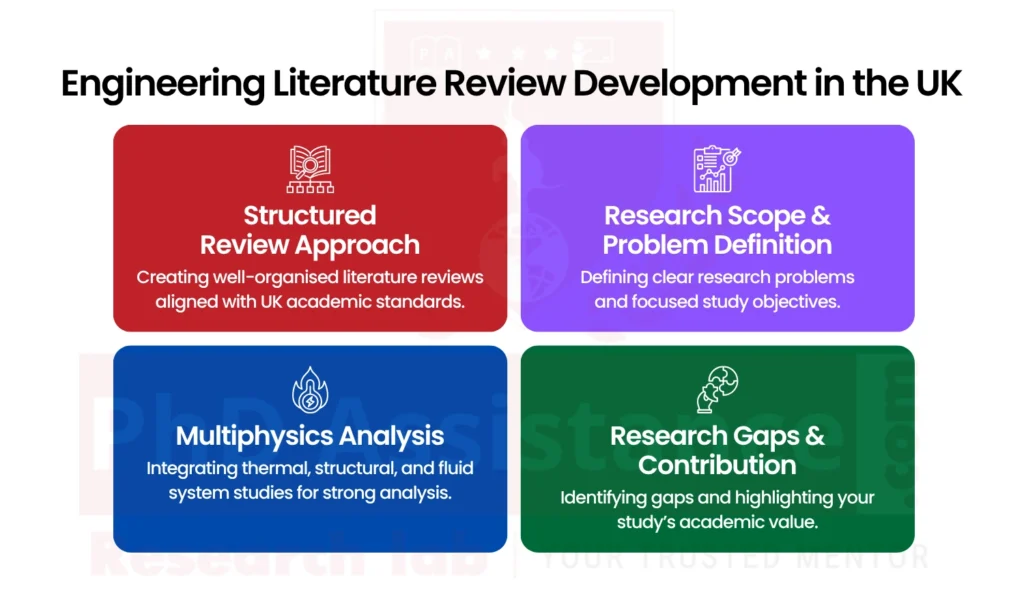
The academic requirements of UK universities require students to develop critical thinking abilities and structured writing skills, and establish solid theoretical foundations for their research work. A literature review needs to show analytical depth beyond simply summarising existing research. Researchers need to evaluate previous research work while comparing different research methods and identifying the existing research work’s inconsistencies and limitations. The research study needs to identify specific research gaps since this demonstrates how the research study will advance knowledge in the relevant academic field. The research needs to demonstrate how theoretical research can be applied to engineering work that combines multiple physics fields through its simulation research.
Many scholars find it challenging to meet these expectations without proper guidance, which is why engineering literature review help UK is often sought. The researchers receive support that helps them meet institutional requirements and international publication standards, while their literature review shows both academic rigour and practical relevance to engineering problems.
Define Your Research Scope and Objectives
The literature review process requires researchers to establish specific research boundaries together with their research goals. Researchers must first identify the specific engineering problem they intend to address, such as fluid-structure interaction, heat transfer analysis, or coupled Multiphysics systems. The literature review process requires an exact problem definition, which enables researchers to maintain their focus while avoiding unrelated material.
The problem identification process leads to the creation of Multiphysics simulation limits. The study requires researchers to define which physical phenomena they will investigate and how those phenomena interact within the studied system. Researchers can use computational fluid dynamics together with thermal analysis to study cooling efficiency in engineering systems. The study requires researchers to establish research objectives that will help track study progress and measure study success.
For doctoral researchers, this step is particularly important because a well-defined scope lays the foundation for the entire research project. Many scholars, therefore, use PhD engineering literature review UK support to improve their research focus while maintaining accordance with present academic and industrial standards.
Search and Select Relevant Literature
The search process for relevant literature needs to operate through established procedures that combine both systematic and strategic methods. Researchers should access high-quality peer-reviewed studies through academic databases, which include Scopus, Web of Science and IEEE Xplore as their primary sources of information. The most recent research publications should receive priority because they show the current advancements in Multiphysics simulation and engineering research.
Researchers find the engineering research literature review UK guidance to be useful because it helps them efficiently find relevant sources while bypassing information overload, which comes from the huge amount of available research material. The review achieves its highest quality through the selection of well-selected literature.
Analyse and Synthesise Multiphysics Studies
The process of conducting a literature review requires researchers to conduct more than research on their studies because they must read and evaluate all relevant research material until they create a unified narrative. Researchers need to assess the various simulation models, which include different methodologies and computational methods that past studies employed. Through their work, they create a complete field understanding by showing how things connect and differ from each other.
Researchers can use information synthesis to gather knowledge from different studies and present their findings in an organised format. The process becomes difficult because Multiphysics simulation requires complex engineering literature review writing services UK to help researchers create clear and consistent assessments of their work.
Example:
Study: Zienkiewicz, O. C., Taylor, R. L., & Zhu, J. Z. (2013)
Zienkiewicz et al. (2013) present the basic structure that researchers apply to their Multiphysics simulations through their finite element analysis (FEA) framework. The research demonstrates that engineers can resolve engineering problems through numerical methods, which divide physical systems into smaller components. The study demonstrates that engineers need to combine different physical domains into one computational framework because this method enables them to accurately model actual engineering systems. The research approach needs to examine both heat transfer and structural stress because these two phenomena require simultaneous study in Multiphysics research.
Integrate Multiphysics Simulation Approaches
The process of engineering literature reviews in this field requires researchers to integrate Multiphysics simulation methods. Researchers must explain how different physical systems interact and influence each other within a given problem. The interaction between fluid flow and heat transfer creates an effect that then impacts the structural performance. The development of accurate, reliable models requires understanding these interactions.
Researchers need to explain their theoretical research findings by describing the computational tools and software that they use for Multiphysics simulations. The research study uses these tools to assess their effectiveness, along with their benefits and their restrictions, thus delivering useful findings about current research methods.
Example:
Study: Quarteroni, A., & Valli, A. (2008)
Quarteroni and Valli (2008) explore numerical methods for solving partial differential equations (PDEs), which form the core of Multiphysics simulations. The researchers present their findings about using coupled PDE systems to model interactions that occur between fluid flow, heat transfer and structural mechanics. The study shows how computational methods help researchers model complex physical behaviours, while multiple simulation techniques must be integrated for accurate results. This research establishes fundamental theoretical concepts that engineers use to create sophisticated Multiphysics models that power contemporary industrial applications.
Structure Your Literature Review Effectively
The literature review needs proper organisation because it helps readers understand the content better while maintaining logical flow between ideas. The researchers need to divide their review into distinct sections that begin with an introductory section, which explains background details about the research subject. The study should present its research findings through thematic or methodological analysis, which organises existing studies according to their shared research methods and investigation themes.
The next section needs to perform a critical analysis that evaluates research studies through their strengths and weaknesses. The review needs to show existing research gaps while providing directions for future research. The content becomes simpler to comprehend through a logical structure, which also improves the strength of the entire argument.
The engineering literature review services of UK researchers enable them to improve their work presentation through better organization which ensures their academic work meets publication standards.
Highlight Research Gaps and Future Scope
Researchers need to assess current research studies to discover which research areas still need complete investigation. The research may encounter three specific challenges, which include simulation model limitations and missing experimental validation and real-world environment components, which remain insufficiently addressed.
The research gaps become evident through the researcher’s gap identification process, which helps them establish the study’s importance. The researchers advance their work through gap connections, which lead to their research objectives. The research process demonstrates uniqueness through this step, while it proves that the research contributes new information to existing knowledge.
Conclusion
The process of conducting an effective engineering literature review needs three essential components, which include critical thinking skills, technical knowledge and organised writing abilities. The researchers produce complete and valuable assessments through their research work because they combine Multiphysics simulation studies with UK academic standards.
The research process depends on eight steps, which start with establishing the research boundaries and end with the identification of research gaps through complex study synthesis. The engineering literature review services in the UK provide scholars with essential support that helps them produce work with improved quality and better clarity, which leads to successful outcomes that drive progress in engineering research and innovation.
If you are working on an engineering literature review in the UK and need help with structuring or integrating Multiphysics simulation studies, experts at PhD Assistance can support you in developing a well-organised, high-quality review that meets academic standards.
References
- Zienkiewicz, O. C., Taylor, R. L., & Zhu, J. Z. (2013). The finite element method: Its basis and fundamentals (7th ed.). Elsevier. https://www.researchgate.net/profile
- Quarteroni, A., & Valli, A. (2008). Numerical approximation of partial differential equations. Springer. https://link.springer.com/book/10.1007