
The source and why it matters
The paper under review is Kumar et al. (2026), "Stress among research scholars: causes, coping strategies and implications for policy reform", published in Annals of Neurosciences (volume 33, issue 1, pages 123 to 130). It first appeared online in March 2025 and is open access. The four authors are based at universities in Himachal Pradesh and Haryana, India, in biotechnology and medical biotechnology departments, and they declare no conflicts of interest and no funding.
The topic is important. In a large survey of PhD students in Flanders, Levecque et al. (2017) found that about a third were at risk of having or developing a common psychiatric disorder, and linked that risk to work organisation, including job demands, supervisory style and career prospects. A widely discussed online survey reported high rates of anxiety and depression among graduate students (Evans et al., 2018), and a meta-analysis of studies using validated scales estimated that 24% of PhD students had depression and 17% had anxiety (Satinsky et al., 2021). Against this background, a concise synthesis that also proposes institutional action is potentially useful to universities, supervisors and doctoral researchers.
What the paper says
The article is a review. Its method is stated in one sentence: a literature search of Google Scholar and PubMed that included original research and review articles published in English (Kumar et al., 2026). It is organised in sections on the causes of stress, its consequences, the physiology of the stress response, coping strategies and policy implications.
Causes
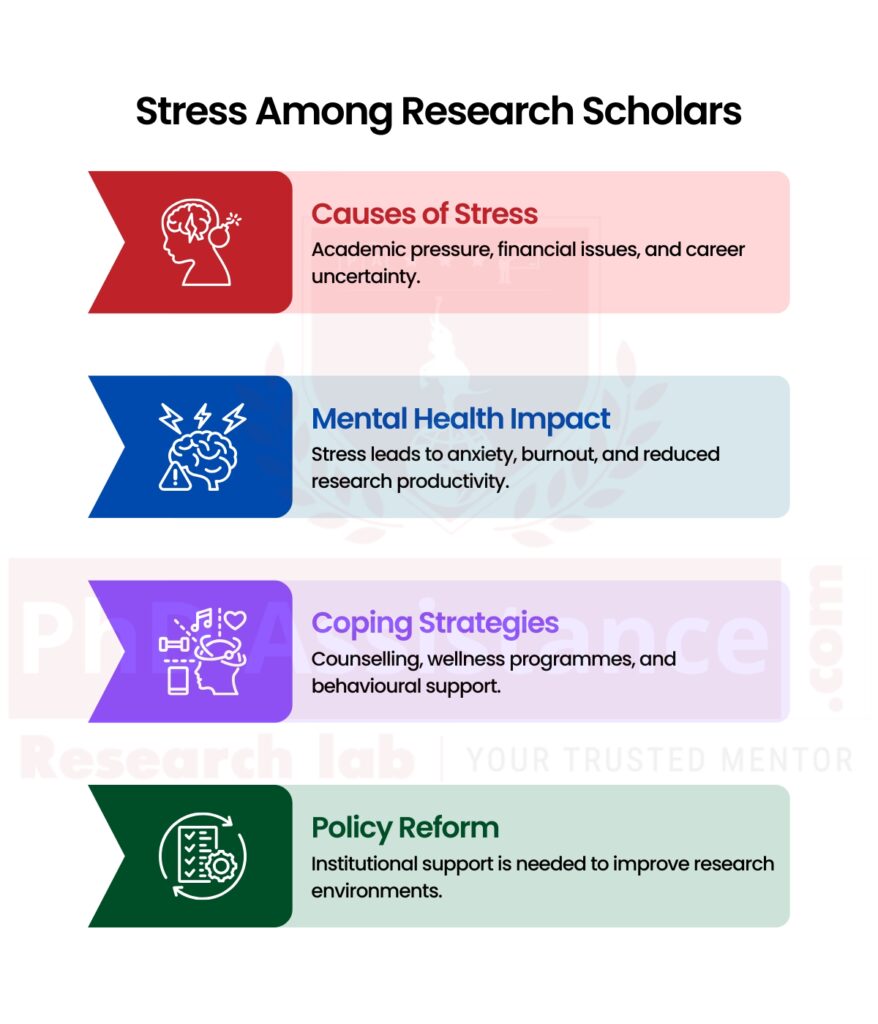
The authors identify six sources of stress, summarised in the table with examples of how the wider literature treats each one.
| Stressor in Kumar et al. (2026) | What the paper describes | Corroborating evidence elsewhere |
|---|---|---|
| Academic pressure | Publication demands, deadlines and competition | Job demands linked to distress in Flanders (Levecque et al., 2017) |
| Limited research resources | Insufficient funding and laboratory materials | Resource problems among environmental stressors (Mackie & Bates, 2019) |
| Financial instability | Reliance on inadequate or late stipends and scholarships | Financial insecurity named in a scoping review (Mackie & Bates, 2019) |
| Guide-student relationship | Quality of supervision and mentoring | Positive supervisory relationship a protective factor (Hazell et al., 2020) |
| Career uncertainty | Worry about employment after the PhD | Job insecurity predicted stress in a German sample (Friedrich et al., 2023); career confidence linked to lower stress (Byrom et al., 2022) |
| Work-life imbalance | Long hours and deadlines intruding on personal life | Work-family conflict linked to distress (Levecque et al., 2017) |
Consequences and physiology
The paper argues that chronic stress harms mental health, sleep, cognition and research productivity, and it includes a general account of the stress response, describing the roles of corticotropin-releasing hormone and noradrenaline and the effects of chronic stress on immunity. It quotes two prevalence figures: that 32% of PhD scholars were at high risk of psychiatric problems, citing Levecque et al. (2017), and that more than 80% of 589 PhD scholars in Germany worried about obtaining a permanent job, citing Friedrich et al. (2023) (Kumar et al., 2026).
Coping and policy
For coping, the authors recommend counselling services and wellness programmes, behavioural coaching in time management and problem-solving, regular communication between guide and student, timely payment of fellowships, and training in emotional regulation. Their central proposal is an "AAA strategy" for universities: Approach scholars through notice boards, messaging groups and departmental visits to identify problems; Assessment by psychologists or counsellors through university surveys; and Administration of interventions based on that assessment. Further policy suggestions include more scholarships and grants, a limited number of doctoral students per supervisor, career guidance, continuous monitoring of organisational stressors, curriculum revision every five years, and support for vacations and sport (Kumar et al., 2026).
Strengths
- A clear, multi-level map. The paper brings academic, financial, relational and career stressors into one framework and connects them to both individual coping and institutional policy, which suits readers who need an overview.
- Institutional focus. By proposing action by universities rather than only by students, it is consistent with reviews that locate much doctoral stress in the research environment (Mackie & Bates, 2019; Sverdlik et al., 2018).
- Concrete proposals. The AAA strategy and the supervisor-load and stipend recommendations are specific enough for a department to discuss and adapt.
- Accessible. It is short, open access and readable by non-specialists, including supervisors outside psychology.
Limitations and methodological issues
The most important issue is the type of review. In the typology of Grant and Booth (2009), a systematic review searches comprehensively with stated methods, appraises the quality of studies and synthesises them transparently, whereas a narrative or literature review selects and summarises sources without those safeguards. Kumar et al. report the databases and language restriction but no search terms, date range, screening process, number of studies or quality appraisal. Criteria for appraising narrative reviews ask exactly for these elements: a justified aim, a described literature search, appropriate referencing and evidence presented with its limits (Baethge et al., 2019). Without them, a reader cannot tell whether the stressors chosen are the best supported or the most often mentioned.
- Figures detached from their context. The 32% figure comes from a Flemish survey (Levecque et al., 2017) and the German figure from one public university (Friedrich et al., 2023). Presented without country, sample or measure, they can be read as general prevalence rates, which they are not. A pooled estimate from a meta-analysis (Satinsky et al., 2021) is a stronger basis for general statements.
- Physiology without doctoral data. The stress-physiology section describes general mechanisms; it does not show that doctoral researchers experience the cardiovascular or immune effects discussed, so those links remain extrapolations.
- No ranking of stressors. Because no primary data are collected or pooled, the paper cannot say which stressors matter most, or for whom. Hazell et al. (2020), by contrast, could identify isolation and female gender as the risk factors with the strongest evidence, and social support, a positive supervisory relationship, self-care and viewing the PhD as a process as protective factors.
- An untested strategy. The AAA strategy is plausible but has not been implemented or evaluated. Mackie and Bates found that few interventions addressing doctoral stressors had been tested and that outcome measures were inconsistent (Mackie & Bates, 2019); a new proposal adds to the list of untested ideas unless it is accompanied by an evaluation plan.
- Practical and ethical questions. Surveying scholars to identify those "facing stress" raises issues of consent, confidentiality and who sees the results, especially where the supervisor is part of the problem. The paper does not discuss them.
These limitations shape how the paper should be cited. It is fair to describe Kumar et al. as offering a narrative overview and an institutional proposal; it would overstate the evidence to cite it as establishing the prevalence of stress among research scholars or the effectiveness of the AAA strategy.
How the paper sits in the wider literature
The paper's list of stressors agrees broadly with more systematic work. Sverdlik et al. (2018) reviewed factors that influence doctoral completion, achievement and well-being, synthesising 163 empirical articles and distinguishing external factors (supervision, personal and social lives, the department and socialisation, and financial support) from internal factors (motivation, writing skills, self-regulatory strategies and academic identity). Mackie and Bates (2019) named problems in the supervisory relationship, lack of transparency in university processes, workload, role conflict, financial insecurity and uncertain career prospects as environmental stressors. The mixed-methods review by Hazell et al. (2020), covering 52 studies, found that doctoral researchers reported markedly higher stress than population norms.
Empirical studies add nuance that a narrative synthesis can miss. In a cross-sectional study of 431 UK doctoral researchers, family support, good general health, sleep and low self-depreciation predicted better well-being and lower stress, and confidence about future careers was associated with lower stress (Byrom et al., 2022). In the German study cited by Kumar et al., about a third of participants were above the cut-off for depression, and job insecurity and deficient supervision were among the factors linked to poorer mental health (Friedrich et al., 2023). Together, these studies suggest that institutional action on career preparation, supervision and isolation is likely to matter at least as much as individual coping training, which supports the paper's policy emphasis while showing where its evidence base needs strengthening.
What it means for doctoral researchers
For doctoral researchers experiencing stress, the practical message of this literature is that stress is common, is shaped by the environment as well as the individual, and is worth raising early. Universities provide counselling, well-being and disability services, doctoral or graduate schools and student representatives; these are the right first contacts, and a GP or local health service should be consulted for persistent symptoms. This article does not offer clinical advice.
For researchers who want to study the topic, the paper is a useful starting map but not a template. The table sets out what a primary study would need to report to answer the questions a narrative review cannot.
| Element | What to report | Why it matters |
|---|---|---|
| Population and setting | Country, institutions, disciplines, stage of doctorate, funding status | Stress and its causes differ across systems and stages |
| Sampling and response | How participants were recruited, response rate, comparison with the population | Self-selected online samples can overstate distress |
| Measures | Validated scales with citations and cut-offs, e.g. the Perceived Stress Scale (Cohen et al., 1983) | Makes results comparable across studies (Mackie & Bates, 2019) |
| Stressors | How each stressor was measured, not only listed | Allows stressors to be ranked and compared |
| Analysis | Models used, covariates, effect sizes with confidence intervals | Shows the strength as well as the existence of associations |
| Ethics and support | Consent, confidentiality, signposting to support services | Participants may disclose distress during data collection |
Worked example (illustrative)
Suppose a doctoral researcher in education wants to test whether Kumar et al.'s six stressors predict perceived stress in their own university. They could adapt items for each stressor, measure perceived stress with a validated scale (Cohen et al., 1983), and recruit across disciplines and years through the doctoral school rather than through a single social media post. A regression model would estimate the association of each stressor with stress while controlling for stage, funding and caring responsibilities, and follow-up interviews with a purposive subsample could explain the patterns. The ethics application would describe how responses are anonymised, why supervisors never see individual data, and how every participant is given details of university support services. The example is hypothetical and indicates the kind of design that could test, rather than assume, the paper's map.
Related Academy reviews examine individual interventions for well-being (self-compassion and psychological capital), the supervisory relationship (supervision and self-efficacy; supervisor support) and computational approaches to detecting distress (sentiment analysis).
Common mistakes when citing or researching doctoral stress
- Quoting a prevalence figure from a review without checking the original study's country, sample and measure.
- Treating a narrative review as if it were a systematic review or meta-analysis.
- Listing stressors without measuring them, so that their relative importance remains unknown.
- Recruiting only through self-selected online channels and generalising the results.
- Proposing interventions without saying how they would be evaluated.
- Framing stress solely as an individual coping problem and overlooking supervision, funding and career structures.
Key takeaways
- Kumar et al. (2026) map six stressors among research scholars and propose an institutional "Approach, Assessment, Administration" strategy.
- The paper is a narrative review with a minimal search description, so it cannot rank stressors or establish prevalence (Grant & Booth, 2009; Baethge et al., 2019).
- Its headline figures come from single-country studies and should be cited from those sources (Levecque et al., 2017; Friedrich et al., 2023).
- Systematic and empirical work supports its emphasis on supervision, funding and career uncertainty (Hazell et al., 2020; Mackie & Bates, 2019; Byrom et al., 2022).
- Its policy proposals are reasonable starting points that now need implementation and evaluation.