
Critical Review: Supervisor Support and Academic Performance in the PhD Journey
Introduction
Doctoral education represents the highest level of academic training and requires sustained intellectual engagement, research productivity and emotional resilience from students. The worldwide doctoral programs face challenges because students drop out and complete their studies late, leading to dissatisfaction with the process. Doctoral programs depend on effective supervision and academic institutions that provide PhD student mental health support to achieve their educational goals.
The counselling and academic support services that universities provide do not adequately meet the specific academic needs and emotional challenges that doctoral researchers face. The need for peer support emerged because it provides people with common experiences and emotional support, and practical assistance. Newlands et al. (2025) investigate doctoral students’ perceptions of peer support and explore how structured peer support programmes can be adapted to meet their specific needs. The critical review assesses the study’s research framework, methodology, and contributions and limitations, with particular relevance to doctoral education and student well-being.
Summary of the Article
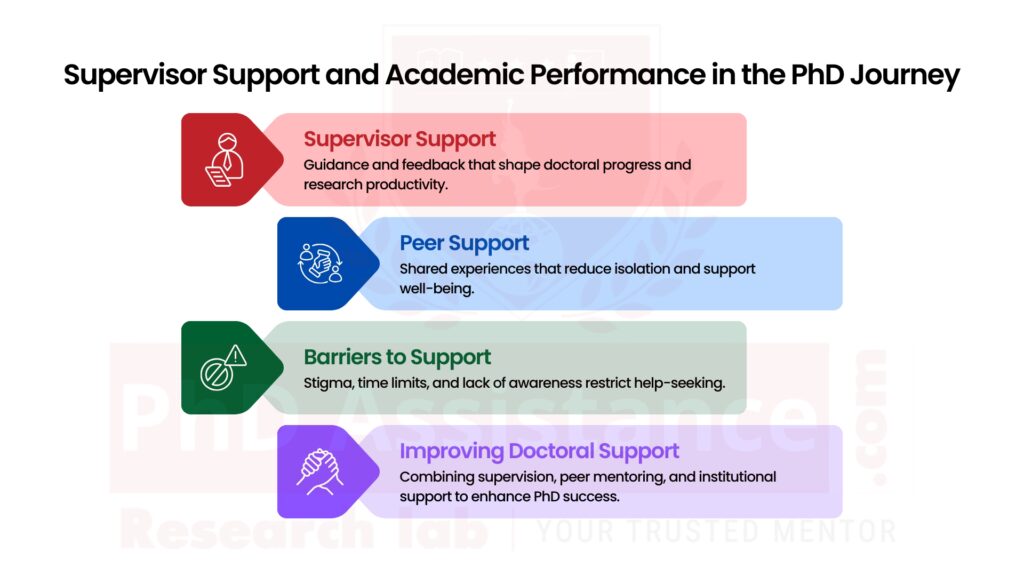
Scholars now focus on researching different support systems that universities can use to help doctoral students, since there is an increasing need to protect PhD student burnout. The examination of peer support systems demonstrates their capability to help doctoral researchers overcome their social isolation and academic uncertainty and study-related stress.
Qualitative research methods were used to study how doctoral students experience peer support in their daily lives. The study involved nineteen doctoral students from a southern England university who participated in both focus groups and semi-structured interviews. The reflexive thematic analysis produced four primary themes, which included barriers to seeking support, perceived value of peer support, expectations of the peer supporter role, and the importance of diversity and accessibility in support systems.
Findings show that three factors, which include stigma, time limitations and insufficient knowledge about support options, stop doctoral students from using institutional resources. The peer networks create a comfortable space where students can share their academic problems and receive practical solutions. The essential elements of successful peer support programs require shared experience, flexible delivery methods, culturally appropriate methods and official recognition of peer supporters. The university needs to establish customised peer support systems that will help improve the well-being and active participation of doctoral students.
Critique
Significance and Contribution to the Field
Consideration of Peer support in PhD programs shows its major impact on current student well-being research and academic sustainability studies. The academic environment provides students with two types of support, which, together with their academic guidance, determine their academic performance and completion rates.
The structured peer support system enables students to develop better skills for handling their academic responsibilities and emotional issues. The study demonstrates how shared experiences and relationship support work together to enhance resilience and engagement among doctoral students. The discussion stresses the need for support systems that handle all student needs because they should match the different backgrounds of doctoral supervision research.
The research findings focus on one university environment established in the United Kingdom. The research findings would gain more international significance through studies that involve multiple cultural backgrounds and different academic institutions.
Methodology and Research Design
The adoption of a qualitative research design enables researchers to study doctoral students’ actual experiences and their personal understanding of their diverse research work. The research method uses focus groups and semi-structured interviews to create detailed narrative data, which shows both emotional and academic aspects of doctoral student life. Thematic analysis through reflexivity provides researchers with a method to discover all repeated themes and patterns that appear in participant answers.
Research methods achieve their required level of scientific validity through the implementation of three essential components, which include ethical approval procedures, informed consent and transparent analytical methods. The research team establishes research reliability through two methods, which include their collaborative coding process and their application of qualitative data analysis software.
Despite these strengths, its use of convenience sampling, together with its small study group, restricts the ability to produce representative results. The inclusion of larger samples together with more diverse participants from different institutions will help researchers to obtain a better understanding of how peer support functions. The research requires longitudinal and mixed-method research designs, which will provide a better understanding of how peer support programs impact doctoral students’ academic progress and their mental health throughout their studies.
Argumentation and Use of Evidence
The logical connection between arguments receives support through complete evidence, which comes from participant stories. The use of direct quotes establishes credibility while showing the genuine emotional experiences doctoral students encounter. The research results establish links with existing studies about mental health and Academic peer mentoring, which help support the analysis.
While the qualitative design provides in-depth details, the study faces potential bias because it relies on participants’ self-reported data. The study will gain stronger evidence through the inclusion of well-being measures, academic productivity metrics and retention statistics. The research findings will achieve better validation through a mixed-method approach, which enables stronger triangulation.
Ethical Considerations and Omissions
The organisation demonstrates its commitment to abide by ethical standards because it obtains institutional approval, secures participant consent and implements measures for protecting confidential information. The research team provided participants with complete information about the study objectives and their right to withdraw from the study at any time, which enabled them to conduct research according to ethical standards.
The participant base is restricted because it only examines one specific institutional environment. Doctoral support systems require an in-depth investigation that should be conducted through comparative research, which examines various disciplines and institutions and different cultural settings. The study of supervisory functions and institutional regulations, together with peer assistance systems, will deliver a comprehensive understanding of doctoral student mental health.
Writing Style and Structure
The Presentation follows a coherent academic structure, which guides readers through its theoretical background and methodological design and its thematic findings. The study achieves better readability because its arguments follow a logical structure and its writers present their points consistently.
Integration of theoretical perspectives with empirical research results was achieved properly. The discussion would benefit from increased analysis through different theoretical models that explain Social support in doctoral studies, doctoral identity development and academic resilience.
Conclusion
The emotional and academic challenges of doctoral education find their solution through peer support, which serves as an essential component of this process. The doctoral candidates experience better well-being and maintain their research activities through three specific elements, which include shared experiences, informal communication areas and inclusive support systems.
Useful information was provided about creating and running successful peer support programs for higher education institutions despite facing limitations from their contextual and methodological constraints.
Establishing broader longitudinal studies together with cross-institutional research will improve research about how peer support affects doctoral students’ mental health and academic success and doctoral degree completion rates. The development of structured peer support programs, which include all students together with institutional support and supervisory guidance, will create a supportive environment for doctoral students that fosters their academic success and personal development.
For PhD scholars searching for professional support in developing a research manuscript, the PhD Assistance Research Lab offers specialised academic guidance tailored to doctoral scholars and early-career researchers.
Book a free consultation to receive expert guidance to transform your ideas into a high-quality, submission-ready research paper with confidence.
Reference:
Newlands, F., Markan, T., Pomfret, I., Davey, E., King, T., Roach, A., et al. (2025). “A PhD is just going to somehow break you”: A qualitative study exploring the role of peer support for doctoral students. PLOS One, 20(6), e0325726. https://doi.org/10.1371/journal.pone.0325726
Methodology and Research Design