Critical Review: Report on Self-Compassion-Based PsyCap Intervention for PhD Students’ Well-Being
Report on Self-Compassion-Based PsyCap Intervention for PhD Students’ Well-Being
Introduction
Doctoral education serves as the main pathway through which researchers develop new knowledge and conduct their academic research, yet PhD students around the world experience growing mental health difficulties due to their academic responsibilities and the need to compete with others and exceed performance standards. Studies indicate that PhD students experience significantly higher levels of anxiety, depression and stress compared with the general population, which results in negative effects on their personal health and their ability to conduct research.
The research article by Solms et al. (2025) titled “Be a hero, be your own best friend: A self-compassion-based PsyCap intervention improves PhD students’ well-being” demonstrates how doctoral students can improve their mental health through psychological capital and self-compassion development programs. The article evaluates whether combining self-compassion with PsyCap training produces stronger outcomes than PsyCap alone.
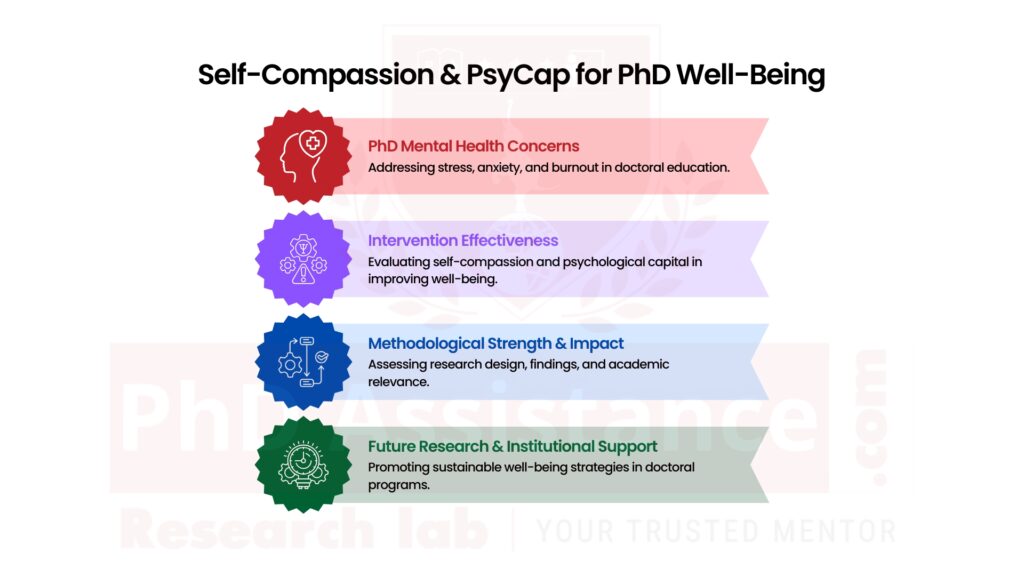
The critical review assesses the article through its theoretical framework, research methodology, and research findings, which show its contribution to doctoral education research while highlighting its strengths and weaknesses and its effects on higher education institutions.
Summary of the Article
PhD students achieve better mental health through personal psychological resources, according to Solms et al. (2025). The authors use the Conservation of Resources (COR) theory to demonstrate that doctoral students can handle academic stress better through the combination of psychological capital elements, which include hope, self-efficacy, resilience and optimism, with self-compassion.
The researchers conducted their study by using a randomised controlled intervention design, which included 115 PhD students from a Dutch university. The researchers placed participants into three different groups for the study.
The researchers conducted their five-week intervention, which assessed three different outcomes through their study. The self-compassion-based PsyCap intervention brought about three significant changes to PhD students who participated in the study.
The research demonstrates that self-compassion functioned as the primary pathway through which students achieved their long-term well-being results because emotional coping resources proved essential for their success in doctoral studies.
Critique
Significance and Contribution to the Field
The article establishes two significant research domains through its educational value, which helps PhD students and academic research efforts. The research establishes new knowledge about doctoral students’ well-being and academic performance through its analysis of psychological capital and self-compassion frameworks.
The study demonstrates that workers require emotional coping strategies to manage their cognitive resources while showing that self-compassion enhances the effectiveness of psychological capital programs. The integrated approach provides universities with essential knowledge to enhance both their doctoral student retention and student well-being programs.
The research studies one specific institutional and cultural environment within the Netherlands as its main focus. The findings hold global significance, yet researchers must conduct wider cross-national studies to establish their applicability across various doctoral education systems.
Methodology and Research Design
The study employs a randomised controlled intervention design, which strengthens the reliability and validity of its findings. The researchers used multiple measurement points with follow-up assessments to study both immediate and future outcomes of the intervention.
The research design gains strength from including both control and comparison groups. The statistical analyses, which include mediation models, show strong empirical evidence that self-compassion leads to better well-being results.
Argumentation and Use of Evidence
The article presents a clear, logically structured argument supported by relevant theoretical frameworks, such as COR theory and psychological capital theory. The research results establish a direct connection with existing studies that focus on doctoral students’ mental health issues and their corresponding intervention methods.
The authors demonstrate that self-compassion leads to better emotional resilience, which PhD students use to handle academic stress and their failures. The researchers use tables and models to display statistical results that demonstrate how variables interact with different intervention methods.
The article needs more in-depth qualitative research to better understand how doctoral students experience their academic journey. The addition of participant narratives and case examples would enhance understanding of how academic interventions affect student well-being in actual educational settings.
Ethical Considerations and Omissions
The study demonstrates strong ethical standards by obtaining informed consent and institutional ethical approval before data collection. The research team explained to participants that they could choose to participate in the study while their private information would remain protected.
The article confirms that academic institutions face structural challenges, yet it offers a restricted analysis of systemic issues, which include supervisory practices and funding insecurity, and institutional culture. The doctoral well-being analysis would benefit from examining these structural factors that affect the research study.
Writing Style and Structure
The article presents its academic content through a structured format which includes sections that present theoretical information, research methods, study results and their analysis. The visual models, together with the statistical tables, help readers to better understand the content while they process the results of the study.
The text includes complex statistical descriptions that require specialised knowledge for proper understanding. The academic content becomes more accessible to different academic groups through the use of simplified explanations together with extended contextual information.
Conclusion
Solms et al. (2025) provide an important contribution to doctoral education research by demonstrating how self-compassion and psychological capital interventions can enhance PhD students’ well-being. The study highlights the importance of emotional and psychological resources in supporting doctoral success and reducing work-related stress
The research proves strong methodological design and practical relevance, yet its findings become restricted because of self-reported data and single-institution research limitations. Future research should adopt cross-cultural and longitudinal approaches to better understand how institutional environments influence doctoral well-being.
The article provides universities with essential theoretical and practical guidance that they can use to establish supportive doctoral environments that enhance student well-being and completion rates. The article provides universities with essential theoretical and practical guidance that they can use to establish supportive doctoral environments that enhance student well-being and completion rates.
Reference:
Solms, L., van den Heuvel, M., Nevicka, B., & Homan, A. C. (2025). Be a hero, be your own best friend: A self-compassion-based PsyCap intervention improves PhD students’ well-being. Higher Education. https://link.springer.com/article/10.1007/s10734-024-01257-3a
Methodology and Research Design