
The source and why it matters
The paper under review is Boisselier (2025), "Unveiling the hidden key: can help-seeking behaviors bridge the gap between doctoral supervision relationship and research self-efficacy of PhD candidates?", published in Higher Education Research & Development (volume 45, issue 1, pages 33 to 48; online in July 2025). The author is affiliated with Adoc Talent Management in Paris.
Research self-efficacy is a candidate's belief in their capability to carry out research tasks. The concept comes from Bandura (1977), who argued that expectations of personal efficacy influence whether people attempt tasks and how long they persist, and who identified four sources of efficacy information: performance accomplishments, vicarious experience, verbal persuasion and emotional arousal. Supervision touches all four, through the tasks candidates complete, the researchers they observe and the feedback they receive.
Earlier work had already linked supervision to research self-efficacy. In a survey of doctoral students, Overall et al. (2011) found that autonomy support from supervisors predicted greater research self-efficacy, that outcomes were most favourable when high autonomy support was combined with high academic support, and that personal support combined with low autonomy support was associated with lower self-efficacy. What remained unclear, Boisselier argues, is the pathway through which supervision relates to self-efficacy. The paper proposes that candidates' help-seeking behaviour is part of that pathway (Boisselier, 2025).
What the study did and found
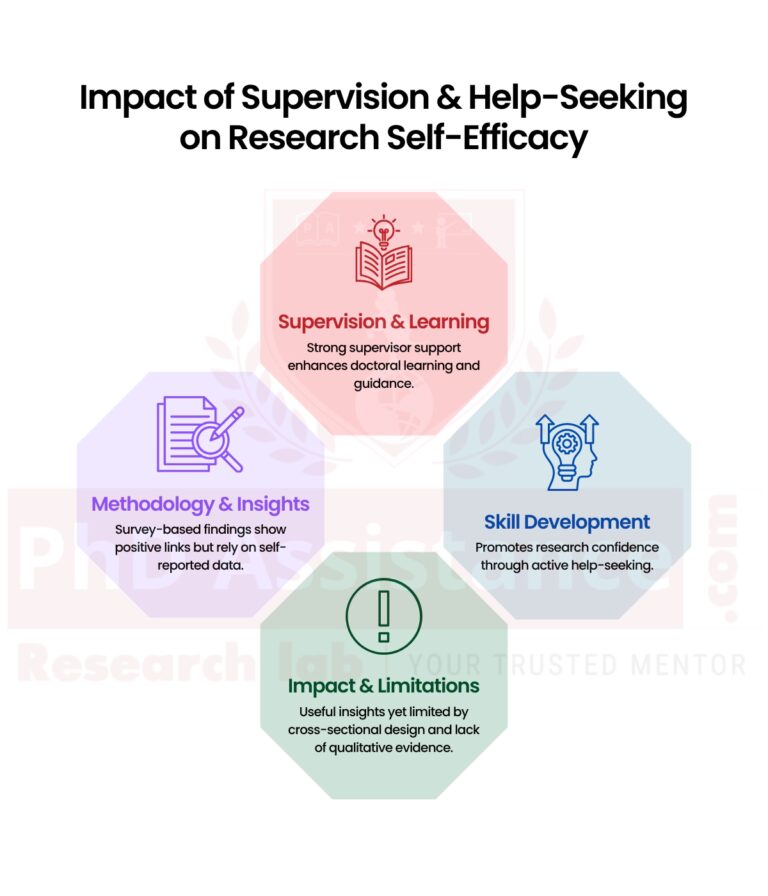
Help-seeking behaviours, in the paper's terms, are adaptive or maladaptive strategies for seeking assistance when facing difficulties. The concept draws attention to the candidate's own active role and to the relational side of developing skills. The study tested whether doctoral supervision and help-seeking behaviours predict research self-efficacy, and whether help seeking mediates the relationship between supervision and self-efficacy (Boisselier, 2025).
Data came from an online questionnaire completed by 178 PhD candidates across a range of scientific fields. According to the abstract, the analysis showed a predictive relationship between supervision and research self-efficacy, and mediation analysis showed indirect effects through help-seeking behaviours. Crucially, these effects varied with the specific dimension of supervision and the specific help-seeking behaviour considered (Boisselier, 2025). In other words, the study does not report a single route from "good supervision" to "confident researcher"; it reports several, some stronger than others.
The distinction between kinds of help seeking is central. Research on academic help seeking commonly separates three patterns, summarised in the table from a systematic review of the field (Martín-Arbós et al., 2021). The same review notes that there is no consensus on the structure of help seeking as a construct, which matters when comparing studies that measure it differently.
| Pattern | What it looks like | Likely effect on learning |
|---|---|---|
| Instrumental (adaptive) | Asking for only as much help as you need to complete the task yourself | Builds capability and, plausibly, self-efficacy through your own success |
| Executive (expedient) | Asking for the task to be solved or done for you | Gets the task done but adds little to your own capability |
| Avoidance | Not seeking help when it is needed | Problems persist or grow; often linked to fear of judgement |
Strengths
- An integrating question. Supervision, help seeking and self-efficacy have mostly been studied separately. Linking them shifts attention from what supervisors provide to how candidates draw on it.
- Candidate agency. Treating help seeking as a behaviour the candidate controls gives candidates something actionable, rather than presenting supervision quality as fixed.
- Differentiated results. Reporting that effects vary by supervision dimension and type of help seeking is more informative, and more credible, than a single overall effect.
- A sample across fields. Recruiting candidates from several scientific fields reduces the risk that the findings reflect one discipline's supervision culture.
- Builds on established work. The study extends findings on supervisory support and research self-efficacy (Overall et al., 2011) rather than starting afresh.
Limitations and methodological issues
The most important point concerns causal language. Mediation describes a process that unfolds over time: supervision first shapes help seeking, which later shapes self-efficacy. When all three variables are measured at the same moment, the analysis can show that the pattern of associations is consistent with mediation, but not that the process happened in that order. Maxwell and Cole (2007) showed that cross-sectional analyses can give substantially biased estimates of longitudinal mediation, even when mediation is complete. The reverse direction is also plausible: candidates who already feel capable may seek help more comfortably and may rate their supervision more favourably.
- One informant, one occasion. Candidates reported their supervision, their help seeking and their self-efficacy in the same questionnaire. Shared method variance can inflate associations, and procedural and statistical remedies exist (Podsakoff et al., 2003).
- Measuring self-efficacy. Research self-efficacy scales do not always have the structure their authors intend; in a study of 1,004 psychology graduate students, confirmatory analyses did not support the hypothesised structures of three measures, and four dimensions emerged instead: data analysis, research integration, data collection and technical writing (Forester et al., 2004). Readers should check which instrument a study used and how it performed.
- Measuring help seeking. Because help seeking lacks an agreed structure (Martín-Arbós et al., 2021), findings about one help-seeking dimension may not transfer to studies that define it differently.
- Sample and setting. With 178 respondents, complex models with several mediators and supervision dimensions have limited precision. National systems of supervision also differ, and the abstract does not establish how far results transfer across countries and institutions.
- Self-efficacy is not performance. The outcome is a belief. The study does not show effects on publications, progress or completion.
These points do not undermine the paper's contribution. They determine how it should be cited: as cross-sectional evidence that supervision, help seeking and research self-efficacy are associated in ways consistent with a mediating role for help seeking, with effects that depend on which aspects are considered. It would overstate the evidence to say that the study showed supervision increases self-efficacy by changing help seeking.
| Item | Why readers need it |
|---|---|
| Instruments, with reliability and evidence of structure | Shows what "supervision", "help seeking" and "self-efficacy" actually mean in the data |
| Indirect effects with bootstrap confidence intervals | Resampling methods are recommended for testing indirect effects (Preacher & Hayes, 2008) |
| Direct effects and the proportion mediated | Shows whether help seeking explains a little or a lot of the association |
| Tests of alternative orderings | Shows whether the data fit reverse or competing models equally well |
| Steps taken against common method bias | Separating measures or sources reduces inflated associations (Podsakoff et al., 2003) |
| Explicit statement on causal inference | Prevents readers from reading a cross-sectional model as a timeline (Maxwell & Cole, 2007) |
How the study sits in the wider literature
The findings fit a broader picture in which the supervisory relationship affects both doctoral learning and well-being. Lee (2008) described several concepts of supervision, from functional management of the project to enculturation, critical thinking, emancipation and relationship development; each implies different expectations about when and how a candidate should ask for help. In the Flemish survey by Levecque et al. (2017), supervisory style was among the work-organisation factors associated with risk of common mental health problems, and Barry et al. (2018) examined the psychological health of doctoral candidates alongside study-related challenges and perceived performance. Difficulties of socialisation are also among the most common reasons doctoral students give for considering dropping out (Castelló et al., 2017).
Help seeking is not limited to the supervisor. A qualitative study of doctoral students found that normalised struggle, stigma and poor awareness of services were barriers to seeking support, and that students valued informal help from peers with shared experience (Newlands et al., 2025); see our companion review of peer support and well-being in the PhD. For the role of artificial intelligence in supervision, see the review of AI and doctoral supervision.
What it means for doctoral researchers
The study suggests that how you ask for help may matter as well as what your supervisor offers. Instrumental requests, which ask for just enough help for you to complete the task, keep the work and the learning with you; this is also where the mastery experiences that Bandura identified as a source of self-efficacy come from (Bandura, 1977).
Worked example (illustrative)
A second-year candidate's regression model will not converge and the deadline for a progress report is near. An executive request would be: "Can you fix my model?" An instrumental request would be: "My mixed model does not converge. I have rescaled the predictors and simplified the random effects, and it converges only without the random slope. Could you help me understand whether dropping it is defensible, or what else I should try?" The second request shows what the candidate has tried, asks for reasoning rather than a solution, and leaves the decision with the candidate. Avoidance, staying silent until the report is late, is the costliest option of the three.
| Step | What to do |
|---|---|
| Before the meeting | Write down the problem, what you have tried and what you think the options are |
| Frame the request | Ask for an explanation, a resource or a check of your reasoning, not a finished answer |
| Agree the type of support | Discuss with your supervisor when you should come with questions and how much direction you want |
| Widen your sources | Use peers, methods advisers, library and researcher development staff as well as your supervisor |
| Close the loop | Report back on what you did; completed tasks are a basis for confidence |
If a difficult supervisory relationship is affecting your well-being, speak to your graduate school, doctoral programme director or the university's well-being or counselling service, which can advise in confidence. For more on planning support across the doctorate, see the course Conducting Research: Topic to Viva.
Common mistakes when citing or using this study
- Writing that the study proved supervision raises self-efficacy through help seeking; the design is cross-sectional.
- Reporting a single overall mediation effect when the paper stresses that effects vary by dimension and behaviour.
- Treating all help seeking as beneficial, rather than distinguishing instrumental, executive and avoidant patterns.
- Equating research self-efficacy with research competence or with doctoral completion.
- In your own survey research, testing mediation with one-time self-report data and no discussion of alternative orderings or common method bias.
- Waiting until a problem is urgent before asking for help.
Key takeaways
- Boisselier (2025) surveyed 178 PhD candidates and reported that supervision predicted research self-efficacy, with indirect effects through help-seeking behaviours.
- The indirect effects varied with the dimension of supervision and the type of help seeking, so there is no single route from supervision to confidence.
- Because the data are cross-sectional, the mediation results are consistent with, but cannot establish, a causal sequence (Maxwell & Cole, 2007).
- Earlier evidence suggests that combining academic guidance with autonomy support is associated with higher research self-efficacy (Overall et al., 2011).
- Candidates can act on the findings by making instrumental help requests and by drawing on peers and services as well as supervisors.