
Critical Review: Sentiment Analysis and Machine Learning for Understanding PhD Scholars’ Mental Health
Sentiment Analysis and Machine Learning for Understanding PhD Scholars’ Mental Health
Introduction
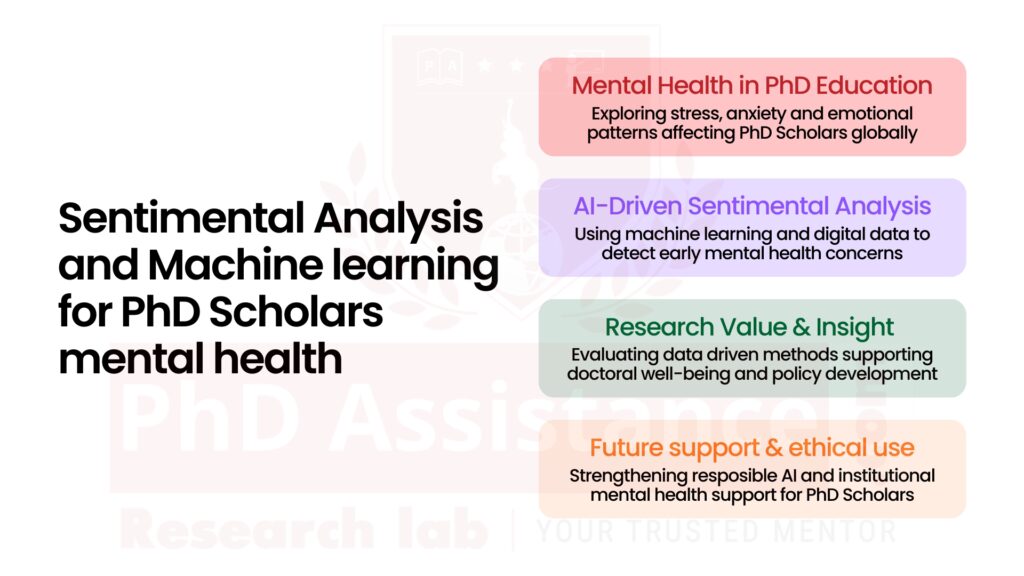
The mental health of doctoral researchers has emerged as a critical concern that universities across the world need to address. The increasing number of PhD students who experience stress, anxiety and depression needs urgent research studies which will use data to study and resolve their mental health challenges. The research investigates the ways in which digital platforms and computational methods help doctoral students to identify their emotional distress and academic stress patterns. Researchers developed Sentiment Analysis for PhD Scholars Mental Health as a successful method that enables them to monitor psychological well-being through social media content and survey responses.
The critical review assesses a research study which examines how sentiment analysis and machine learning methods enable researchers to study doctoral students’ mental health disorders. The review analyses the study’s conceptual framework, research design, findings and contribution to doctoral mental health research.
Summary of the Article
It investigates the mental health condition of PhD students through the combined methods of social media sentiment analysis and survey research. The authors maintain that digital data sources should be used to detect early signs of stress and anxiety which doctoral students experience as their mental health problems increase. Social media platforms provide researchers with effective tools to study student emotions because students use these platforms to show their stress levels and motivation and mental health challenges in real time.
A dataset was created that included 5096 social media posts that were gathered from 1170 Pakistani graduate students. The posts were divided into three categories, which related to mental health disorders because they included anxiety (46.7%), depression (12.6%) and motivation (40.7%). The research combined survey data with social media information to create reliable results, which helped better understand the studied content. The researchers used Support Vector Machine (SVM), Artificial Neural Network (ANN), and Random Forest (RF) machine learning models to identify mental health patterns in doctoral students.
The results show that about 59.3% of graduate students in Pakistan experience mental health problems and anxiety. The research demonstrates that doctoral programs need to establish better support systems through policy changes that focus on improving student health and academic stress management.
Critique
Significance and Contribution to the Field
It improves PhD scholars mental health analysis through its use of computational methods together with educational research methods. The research study demonstrates how data-driven methods can help researchers identify mental health issues that doctoral students experience, which extends beyond the existing methods that use qualitative research and survey data to study mental health. The research results show that doctoral students experience mental health problems that exist throughout the world and require institutions to implement solutions.
The PhD student wellbeing research needs both behavioural and self-reported survey data for effective study outcomes. The study analyses emotional expressions in social media posts to create a new understanding of how doctoral students experience their daily lives. The study reveals anxiety and depression and motivational patterns, which create essential evidence for institutions and policymakers who want to develop better support systems for doctoral students.
Methodology and Research Design
It uses a mixed-methods approach, which combines quantitative survey data with qualitative social media sentiment analysis. The research team achieved methodological success through their development of a massive dataset, which contains more than 5000 posts shared by over 1000 users. Researchers use post-classification into mental health categories to assess doctoral students’ emotional states in a systematic manner.
Machine learning models, which include SVM, ANN and Random Forest, work together to predict and analyse mental health conditions. The use of multiple algorithms strengthens the reliability of findings and allows comparative evaluation of model performance. The approach shows how Sentiment analysis in doctoral research has become more common, which uses computational tools to study academic stress and psychological well-being.
Argumentation and Use of Evidence
The arguments follow logical reasoning because they use participant stories and research results as their basis. The direct quotations show how participants identified program advantages through their development of research skills and proposal writing abilities, and their doctoral planning activities.
The method of Mental health prognosis using sentiment analysis shows its importance because it demonstrates how predictive analytics can determine which students need help. The negative language patterns and stress indicators, which researchers found, enable institutions to create early support systems for their doctoral students. The public availability of the dataset makes the research work more transparent and replicable.
A thorough analysis of psychological and educational theories is required in this study. The research would benefit from academic stress theories and motivation theories together with well-being theories because these theories would create a stronger theoretical framework and explain how computational results connect to educational practices.
Ethical Considerations and Omissions
Researchers understand ethical principles that govern their data collection methods and the protection of participants’ personal information. The research team needs to establish proper methods for handling survey data and social media content because they must protect participant privacy rights and maintain ethical standards for using their data.
Information about available datasets was provided , but it needs to include more information about how researchers protect data through anonymisation and obtain study participants’ consent. The research study shows that AI-based mental health prediction for PhD students represents an emerging field of research. The use of predictive models provides useful information, but researchers must solve three ethical issues, which concern data privacy, algorithmic bias and responsible prediction model usage. Educational institutions need to make sure that these technologies support student well-being instead of being used for monitoring purposes or creating negative perceptions about students.
Writing Style and Structure
It maintains a clear academic structure, which guides readers through its research context and methodology and its findings and implications. The research gains credibility through the combined use of statistical data and machine learning explanations. The technical sections of the document become difficult to understand for readers who lack knowledge about data science and machine learning. The document needs to simplify technical descriptions while establishing stronger connections between educational outcomes and educational materials to reach more academic readers.
The presentation of findings is coherent and supported by relevant data visualisation and classification results. The structured organisation of the paper enables readers to understand the relationship between sentiment analysis techniques and doctoral mental health outcomes.
Conclusion
The research reveals essential mental health challenges that doctoral students experience. The research demonstrates that machine learning and sentiment analysis techniques can be used to detect their emotional suffering. The researchers used social media data and survey responses to create a complete understanding of doctoral student well-being while showing that institutional policies need to be changed.
Doctoral students need mental health support, which should be prioritised by academic institutions and policymakers who need to develop research environments and mental health resources. Future research should expand the geographical scope of the study while using theoretical frameworks to examine how mental health evolves across different time periods.
The interdisciplinary research has reached a new level because it combines computational analysis with studies of doctoral education. The research establishes a solid base that future studies can use to enhance doctoral student well-being and develop better academic settings.
Book a free consultation to receive expert guidance to transform your ideas into a high-quality, submission-ready research paper with confidence.
Reference:
Noreen, R., Zafar, A., Waheed, T., Wasim, M., Ahad, A., Coelho, P. J., & Pires, I. M. (2025). Unraveling the inner world of PhD scholars with sentiment analysis for mental health prognosis. Behaviour & Information Technology, 44(10), 2244–2256. https://doi.org/10.1080/0144929X.2023.2289057
Methodology and Research Design