
Why AI topics stay too broad
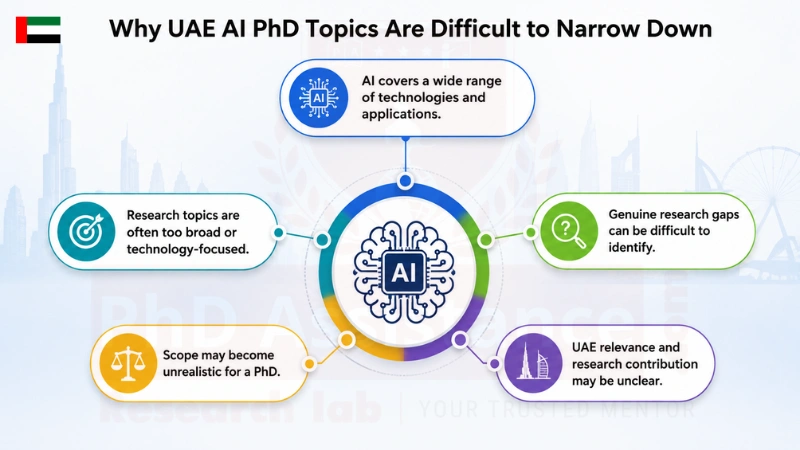
Artificial intelligence covers machine learning, computer vision, natural language processing, robotics and, more recently, generative models, and each of these is applied across health, government, energy, transport and finance. A doctoral researcher who begins with "AI in healthcare" or "generative AI in government" has named a field, not a study. The difficulty is not choosing an area but finding, within it, one problem, one gap and one study that can be completed and evaluated.
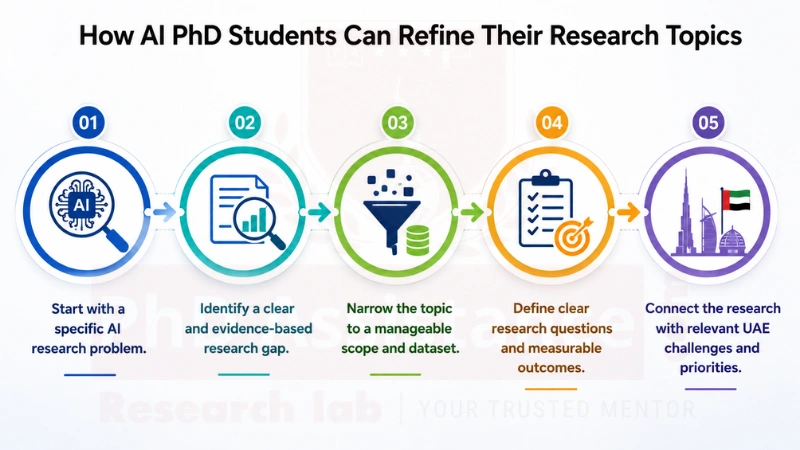
Advice on research questions has long stressed this. The FINER criteria ask whether a question is feasible, interesting, novel, ethical and relevant (Hulley et al., 2013), and a broad field fails the first test before the others can be applied. The progression below captures the narrowing well.
- 1Broad AI field
- 2Specific problem
- 3UAE context
- 4Research gap
- 5Research question
- 6Contribution
Each step removes options. The problem fixes what must improve or be explained; the context fixes the data and constraints; the gap fixes what is not yet known; the question fixes what you will measure; and the contribution states what the field will have afterwards that it lacks now. For the general method of testing a candidate topic, see How to choose a PhD topic and, for the discipline, How to select the right topic for your PhD in computer science.
How UAE-based studies have framed focused AI problems
Published work by researchers in the UAE, or carried out in UAE settings, shows what a narrowed AI problem looks like in practice. The studies below differ in method, but each starts from a specific problem and a defined body of data or participants.
Researchers at Mohamed bin Zayed University of Artificial Intelligence, with colleagues at NYU Abu Dhabi and Saudi universities, built ArabicMMLU, a benchmark of 14,575 multiple-choice questions in Modern Standard Arabic across 40 tasks, drawn from school examinations in North Africa, the Levant and the Gulf (Koto et al., 2024). Of the 35 models they evaluated, several widely used multilingual models scored below 50%, and the best Arabic-focused model reached 62.3%. The problem was precise (do language models understand Arabic school knowledge?), the data were new, and the evaluation was defined in advance.
In health, Chaddad et al. (2023), a team that included a researcher at the University of Sharjah, surveyed explainable AI methods for medical imaging and clinical prediction. They grouped methods into intrinsic and post hoc approaches and identified open problems: explanations that suit clinicians and patients, practical deployment and fairness. A survey of this kind is a source of gaps rather than a gap in itself. On the user side, Mansour and Bick (2024) interviewed 12 physicians in Dubai and Abu Dhabi and reported that fragmented data systems, training gaps, patient acceptance and reimbursement uncertainty held back adoption, while reliable data with clear privacy protection and integrated systems supported it.
In government, Alshehhi et al. (2024) at the University of Sharjah used interpretive structural modelling to map the critical success factors for procuring AI systems in UAE public-sector organisations. The study narrows "AI in government" to one organisational process, procurement, and one analytic aim, the relationships among success factors.
| Study | Focused problem | Data and method | What it shows about narrowing |
|---|---|---|---|
| Koto et al. (2024) | How well language models handle Arabic school knowledge | 14,575 exam questions, 40 tasks; 35 models evaluated | A new dataset and a fixed metric turn a broad interest into a measurable question |
| Chaddad et al. (2023) | Which explainability methods suit healthcare and what remains open | Literature survey of XAI methods | Surveys supply candidate gaps; your study must then pick one and test it |
| Mansour & Bick (2024) | Why physicians in the UAE adopt or resist AI tools | 12 interviews, grounded theory | A human and organisational problem can be the AI topic, not only the model |
| Alshehhi et al. (2024) | What makes AI procurement succeed in UAE public bodies | Interpretive structural modelling | Narrowing to one process makes a government AI topic tractable |
Five places where narrowing breaks down
1. The field is too wide
Narrow by successive choices, each of which you can justify from the literature. Here is the chain for a health topic.
- 1AI
- 2Machine learning
- 3Healthcare
- 4Disease prediction
- 5Early detection
- 6One named disease
- 7One defined data source
2. Starting with the technology instead of the problem
"Generative AI in UAE government" names a tool and a sector. "Evaluating the reliability of generative AI for Arabic-language public service information in UAE government applications" names a problem (reliability), a language, a use and a setting. The second version also suggests its evaluation, which is where much AI research succeeds or fails; the ArabicMMLU results show why Arabic-language reliability cannot be assumed (Koto et al., 2024).
3. Mistaking an area for a gap
An area is where research happens; a gap is a specific thing that is not yet known or not yet done well. Gaps can be found systematically, by classifying what the literature leaves unresolved (Müller-Bloch & Kranz, 2015), but the strongest questions often come from questioning an assumption the literature takes for granted rather than from spotting an untried combination (Sandberg & Alvesson, 2011). Explainable AI in healthcare illustrates the distinction.
| Element | Example |
|---|---|
| Topic | Explainable AI in healthcare |
| Research problem | Complex AI models can be difficult for clinicians to interpret |
| Research gap | Existing explainability methods differ in how well their explanations support specific clinical tasks and users |
| Research question | How can explainability methods be evaluated for their effect on clinicians' understanding of AI-based predictions? |
| Contribution | A framework or evidence-based approach for assessing explanation quality |
4. Letting the scope expand
Projects grow when each supervisor meeting adds a dataset or an application. "AI applications for smart cities in the UAE" can become "a machine-learning model for short-term traffic congestion prediction in UAE urban environments", which fixes the task, the horizon and the setting. A narrower scope also makes evaluation honest: with fewer datasets you can afford proper train and test separation, and data leakage between them is a documented source of inflated results across machine-learning-based science (Kapoor & Narayanan, 2023).
5. Claiming a UAE contribution without showing one
A UAE study adds knowledge when something about the setting could change the answer: Arabic and its dialects, a multinational workforce, a distinctive regulatory framework, a particular health system or an industry such as energy or logistics. Ask what is distinctive about the context, what UAE problem needs investigation, whether the findings would differ elsewhere, and which national or sectoral challenge the work addresses.
Using national priorities without letting them choose for you
The UAE National Strategy for Artificial Intelligence 2031 sets eight objectives, among them to "bring world-leading research capability to work with target industries", to "provide the data and supporting infrastructure essential to become a test bed for AI" and to "ensure strong governance and effective regulation" (UAE Government, n.d.-b). It also names priority sectors. Because sector lists are revised, quote the current version of the strategy rather than a secondary summary.
Industrial programmes show the same problem-first logic. The Ministry of Industry and Advanced Technology announced $100 million of AI financing with Emirates Development Bank in 2024 (Ministry of Industry and Advanced Technology, 2024), linked to an AI Innovation Program intended to bring industry and technology developers together to address "the most pressing industrial challenges within national industry" (Emirates Development Bank, 2024). For a doctoral researcher, programmes like this indicate where industrial problems and partners may exist; they do not supply a research gap.
Data access is the other national factor. Federal Decree-Law No. 45 of 2021 on the protection of personal data, in force since January 2022, restricts processing personal data without consent except in defined cases, and some free zones and the health sector have their own rules (UAE Government, n.d.-a). If your topic depends on patient records, citizen interactions or employee data, confirm the legal basis and ethics route before you commit, because a topic without lawful data is not feasible.
Worked example: narrowing a generative AI interest (illustrative)
The following case is hypothetical and implies no results. A computer science doctoral researcher in Abu Dhabi is interested in "generative AI for government services".
- Problem. Citizens increasingly ask chatbots about public services, and wrong answers about eligibility or procedures cause real harm. The problem is reliability, not adoption.
- Context. Many queries are in Arabic, some in Gulf dialect, and benchmark evidence shows that Arabic performance cannot be taken for granted (Koto et al., 2024).
- Gap. General Arabic benchmarks test school knowledge, not procedural answers about public services, so it is not known how reliably models answer such questions in Arabic and English.
- Question. How accurately and consistently do selected language models answer Arabic and English questions about published UAE public service procedures, and which retrieval strategies reduce errors?
- Data and evaluation. A question set built from publicly available service pages, with reference answers checked by two annotators, and accuracy and consistency defined before testing. Using public pages avoids personal data (UAE Government, n.d.-a).
- Contribution. A reusable evaluation set and evidence on which strategies improve reliability.
The final question is narrow enough to finish, has a defined evaluation, and owes its importance to the UAE context rather than to a label. For how the same narrowing feeds a proposal in management, see building a strong business proposal in the UAE; for the programming problems that follow once the study starts, see programming problems in AI research.
Feasibility check before you commit
Eight criteria help. The table restates them with the evidence you should be able to show for each.
| Criterion | Question to ask | Evidence to show |
|---|---|---|
| Clear problem | Can I state the problem in one sentence? | A problem statement your supervisor accepts |
| Supported gap | Does recent literature show this is unresolved? | Three to five recent sources that leave it open |
| Manageable scope | Can it be finished within the doctorate? | A timeline with one main dataset or setting |
| Genuine UAE relevance | Could the answer differ outside the UAE? | A stated reason from data, language, regulation or industry |
| Access | Can I obtain the data, participants or systems? | Written access, public data or an agreed partner |
| Appropriate design | Does a method exist that can answer the question? | A named design with precedents |
| Evaluation criteria | How will success be judged? | Metrics, baselines or criteria fixed in advance |
| Contribution | What new knowledge, method or evidence results? | A one-sentence contribution statement |
A shorter self-check is useful at the end of each revision: is the topic focused on one AI area; is there one specific problem; is the gap supported by recent literature; can the study be completed in time; and does the UAE context add genuine research value?
Common mistakes and what to do next
- Naming a technology and a sector and calling it a topic.
- Treating a survey's list of open problems as your gap without checking which have since been addressed.
- Planning several datasets and applications at once, leaving no time for rigorous evaluation.
- Assuming access to health, government or employee data that has not been agreed in writing.
- Using national strategy language as the justification instead of evidence from the literature.
- Leaving evaluation criteria until the end, when they should shape the question.
Next, write your topic as a one-sentence problem, a one-sentence gap and one question, and test it against the feasibility table with your supervisor. When it holds, move on to the research proposal.
Key takeaways
- An AI topic becomes researchable only when it names a specific problem, a gap, a question and a way of evaluating the answer (Hulley et al., 2013).
- UAE-based studies show focused framing: a new Arabic benchmark, a survey of open explainability problems, physician interviews and a model of procurement success (Koto et al., 2024; Chaddad et al., 2023; Mansour & Bick, 2024; Alshehhi et al., 2024).
- A gap is an unresolved problem or a questionable assumption, not an untried combination of method and setting (Sandberg & Alvesson, 2011; Müller-Bloch & Kranz, 2015).
- National strategies and industry programmes show where problems matter but do not supply the research question (UAE Government, n.d.-b; Emirates Development Bank, 2024).
- Check lawful data access and plan leakage-free evaluation before committing to an AI topic (UAE Government, n.d.-a; Kapoor & Narayanan, 2023).