
Three tests for a computer science topic
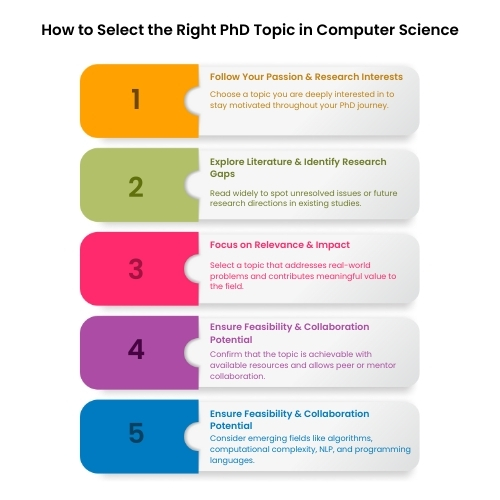
Starting a PhD in computer science is exciting but demanding, and the topic you choose shapes what you read, what you build or prove, and where you can publish. Three tests are useful: the topic should connect with a genuine interest that will sustain you for several years, it should address a real gap in the literature, and it should be feasible with the time, skills and resources you have. The general method for applying these tests is set out in How to choose a PhD topic; this article applies them to computing.

Computer science is unusually broad. A thesis may prove a theorem, design a faster algorithm, build and evaluate a system, or study how people and organisations use technology. Each kind of work counts as a contribution in a different way, so the first step is to know which kind you want to make.
| Contribution type | What counts as evidence | Example area |
|---|---|---|
| Theoretical | Proofs of new results, lower bounds or separations | Computational complexity |
| Algorithmic | Proven improvement in time or space bounds, plus implementation where relevant | Graph algorithms, data structures |
| Systems or artefact | A working system evaluated against baselines on agreed benchmarks | Compilers, NLP models, databases |
| Formal | Machine-checked proofs about a language, protocol or program | Programming language theory |
| Empirical | Carefully designed experiments or studies with valid comparisons | Machine learning evaluation, human-computer interaction |
Computational complexity: open problems and tractable questions
Complexity theory classifies problems by the resources needed to solve them. Its central question, whether P equals NP, goes back to the definition of NP-completeness by Cook (1971), and remains open; Fortnow (2009) gives an accessible account of why it matters and why it is so hard. Related open questions include the status of problems believed to be neither in P nor NP-complete. Ladner (1975) proved that if P differs from NP, such NP-intermediate problems must exist, and natural candidates include integer factoring and graph isomorphism; for graph isomorphism Babai (2016) gave a quasipolynomial-time algorithm. The unique games conjecture (Khot, 2002) would, if true, settle the approximability of many optimisation problems. Progress on circuit lower bounds continues too: Murray and Williams (2018) proved that nondeterministic quasipolynomial time (NQP) is not contained in the circuit class ACC0.
These problems make excellent orientation, but none is a sensible doctoral topic in itself. Doctoral researchers in complexity typically prove results about restricted models of computation, special classes of inputs, conditional hardness under a stated conjecture, or the exact complexity of a specific problem. Read recent survey articles and the open-problems sections of strong theory papers, and choose a question whose partial answer would still be publishable.
Algorithmic problems: where improvement is still possible
Algorithms research spans data structures, optimisation, computational geometry and number theory. It is tempting to assume that most algorithms can easily be improved, but this is not so. For comparison-based sorting, for instance, a lower bound of order n log n comparisons is proven, so asymptotic improvement is impossible in that model (Cormen et al., 2022). For other classic problems improvements still arrive, but they are major results: Chen et al. (2022) gave an almost-linear-time algorithm for maximum flow and minimum-cost flow, problems studied for decades.
New computational settings also create new algorithmic questions. Quantum algorithms such as Shor's polynomial-time method for factoring (Shor, 1997) show how a different model changes what is efficient, and the scale of modern machine learning and data processing raises questions about streaming, parallel and approximate algorithms. A realistic doctoral topic here often combines a theoretical analysis with an implementation and an empirical comparison on standard inputs.
Natural language processing: current gaps
Natural language processing has changed fundamentally. Classic rule-based components such as the Porter stemmer (Porter, 1980) remain useful, but research is now dominated by neural models built on the transformer architecture (Vaswani et al., 2017). Proposing better stemming or part-of-speech tagging for English is therefore unlikely to be a strong doctoral topic: English is the best-resourced language in the field. Joshi et al. (2020) showed that the great majority of the world's languages have very little labelled or unlabelled data and are barely represented at major NLP venues, which makes under-resourced languages a well-documented gap.
Evaluation is a second source of good questions. Machine learning studies are vulnerable to pitfalls such as sampling bias, data snooping and inappropriate baselines (Arp et al., 2022), and leakage between training and test data has undermined results across many fields (Kapoor & Narayanan, 2023). A topic that builds a careful benchmark, or re-evaluates published claims under sound conditions, can be both feasible and valuable.
Programming language theory
Programming languages remain a lasting research area: there are always new ways to design, implement, analyse and classify languages, and type systems sit at the centre of much of this work (Pierce, 2002). A good illustration of a doctoral-scale contribution is RustBelt, which gave the first formal, machine-checked safety proof for a realistic subset of the Rust language, including libraries that use unsafe features internally (Jung et al., 2018). The lesson for topic selection is that formalising and verifying properties of languages already in use can be as valuable as designing a new language.
Programming language topics usually combine three elements: a formal model of some language feature, a property proved about that model, and evidence that the model reflects practice, for example by implementing it in a compiler or checking it against real programs. Each element demands distinct skills, from mathematical logic to proof assistants and compiler engineering, so it is worth asking early which of them you already have and which a supervisor can help you learn.
Finding open questions in practice
Whatever the area, open questions are easiest to find in a few kinds of source. Recent survey articles map a field and usually end with a list of open problems. The future-work and limitations sections of strong conference papers show what the authors themselves could not do. Benchmark leaderboards reveal where performance has stalled, and published critiques of evaluation practice, such as those on machine learning in security (Arp et al., 2022), show which results deserve re-examination. Talks and workshop papers from the main conferences in your area are often a year or more ahead of journal publications.
- Choose one area from those above and read two or three recent surveys.
- List the open problems they name, and note which ones match your skills and interests.
- For each candidate, find the most recent papers that attack it and read their limitations sections.
- Ask whether a partial answer, a special case or a better evaluation would still be a contribution.
- Keep the two or three candidates that survive and test them against the feasibility checks below.
Speed matters in computing. In fast-moving areas such as large language models, a question can be answered by a well-resourced group within months, so a doctoral topic there should rest on something the field is less likely to pursue quickly: a particular language or domain, a dataset you can uniquely access, or a careful evaluation that others have neglected. In slower, more theoretical areas the risk is the reverse: a question may be too hard to yield results within the funded period, so choose one with intermediate results along the way.
Worked example: narrowing an NLP topic
The table below shows how a broad interest becomes a focused, evaluable question. It is illustrative: the gap would need to be confirmed with a systematic search.
| Level | Illustrative example |
|---|---|
| Area | Natural language processing |
| Interest | Language technology for under-resourced languages |
| Problem | Models perform poorly on languages with little labelled data |
| Gap (to verify) | Few studies compare cross-lingual transfer and small-scale annotation for named entity recognition in a specific language family |
| Focused question | For three closely related under-resourced languages, does transfer from a related high-resource language outperform annotating 1,000 sentences per language? |
| Evaluation | Held-out test sets annotated independently, with leakage checks and a stated baseline |
Each step makes the question more testable. By the final row you know what data you need, what you will compare and how success will be judged, which is what a supervisor and a proposal panel will look for.
Test the topic before you commit
Apply the FINER criteria, asking whether the question is feasible, interesting, novel, ethical and relevant (Hulley et al., 2013), and verify any claimed gap through a structured search rather than the absence of a paper you happened not to find (Müller-Bloch & Kranz, 2015). In computing, several feasibility checks are specific to the field.
| Check | Question to answer |
|---|---|
| Data | Are datasets available, licensed and suitable, or can you create them ethically? |
| Compute and hardware | Can you run the experiments with the GPUs, clusters or devices you will have? |
| Skills | Do you have, or can you learn, the mathematics, programming or proof tools required? |
| Baselines | Is there an accepted benchmark or baseline to compare against? |
| Supervision | Does a supervisor in your department work in this area? |
| Venues | Which conferences or journals publish this kind of work, and how fast is the area moving? |
For a structured process of turning the topic into a proposal, see research proposal support. Defining the precise problem is covered in Problem identification in computer science, and a comparable four-step process for another discipline is described in How to identify a psychology dissertation topic.
Common mistakes
- Choosing a famous open problem as the whole topic, with no tractable sub-question.
- Following a trend without checking how many groups with more resources are working on the same question.
- Proposing a new method without a clear baseline, benchmark or evaluation plan.
- Underestimating the data, compute or hardware the project needs.
- Relying on results that may suffer from data leakage or unfair comparisons.
- Choosing a topic no available supervisor can guide.
Other articles on the PhD Assistance blog discuss further areas: research trends including human-computer interaction, PhD topics in artificial intelligence, algorithm development and machine learning for cybersecurity.
Key takeaways
- Decide early whether your contribution will be theoretical, algorithmic, systems-based, formal or empirical, because each needs different evidence.
- Famous open problems such as P versus NP orient research, but doctoral topics are usually tractable questions near them (Fortnow, 2009; Ladner, 1975).
- Algorithmic improvements are possible but hard-won, and some problems have proven lower bounds (Cormen et al., 2022; Chen et al., 2022).
- In NLP, under-resourced languages and sound evaluation are better-documented gaps than English text processing (Joshi et al., 2020; Kapoor & Narayanan, 2023).
- Feasibility in computing includes data, compute, skills, baselines and supervision, and should be checked before committing (Hulley et al., 2013).