
Why nature-inspired optimisation, and why the ant lion
Many engineering design and scheduling problems, including the economic dispatch of generation, storage and demand response in a micro-grid, are non-convex, non-differentiable or too large to solve exactly within a useful time. Metaheuristic algorithms search for good, though not provably optimal, solutions without needing gradients of the objective function, which makes them attractive for this class of problem.
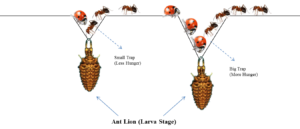
The ant lion optimizer (ALO) is one such algorithm, introduced by Mirjalili (2015) and motivated by the hunting behaviour of ant lion larvae (family Myrmeleontidae), which dig conical pits, wait at the bottom, and use motion to draw ants and other small prey down the slope. Scharf and Ovadia (2006) reviewed the ecology of this pit-building behaviour, including how larvae choose and abandon sites, which is the behavioural basis the algorithm formalises as a search strategy rather than a literal simulation of insect physiology.
The algorithm’s mechanics
ALO is population-based: a set of "ants" perform random walks across the search space, and a set of "antlions" represent candidate solutions that influence where those walks occur. Four mechanics, independently verifiable against the original paper and later reviews, define the search:
- Random walk: each ant’s position is updated by a random walk around a chosen antlion, which explores the space near that candidate solution.
- Roulette-wheel selection: antlions are chosen to guide ants with a probability weighted by fitness, so better solutions are more likely, but not certain, to attract ants.
- Elitism: the single best antlion found so far is preserved and used to guide a portion of the ants directly, which protects the search from losing a good solution.
- Shrinking boundaries: the range of the random walk around each antlion narrows as iterations proceed, shifting the search from broad exploration toward local exploitation near promising solutions (Mirjalili, 2015; Heidari et al., 2020).
An "ant" caught by an antlion (that is, a candidate solution evaluated as better than the antlion holding it) replaces that antlion’s position, so the population of candidate solutions improves over iterations without the algorithm needing gradient information. Heidari et al. (2020) reviewed variants of ALO and its use with multi-layer perceptron neural networks, which is a useful secondary source for comparing ALO against other population-based metaheuristics on the same benchmark functions.
Two design choices follow directly from these mechanics and belong in a dissertation’s methods chapter. First, the population size and the maximum number of iterations trade off solution quality against computation time, and should be set with reference to a pilot run or a published setting for a comparably sized problem, not an arbitrary round number. Second, because the random walk’s shrinking boundary controls the exploration-to-exploitation balance, a dissertation should state the schedule used (for example, linear shrinkage with iteration count) rather than leave it as an implicit default, since different schedules can change how quickly the algorithm settles on a solution.
A verified application: micro-grid energy management
The clearest, directly verifiable link between ALO and micro-grid-connected systems is Roy et al. (2019), who combined a recurrent neural network that forecasts demand response with an ALO-based economic dispatch module. The recurrent network estimates how demand will respond to price and control signals; ALO then schedules generation, storage and responsive loads, for both day-ahead planning and real-time adjustment, to minimise production cost while making better use of photovoltaic and wind generation and battery storage.
Roy, Mandal and Mandal implemented their method in MATLAB/Simulink and compared it against the genetic algorithm, artificial bee colony and bacterial foraging algorithms on the same scheduling problem, reporting lower production cost for the ALO-based approach on their test system. This is the specific, checkable precedent a dissertation should cite when proposing ALO for micro-grid scheduling, rather than a generic claim that nature-inspired algorithms suit power systems.
A micro-grid in this context is a local cluster of generation (commonly photovoltaic and small wind), storage and loads that can operate connected to the main grid or, in some configurations, island itself during a disturbance. The scheduling problem that Roy et al. (2019) solve with ALO is an economic dispatch: deciding, for each time step, how much power each generator and the battery should supply, and how far responsive loads should shift, so that forecast demand is met at the lowest cost without violating equipment limits. This is a genuinely difficult optimisation problem because storage decisions in one period constrain what is available in later periods, which is part of why a population-based search such as ALO is a reasonable choice over a simple rule-based dispatch.
| Reference | What it reviews | Relevance to ALO in micro-grids |
|---|---|---|
| Rezk et al. (2023) | Metaheuristics in micro-grid operation and management, broadly | Positions ALO among the families of algorithms used for sizing, scheduling and control |
| Akter et al. (2024) | Meta-heuristic techniques for micro-grid optimisation, scopes and trends | Surveys recent applications and reports where meta-heuristic methods, including ALO variants, are still under-evaluated |
| Mojumder and Roy (2024) | Meta-heuristics for PID controller tuning in automatic voltage regulation | A second, verified power-system application of ALO beyond economic dispatch |
Benchmarking and reporting
A dissertation that develops or applies ALO should report, at minimum: the exact objective function and constraints for the micro-grid scheduling problem; the population size, number of iterations and any parameter settings used; the algorithms ALO is benchmarked against and why they were chosen; and the test system (a standard benchmark feeder or a described, synthetic micro-grid) with its generation, storage and load profile.
Because ALO, like other metaheuristics, is stochastic, a single run proves little. Report results across multiple independent runs with a measure of spread (standard deviation or interquartile range), not only the best run, and state the computational cost (iterations or wall-clock time) alongside solution quality, since a method that reaches a slightly better result after far more computation is not straightforwardly "better" for a real-time scheduling application.
It is also worth stating explicitly which constraints were enforced and how. Power-system scheduling problems typically include generator and storage capacity limits, ramp-rate limits on how quickly output can change between time steps, and a requirement that supply meets forecast demand within some tolerance at every step. A dissertation should say whether constraint violations were penalised in the objective function, repaired after each evaluation, or prevented by construction, since this choice affects both the fairness of a comparison against other algorithms and how directly the reported cost figures can be interpreted.
Worked example (illustrative)
A hypothetical dissertation extends Roy et al. (2019)’s micro-grid formulation to include a small battery degradation cost in the objective function, then re-runs ALO, genetic algorithm and particle swarm optimisation on the same test feeder across thirty independent runs each. The comparison reports mean and standard deviation of total cost, the number of constraint violations, and iterations to convergence, following the reporting practice described above, and discusses whether the ranking between algorithms changes once degradation cost is included.
Common mistakes
- Describing ALO’s biological motivation with specific numeric claims (pit depth, lifespan, lunar effects) that are not traced to a verified source.
- Benchmarking against only one competing algorithm, which cannot show whether ALO’s advantage is general.
- Reporting only the best run of a stochastic algorithm, rather than a distribution across repeated runs.
- Citing a general metaheuristic survey as evidence for a micro-grid-specific claim, rather than the specific application paper that supports it.
Key takeaways
- ALO is a published, verifiable metaheuristic with four checkable mechanics: random walk, roulette-wheel selection, elitism and shrinking search boundaries (Mirjalili, 2015; Heidari et al., 2020).
- Its biological motivation (ant lion pit-building and prey capture) should be cited to ecological literature, not retold from memory (Scharf & Ovadia, 2006).
- The clearest verified precedent for micro-grid use pairs ALO-based economic dispatch with a recurrent-network demand forecast (Roy et al., 2019).
- Broader reviews situate ALO among other metaheuristics used in micro-grid management and power-system control (Rezk et al., 2023; Akter et al., 2024; Mojumder & Roy, 2024).
- A dissertation using ALO should report parameters, benchmarks, multiple runs and computational cost, not a single best result.