
Why choosing a psychology topic is hard
Identifying a promising dissertation topic is widely recognised as one of the most important, challenging and stressful parts of the research process in psychology (Holliman & Jones, 2018). A good topic has to be grounded in the literature on human thinking and behaviour, original enough to add something, ethical, methodologically sound and achievable within the time and resources available. Students are expected to reach it with a high degree of independence, which is precisely what makes the task uncomfortable.
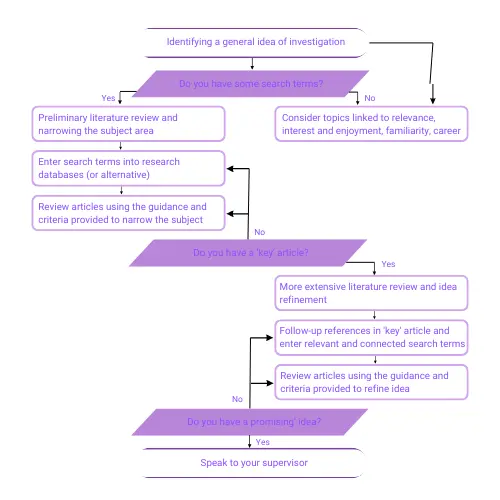
Holliman and Jones (2018) responded to this difficulty with a process map that breaks topic identification into four steps: identify a general area, conduct a preliminary literature review that ends with a single key article, conduct a more extensive review to refine the idea, and only then speak to a supervisor. The map was written for psychology students at undergraduate and postgraduate level, but its logic scales to doctoral work, where the same steps are repeated with more depth. This guide follows those four steps and adds the feasibility, ethics and design checks a doctoral or professional doctorate project (see PhD and PsyD) requires.
- 1Identify a general area: do you have some search terms?
- 2Preliminary literature review: do you have a key article?
- 3Extensive literature review and refinement: do you have a promising idea?
- 4Speak to your supervisor, well prepared
Step 1: identify a general area
The first step is reflective rather than bibliographic. Holliman and Jones (2018) suggest weighing four considerations, and the aim is to finish with a handful of general, loosely connected terms that can be used to search databases.
| Consideration | Question to ask yourself |
|---|---|
| Relevance | Is the area rooted in psychological literature on human thinking and behaviour? |
| Interest | Which modules, lectures or staff research did you find most engaging? |
| Familiarity | Do you already know enough to read the literature critically, without relying only on personal experience? |
| Career connection | Would the topic give you knowledge or experience relevant to the work you want to do? |
Personal experience can be a legitimate starting point, for example an interest in anxiety arising from work in schools, but the topic must be justified by the literature rather than by the experience alone. At doctoral level it also helps to think early about the population you could realistically reach. Much of psychology has been built on samples from Western, educated, industrialised, rich and democratic societies, which are unusual on many measures (Henrich et al., 2010), so access to a different population can itself be the basis of a contribution.
Step 2: a preliminary review that ends with one key article
Enter your search terms into specialist databases such as PsycINFO, Scopus and Web of Science; Google Scholar is useful for a first sweep but harder to search systematically. Holliman and Jones (2018) recommend restricting this first search to peer-reviewed journal articles from the last one to three years, so that you see the current state of the debate before you read its history. Scan titles for resonance with your interests, read the abstracts of the promising ones, and for the best few read the introduction for the research questions and the opening of the discussion for the summary of findings, limitations and future directions.
The output of this step is a single key article that will anchor the next stage. Record its details carefully, because they become the skeleton of your later rationale.
| Record | Why it matters |
|---|---|
| Full reference | You will cite it repeatedly and need to find it again quickly |
| Aims, research questions and hypotheses | Show what has been asked and how it was framed |
| Population and sample | Reveal who has and has not been studied |
| Methodology and measures | Tell you what is achievable and what could be changed |
| Findings | Define what is already known |
| Theoretical framework | Connects the study to a wider body of work |
| Researchers cited | Give you names to search in step 3 |
| Limitations and future directions | Often point directly to an open question |
Worked example: physical activity and children's cognitive performance
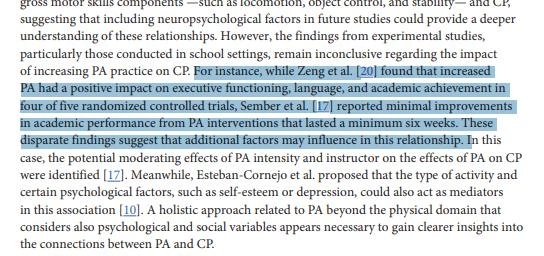
Suppose your general area is physical activity and cognition in childhood, and your preliminary search leads to Montalt-García et al. (2025) as a key article. Its introduction does what a good key article should: it shows that the evidence is mixed. A systematic review of trials in preschool children found that four of the five studies that tested cognitive outcomes reported significant improvements in areas such as language learning, attention and working memory (Zeng et al., 2017). A meta-analysis of 44 interventions in children and adolescents aged 5 to 16, by contrast, found only a weak positive overall effect on academic performance, and noted that academic performance is not caused by physical activity alone (Sember et al., 2020).
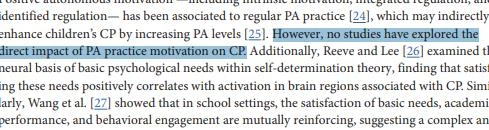
Contradictory evidence of this kind is one of the clearest signals of a gap, provided you check that it is real by searching systematically rather than relying on one article (Müller-Bloch & Kranz, 2015). The authors then propose an explanation: physical activity may affect cognition directly, but psychological and social factors such as motivation, enjoyment and relatedness may also matter, and studies that look at one variable at a time cannot capture how these combine in individual children.
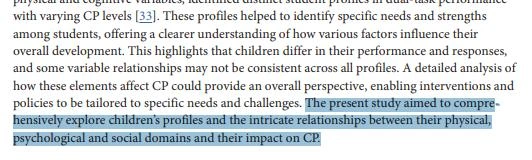
From that reasoning comes the aim: to explore children's profiles across physical, psychological and social domains and their relationship with cognitive performance. The study measured 194 fifth-grade children in Spain, combining accelerometer-measured activity, fitness and motor competence with motivation, social measures and cognitive tests, and used self-organising maps to identify six profiles. Children in profiles with moderate to high physical scores generally performed better, while profiles marked by low motivation and social engagement performed worst (Montalt-García et al., 2025).
For your own topic, the lesson is not to copy the study but to read its limitations and design choices as openings. The sample is cross-sectional and drawn from one region, so a longitudinal design, a different age group or a different cultural setting would each ask a genuinely new question.
Step 3: extend the review and refine the idea
Step 3 builds outwards from the key article: follow its references backwards, search for the authors and subject terms it uses, and find newer papers that cite it (Holliman & Jones, 2018). As you read, keep asking whether the topic still interests you, whether you can explore an existing aim further or slightly differently, whether the published methods are achievable for you, and whether you could partially replicate or adapt a method with important amendments. Replication is a respectable aim in psychology: a large coordinated attempt to reproduce 100 published studies obtained significant results in only about a third of cases (Open Science Collaboration, 2015), which shows how much established findings still need testing.
Check feasibility early
| Area | What to check before committing |
|---|---|
| Participants | Can you reach the population, and in sufficient numbers, within your timeline? |
| Sample size | Can you justify the sample on power, precision or resource grounds (Lakens, 2022)? |
| Ethics | Does the study involve vulnerable groups, deception or sensitive data that need special approval (British Psychological Society, 2021)? |
| Measures | Are validated instruments available, licensed and suitable for your population? |
| Skills | Do you have, or can you learn, the analysis the design requires? |
Sample size deserves particular attention. Small studies have low power, which not only makes true effects harder to detect but also lowers the chance that a significant result reflects a true effect (Button et al., 2013). A topic that only works with a sample you cannot obtain needs to be reshaped, for example by narrowing the population, choosing a within-participant design or asking a qualitative question instead.
Write the question and, where appropriate, a hypothesis
A research question should be specific, answerable and tied to the gap you found. The FINER criteria ask whether it is feasible, interesting, novel, ethical and relevant (Hulley et al., 2013). In quantitative work, a hypothesis predicts an outcome on the basis of previous research; preregistering it, with the analysis plan, before data collection protects you from the undisclosed flexibility that inflates false positives (Nosek et al., 2018). In qualitative work the question is usually exploratory, and the method, for example reflexive thematic analysis (Braun & Clarke, 2006), should follow from it.
From broad idea to testable question: an illustration
Take the question "How does mindfulness meditation affect test anxiety in university students?" It is a reasonable starting point, because test anxiety is consistently associated with lower performance (von der Embse et al., 2018) and mindfulness-based interventions have been tested with university students in many randomised trials (Dawson et al., 2020). But precisely because so much work exists, the question must be narrowed before it identifies a contribution. The table below is illustrative.
| Level | Illustrative example |
|---|---|
| General area | Mindfulness and anxiety in higher education |
| Broad question | How does mindfulness meditation affect test anxiety in university students? |
| Gap (to verify) | Few trials compare brief, exam-period practice with a matched active control in first-year students |
| Focused question | Does a four-week app-based mindfulness programme reduce self-reported test anxiety more than an active relaxation control in first-year undergraduates? |
| Hypothesis | Participants in the mindfulness condition will report lower test anxiety after the programme than those in the control condition |
Each refinement names a population, an intervention, a comparison and an outcome, which in turn tells you which measures, design and sample you need. That is the point at which the topic becomes something you can take to a supervisor.
Step 4: speak to your supervisor
Holliman and Jones (2018) place the supervisor meeting last for a reason: students who arrive having completed the earlier steps can answer the questions supervisors typically ask with confidence, supported by citations. Bring the key article, a one-paragraph summary of the gap, your draft question, a proposed design and a short list of the main feasibility risks. Expect challenge on originality, method and ethics, and treat it as part of refinement rather than rejection. If the idea needs reshaping, return to step 3 with the feedback; the process map is deliberately iterative.
For the next stage, turning an agreed topic into a proposal, see research proposal support and the general testing steps in How to choose a PhD topic. The evidence on what shapes topic choice is reviewed in The importance of dissertation topic selection, and a comparable process for computing is described in How to select a PhD topic in computer science.
Common mistakes
- Starting with a fashionable area and no specific question, then reading without direction.
- Relying on Google Scholar alone and missing studies indexed in PsycINFO or Web of Science.
- Treating one article's claim of a gap as proof, without a systematic search.
- Choosing a design that needs a sample far larger than you can recruit.
- Leaving ethical risks, such as research with children or clinical groups, until the proposal stage.
- Writing a hypothesis that is not grounded in previous findings or cannot be tested with the planned measures.
- Going to the supervisor with only an interest, rather than a key article, a question and a design.
Key takeaways
- A structured process, from general area to key article to refined idea to supervisor, makes topic identification less stressful and more independent (Holliman & Jones, 2018).
- A single, carefully recorded key article anchors the search and often points directly to limitations and open questions.
- Contradictory findings, such as those on physical activity and children's cognition, are strong signals of a gap once verified (Zeng et al., 2017; Sember et al., 2020).
- Feasibility in psychology depends on participants, ethics, validated measures and an adequately justified sample size (Lakens, 2022; British Psychological Society, 2021).
- A good question names population, exposure or intervention, comparison and outcome, and leads naturally to a testable hypothesis or a clear qualitative aim.