
Why the proposal carries so much weight in the UAE
Business and management doctoral researchers in the UAE work on topics that change quickly: digital transformation, artificial intelligence, sustainability, human resource management, innovation, leadership and financial technology. The pace makes it easy to choose a fashionable area and hard to turn it into a defensible study. Many first proposals describe the area well but leave the problem, the gap and the design unclear.
That matters because the proposal is assessed. The Commission for Academic Accreditation requires accredited doctoral programmes to include a comprehensive examination that covers a defence of the research proposal (Commission for Academic Accreditation, 2019). At UAE University the proposal must clearly define the research problem and objectives and outline the methodology, and it is approved by the PhD Advisory Committee (United Arab Emirates University, 2018). More generally, a proposal is a gatekeeping document that must show not only what will be studied but how (Kivunja, 2016).
This article is a diagnostic. For the step-by-step writing of a management proposal, including the choice of theory and of structural equation modelling, see How to develop a PhD research proposal in UAE management; for structure, approvals and ethics, see the guide to dissertation proposals for UAE researchers.
How UAE-based management studies have built their designs
Looking at published UAE management research shows what committees and reviewers have accepted, and where the common designs leave room for a new contribution.
Singh and Shaurya (2021), with the first author at the American University in the Emirates, studied how artificial intelligence affects human resource practices in UAE companies. They combined eight semi-structured interviews, analysed thematically, with a survey of 248 HR and AI personnel analysed with partial least squares structural equation modelling (PLS-SEM). They noted that only a limited number of UAE firms had integrated AI into HR, which constrains generalisation. Sandhu and Al Naqbi (2023) examined leadership behaviour and innovation performance in the UAE telecom and ICT industries, an example of narrowing a broad leadership topic to one outcome and one sector.
Recent studies follow a similar pattern. Almazrouei and Alnahhal (2026) surveyed 233 public-sector employees and used PLS-SEM to relate transformational leadership to employee performance through digital transformation and organisational agility, recommending longitudinal designs and private-sector samples. Sakka (2026) surveyed mid-to-senior managers (600 valid responses from 1,000 invited) and used covariance-based SEM to relate leadership, flexibility and strategic planning to digital transformation success. Thomas et al. (2025) surveyed 315 managers of hospitality SMEs across the seven emirates and reported a cross-sectional, self-reported, mostly male, single-sector sample.
| Study | Focus | Design | Limitation reported or visible | Lesson for your proposal |
|---|---|---|---|---|
| Singh & Shaurya (2021) | AI and HR practices | 8 interviews plus survey of 248; thematic analysis and PLS-SEM | Few firms had integrated AI in HR | Check that enough organisations exist to sample before you commit |
| Sandhu & Al Naqbi (2023) | Leadership and innovation performance | Telecom and ICT industries | Sector-specific | Narrow a broad construct to one outcome and one sector |
| Almazrouei & Alnahhal (2026) | Leadership and performance, public sector | Survey of 233; PLS-SEM with mediators | Cross-sectional; public sector only | A longitudinal or private-sector design can itself be a contribution |
| Sakka (2026) | Digital transformation success | Survey of 600 managers; covariance-based SEM | Single-source survey | Plan remedies for common method bias |
| Thomas et al. (2025) | AI adoption intention in hospitality SMEs | Survey of 315 managers; PLS-SEM | Self-report, mostly male, one sector | Justify the sample and state its boundaries |
The pattern is clear: cross-sectional, single-source surveys analysed with SEM dominate. Such designs are vulnerable to common method bias, which a proposal should anticipate procedurally and statistically (Podsakoff et al., 2003), and they leave openings for longitudinal, multi-source, qualitative or mixed designs.
Five weaknesses and how to fix them
1. The topic is too broad
"Artificial intelligence in business" is an area. "The impact of generative AI adoption on employee productivity in UAE service organisations" names a technology, an outcome, an organisational setting and a population. Each element you specify removes a decision the committee would otherwise ask you to make. For the narrowing process itself, see how to narrow an AI topic in the UAE and choosing a topic in UAE management.
2. The gap is described, not argued
Many proposals list prior studies and conclude that "few studies exist in the UAE". A gap argument instead moves from what is known to why it is insufficient. Gap-spotting of this kind is legitimate, but the more influential questions often challenge an assumption in the literature rather than fill a space in it (Sandberg & Alvesson, 2011; Alvesson & Sandberg, 2011).
- 1Existing research
- 2Its limitations
- 3Unresolved business problem
- 4Proposed contribution
3. Questions and methods are not aligned
Decide what each question asks before choosing a method. A "how" or "why" question about processes points towards qualitative or case designs; a question about the strength of relationships points towards a survey and statistical modelling; a question that needs both explanation and measurement may justify mixed methods (Saunders et al., 2023). For each question, name the data source, the design and the analysis.
| Question asks | Typical design | Typical data | Typical analysis |
|---|---|---|---|
| How or why a process unfolds | Case study or interview study | Interviews, documents, observation | Thematic or within-case analysis |
| Whether and how strongly variables are related | Cross-sectional or longitudinal survey | Validated scales, secondary data | Regression or SEM |
| Whether an intervention changes an outcome | Experiment or quasi-experiment | Measured outcomes before and after | Group comparisons |
| Both what happens and why | Sequential or concurrent mixed methods | Survey plus interviews | Integration of both strands |
4. Originality is not demonstrated
Testing an established theory on UAE data does not by itself say what will be learned. State the contribution as one of a recognisable kind: a new relationship or mediator, a boundary condition under which a theory behaves differently, a design that addresses a known limitation, or a mechanism that previous work assumed. The limitations in the table above are a good source: a longitudinal test of a relationship previously studied cross-sectionally is a contribution that can be argued (Almazrouei & Alnahhal, 2026).
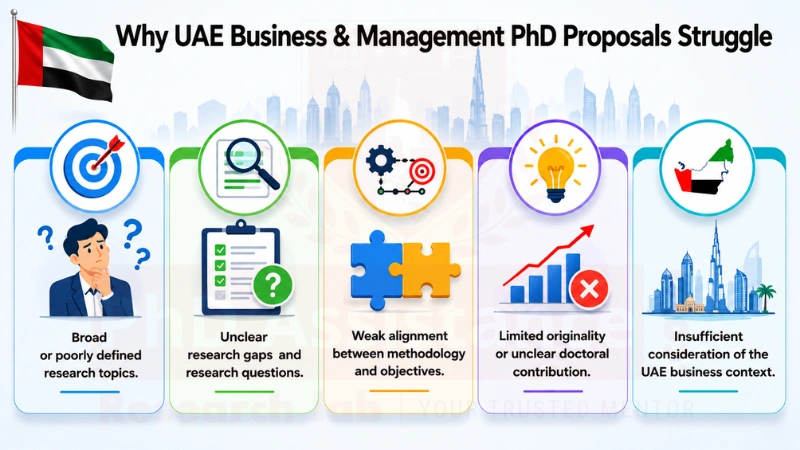
5. The UAE context is asserted, not justified
Adding "in the UAE" to an international topic is not a rationale. Explain which features of the setting could change the result: a highly multinational workforce, the balance of public and private employment, national priorities such as digital government, or the structure of particular industries. If the answer would be the same anywhere, the UAE is a sample, not a context, and the proposal should say so honestly.
Worked example: strengthening a proposal outline (illustrative)
The following case is hypothetical and implies no results. A doctoral researcher in Dubai submits an outline titled "AI in UAE businesses". The diagnostic gives this revision.
- Scope. Narrowed to generative AI tools used by customer-facing employees in UAE service organisations.
- Gap. Existing UAE studies examine adoption intention or leadership with cross-sectional surveys (Thomas et al., 2025; Almazrouei & Alnahhal, 2026); they leave unresolved whether use changes productivity over time.
- Questions. (1) Is the frequency of generative AI use associated with changes in self-reported and supervisor-rated productivity over six months? (2) How do employees describe the tasks where the tools help or hinder them?
- Alignment. Question 1: two-wave survey with matched supervisor ratings, which also reduces single-source bias (Podsakoff et al., 2003). Question 2: follow-up interviews with a purposive sample, analysed thematically.
- Originality. A two-wave, multi-source design addresses a limitation the local literature reports.
- Context. Multinational service teams working in several languages, which may shape how useful the tools are.
Each element can now be defended in a few sentences, which is what a committee will ask the researcher to do.
Self-check before you submit
Five questions to ask. The table adds the evidence that should be visible in the proposal for each.
| Question | Where the evidence should appear |
|---|---|
| Is the research problem clearly defined? | A one-paragraph problem statement in the introduction |
| Is the research gap and originality demonstrated? | The final part of the literature review and a contribution statement |
| Does the methodology align with the research questions? | A table linking each question to design, data and analysis |
| Is the research relevant to UAE business and management? | A short context section explaining why the setting matters |
| Does the proposal show a clear academic or practical contribution? | Contribution and implications, stated separately |
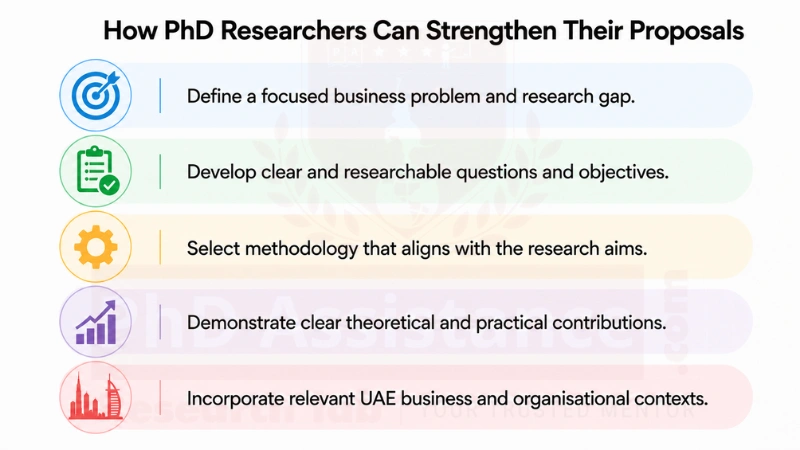
Common mistakes and what to do next
Studies of proposal writing report the same faults across settings: vague or overly broad topics, missing problem statements, no clear gap and inappropriate methods (Manchishi et al., 2015). In UAE business proposals the following are especially common.
- Choosing the method before the question, then writing questions to fit it.
- Proposing an SEM model without checking that enough organisations or respondents exist to sample.
- Claiming originality from the UAE setting alone.
- Relying on a single cross-sectional survey without addressing common method bias.
- Copying the institution's template headings without showing how the sections connect.
Next, write one sentence each for the problem, the gap, the contribution and the UAE rationale, and build the question-design table. Then check your university's current graduate policy for structure and timing, and take the draft to your supervisor. The research proposal pages and the course Conducting Research: Topic to Viva cover the next steps.
Key takeaways
- A doctoral proposal in the UAE is defended as part of the comprehensive examination, so its design must be defensible (Commission for Academic Accreditation, 2019; United Arab Emirates University, 2018).
- UAE management studies rely heavily on cross-sectional surveys and SEM, which leaves room for contributions in design (Almazrouei & Alnahhal, 2026; Sakka, 2026; Thomas et al., 2025).
- A gap is an argument from known limitations to an unresolved problem, and the strongest may question an assumption (Sandberg & Alvesson, 2011; Alvesson & Sandberg, 2011).
- Every research question needs a matching design, data source and analysis (Saunders et al., 2023).
- Local evidence shows the value of checking that enough organisations exist before committing to a design (Singh & Shaurya, 2021).