

Call for Papers: Agentic AI for Intelligent Industrial Systems
April 22, 2026
How to Choose a PhD Topic in UAE Management: Focusing on Generative AI Leadership and Digital Transformation
April 24, 2026How to Write an AI-Focused PhD Research Proposal in the UK: From Problem Design to Intelligent System Development
- April 24, 2026
- PhD Research Proposal
Introduction
The UK PhD research programs need to get approval through a complete research proposal submission, which needs to follow both academic standards, research ethical guidelines, and university-specific requirements. Your AI proposal needs to show your ability to identify research problems, develop evaluation standards, perform literature research, and build an intelligent system that creates new knowledge and real-world solutions.
Artificial Intelligence PhD students experience difficulties when they develop research proposals, as they must integrate different research elements into a single document. Students possess strong technical abilities but struggle to demonstrate their technical knowledge through research presentations required by supervisors and admissions committees.
The blog provides scholars with a structured process to create a high-quality AI PhD research proposal that meets UK university standards while demonstrating research value, innovation potential and technical feasibility. The PhD Assistance Research Lab provides expert PhD research proposal writing service in UK by ensuring their research elements comply with academic standards and future publication opportunities.
What you will learn from this blog?
- How to structure an AI PhD proposal based on UK university expectations
- Key components of a strong and innovative AI research proposal
- Common mistakes that delay approval or revision requests
- Techniques to improve technical depth and academic quality
Step-by-Step Guide and PhD Computer Science Proposal Writing Service in UK
1. Framing an effective AI research problem
Your research proposal needs a problem statement, which will establish its fundamental basis to direct all research activities. The proposal will face difficulties in obtaining approval when the research problem exists as an excessively wide, ambiguous, obsolete, or unimportant issue.
Your proposal should:
- Clearly define a real-world or theoretical AI problem
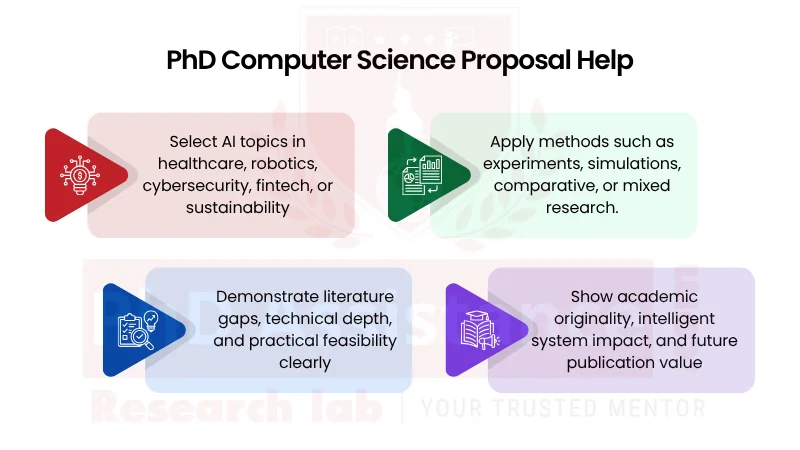
- Show relevance to current UK priorities, which include healthcare AI and robotics, cybersecurity, fintech, sustainability, smart cities and education technology
- Demonstrate why the issue requires intelligent system development instead of using traditional methods
- The existing AI models and systems, together with their decision-making processes, demonstrate two specific areas where clear deficiencies exist.
A strong problem statement enhances the credibility of your research and its research significance. If you’re not sure about this, get help from the expert PhD Computer Science Proposal Writing Service in UK
2. Building research objectives and questions with PhD AI Research Proposal Writing Service in UK
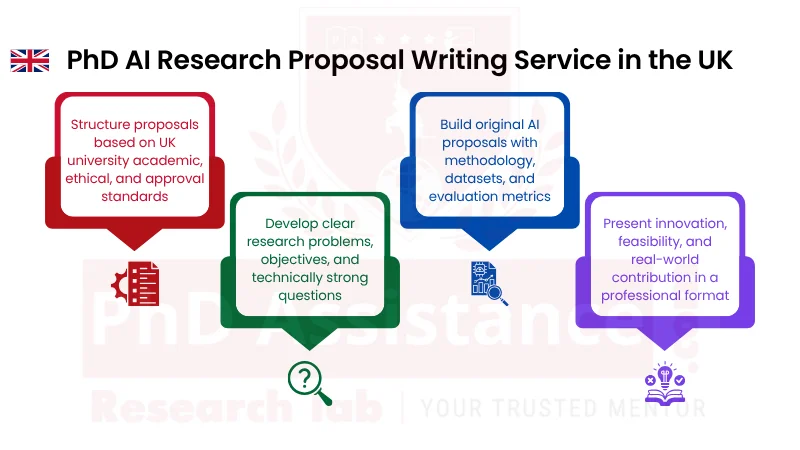
The research objectives and research questions of the study maintain control of the study while keeping the proposal on its planned track. Proposals in artificial intelligence must demonstrate their academic results through the development of technical systems.
You need to:
- Create clear, specific, and achievable objectives
- Define research questions that are technically meaningful and academically relevant
- Ensure logical alignment between the problem, objectives, and methods
- Show how outcomes can be tested or evaluated.
A well-developed research objective demonstrates academic standards and a clear research direction. A customised PhD AI Research Proposal Writing Service in UK ensures the above elements in your research proposal.
3. Conducting an effective literature review
The literature review shows your research knowledge with the ability to analyse research gaps. UK universities expect students to provide critical evaluations of the studies instead of summarising content.
A strong literature review should:
- Review major AI theories, algorithms, and frameworks
- Examine current journal articles, conference papers and technical reports to conduct their study.
- Evaluate the study results to find any existing problems that remain unsolved, the limitations of the research and the areas where findings do not align.
- Compare competing methods and technologies
- Highlight opportunities for innovation and original contribution
UK universities require students to present critical analyses that are different from basic summary work. Your research should begin with a comparative study, which you must prove through evidence.
4. Designing an optimal research methodology
The methodology section is one of the most essential components of an AI proposal because it demonstrates the process through which you will build, evaluate, and authenticate your intelligent system.
You must:
- Choose a suitable research design between experimental, simulation, comparative and mixed methods research approaches
- Select existing datasets or create methods for gathering new data
- Select the algorithms, models, and frameworks that will be implemented
- The process requires us to establish five different stages, which include preprocessing, training, validation and testing activities
- The assessment metrics use seven evaluation metrics, which include accuracy, precision, recall, F1-score, RMSE, AUC and additional metrics.
- The project needs to address the following aspects, which include fairness and privacy and reproducibility, and ethical considerations.
Your research attains significance through its effective methodology, which shows its capacity to deliver actual outcomes.
Get the pricing details for the PhD research proposal service at PhD Assistance, designed to assist AI researchers in meeting university standards
5. Framing a critical research significance
The proposal requires demonstrating your research value through findings. The evaluators use this information to assess the research’s value in both academic and practical domains.
You should:
- Show theoretical contributions to AI knowledge
- Explain practical value for UK industries, public services, or society
- Demonstrate innovation and scalability potential.
- Address national priorities such as NHS efficiency, transport optimisation, sustainability, or digital security
Clear significance increases proposal strength and long-term value.
6. Developing an ideal timeline
Your research study should clearly have a timeline to complete the research.
The schedule needs
- Literature review phase
- Data collection and preparation
- Model development and experimentation
- Validation and performance testing
- Writing journal papers or chapters
- Thesis writing and revisions
- Final submission milestones
Uk universities require research proposals that demonstrate both effective planning and practical execution capacity.
7. Quality checking for university compliance
Before submission, review the proposal carefully to ensure quality and completeness. Students usually ignore this step as it plays a crucial role in the structure and formatting of the proposal. This can be addressed through expert Computer Science PhD Proposal Help in UK
Check for:
Grammar and academic clarity
- Technical consistency across sections
- Correct referencing style
- Logical structure and flow
- UK university formatting requirements
- Ethical approval considerations
- Clear originality and novelty claims.
Mistakes to be avoided:
- Choosing an overly broad or generic AI topic
- Promising unrealistic system development goals
- Ignoring ethics, privacy, or algorithmic bias issues
- Weak alignment between objectives and methods
- Descriptive literature review without critique
- No clear evaluation plan for models
- Lack of originality or contribution statement
- Poor academic writing and formatting.
Researchers can avoid these common mistakes by getting support from an expert PhD AI Proposal Writing Help in UK while enhancing the quality of their proposal.
Example:
- All AI PhD proposals require both a specific problem definition and valid research methods and viable research assessment methods to meet approval requirements. Alaa Abd-Alrazaq et al published a peer-reviewed study in 2023 that demonstrated that most AI research studies failed to implement necessary validation methods and maintain research transparency.
- Research by Lucija Tomasev et al. (2019) showed that many AI systems used weak validation and biased datasets. The evaluation process for PhD proposals requires researchers to demonstrate their capability of conducting research through effective methodologies and trustworthy information sources.
Conclusion
Researchers must demonstrate their academic expertise, technical knowledge, ability to conduct innovative research, and develop strategic projects when they create AI-based PhD research proposals for UK institutions. The complete proposal structure works as the primary evidence that demonstrates your preparedness to conduct doctoral research.
The structured approach enables scholars to achieve better results as it develops higher-quality proposals while increasing supervisor trust and improving their chances of admission.
Experts at PhD Assistance provide comprehensive PhD AI Research Proposal Help in UK, by developing high-quality proposals that meet university requirements for approval.
Book a Free Expert Consultation with PhD Assistance to develop a high-quality research proposal that supports your doctoral success.
References
- van Hartskamp M, Consoli S, Verhaegh W, Petkovic M, van de Stolpe A. Artificial Intelligence in Clinical Health Care Applications: Viewpoint. Interact J Med Res 2019;8(2):e12100. doi: 10.2196/12100.
- Tomašev, N., Glorot, X., Rae, J. W., Zielinski, M., Askham, H., Saraiva, A., Mottram, A., Meyer, C., Ravuri, S., Protsyuk, I., Connell, A., Hughes, C. O., Karthikesalingam, A., Cornebise, J., Montgomery, H., Rees, G., Laing, C., Baker, C. R., Peterson, K., Reeves, R., … Mohamed, S. (2019). A clinically applicable approach to continuous prediction of future acute kidney injury. Nature, 572(7767), 116–119. https://doi.org/10.1038/s41586-019-1390
