

Graphene-Based Nanocomposite Membranes for Selective Gas Separation in Industrial Filtration
August 1, 2026
How to Complete a PhD Dissertation in UAE Agricultural Engineering: Integrating IoT Sensors and Precision Irrigation Systems
August 4, 2026Why UK PhD Healthcare Students Keep Missing Assignment Deadlines
- August 3, 2026
- Assignment
Introduction
Dealing with assignments while pursuing a PhD in healthcare is one of the most challenging things that doctoral students in the UK face. The difference between a PhD in healthcare and most other PhD programs is that healthcare research involves juggling many studies, such as clinical work and research publication.
Apart from research-related duties, healthcare PhD students in the UK are supposed to carry out extensive literature reviews, analyse complex data sets, meet academic writing standards, and follow university regulations. Supervision delays, ethics approvals, and clinical involvement only serve to add more stress to the academic life of students.
By understanding the cause of the delay, a doctoral researcher can learn how to make better strategies to manage the workload and become more productive in academic activities. The following blog will analyse the important causes of assignment deadline failure among UK PhD healthcare students and recommend practical measures to address the situation. For students requiring further assistance in the implementation of these techniques, PhD Assistance Research Lab offers specialist PhD Assignment Writing Support in UK in association with doctoral students.
What you will learn from this blog?
- Why UK PhD healthcare students frequently miss assignment deadlines.
- The major academic and clinical challenges affecting assignment completion.
- Practical strategies for improving time management and research productivity.
- How expert healthcare assignment support can help doctoral researchers.
Why Does Healthcare Assignment Support in UK Matter for UK PhD Students?
PhD-level healthcare assignments involve much more than subject knowledge. The student is required to analyse the literature on healthcare, use evidence-based practice, analyse the results of research and build academic arguments, which are based on university rules and referencing styles. All this is expected of researchers who are engaged not only in academic work but also in other areas such as clinical work, research, publication and professional activity.
As a result of the above factors, it may be harder for the student to maintain the quality of work and adhere to submission deadlines. Healthcare Assignment Support in UK helps improve the student’s academic writing skills and organisation of complicated research as well as the critical analysis of literature.
Why Do UK PhD Biomedical Manuscripts Get Rejected Before Journal Peer Review?
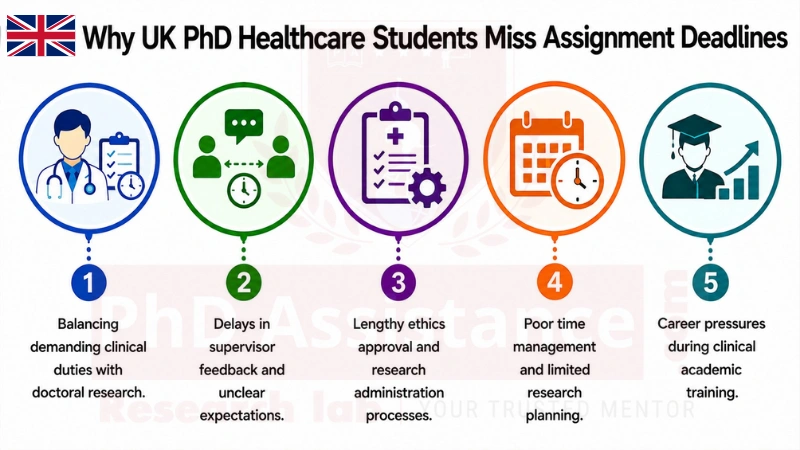
1. Balancing Clinical Responsibilities with Doctoral Research
Many PhD healthcare students in the UK are caught between meeting the challenges associated with performing the functions of their clinical roles as well as conducting research at the level of a PhD. These students not only have to conduct their own research, but they must also assume the role of being either doctors, nurses, pharmacists, or allied healthcare professionals.
As a result of the requirements of patient care and clinical commitments, assignment writing, literature review and research is often delayed. As a result of the lack of protected time to perform the research, the students find it hard to make continuous progress in academia.
What research shows:
A national survey by Shanahan et al. (2022) found significant variations in terms of research time, supervision, and mentorship among UK Academic Clinical Fellows. It is worth noting that most of the participants in this survey stated that their clinical duties tend to hinder their research work.
Tips:
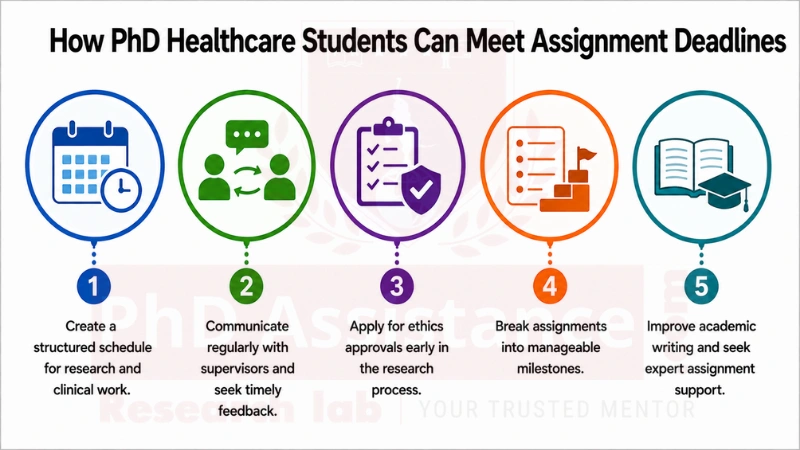
- Develop a weekly schedule that separates clinical and research tasks.
- Begin assignments well before submission deadlines.
- Reserve protected research time exclusively for academic work.
- Communicate workload challenges with your supervisor.
2. Addressing Unclear Research Expectations and Supervisory Challenges with PhD Assignment Writing Services in UK
Supervision is an essential part of assisting PhD candidates in carrying out research successfully. However, variation in supervisory practices, late feedback, and lack of understanding concerning requirements of quality and research criteria may impede the research process substantially. In most cases, students are unaware of the depth of analysis, structure or critique needed in their assignments.
This is why many PhD researchers must rewrite the same assignments several times instead of moving on to the next step of research. Late feedback and lack of coordination may impede planning the schedule effectively. Therefore, setting up clear expectations at the very beginning of the research process would facilitate effective work. Structured PhD Assignment Writing Services in UK can significantly help students address these challenges.
What research shows:
One of the major causes of delayed research, according to Lee (2008), is due to the failure of having good expectations by the doctoral student and his or her supervisor. Most importantly, the study asserts that constant communication and feedback from the supervisor will build confidence in the students and improve their research performance.
Tips:
- Discuss assignment expectations during supervision meetings.
- Establish clear milestones for each submission.
- Request regular feedback throughout the writing process.
- Record agreed action points after every meeting.
3. Ethical Approvals and Research Administration Delays
The ethical approval for patient research or research on hospital records must be obtained from different ethical bodies before beginning any research. The approval process makes the research more difficult compared to research in many other fields, where students must secure clearance from their department.
The time taken to obtain clearance from different bodies may range between several weeks and months depending on the nature of the research that is being undertaken. Data collection cannot be started until all clearances are obtained, hence causing a delay in the research process.
What research shows:
According to the UK Health Research Authority (HRA, 2024), all health care research involving patients or making use of NHS data must have certain approvals related to ethics and governance to ensure safety and the validity of research for the participants. The delay in getting approval is one of the common issues in research.
Tips:
- Submit ethics applications early.
- Prepare all research documents carefully.
- Include contingency time in your research plan.
- Monitor institutional approval requirements regularly.
4. Limited Structure and Independent Research Demands
Unlike postgraduate programmes that are taught, PhD research demands that students organise their schedules, keep track of their progress on their own, and reach their research goals without much supervision. The transition from a structured clinical setting to research can be very difficult for many PhD students in the field of healthcare.
Without having a well-structured schedule or any sort of academic work to do, it may be very easy to avoid assignments until one gets too busy with their clinical duties and research. One may procrastinate due to the absence of a proper schedule.
What research shows:
It was discovered by Sverdlik et al. (2018) that, through the analysis of a number of literature studies, self-regulation, time management, structured supervision, and academic support were essential predictors of the success of a doctorate. It has been discovered in this study that the lack of structure and academic loneliness were common reasons for delaying and inefficiency in academia.
Tips:
- Develop weekly and monthly research plans.
- Break large assignments into smaller milestones.
- Join research writing groups for accountability.
- Review progress against planned deadlines regularly.
Explore the PhD Assignment Writing Help in UK at PhD Assistance Research Lab to balance both clinical practice and assignment writing without stress.
5. Career Uncertainty During Clinical Academic Training
Many PhD students in healthcare must take a break from their full-time clinical practice to conduct their research. At this point in time, it is crucial for the students to develop a solid reputation in an academic field by working on their research papers, presenting at conferences, and doing assignments to be ready to return to practice.
Bringing together these two long-term goals of one’s career can create more uncertainty and stress because the students will have to manage two different tasks related to research and their future career.
Example: According to the National Institute for Health and Care Research (NIHR, 2023), clinical academic trainees often find it hard to balance their need for research training and work in the clinical environment. Properly balancing all these conflicting demands is essential in order to produce research outcomes and successfully complete the doctoral studies.
Tips:
- Develop a long-term academic and clinical career plan.
- Schedule research activities around professional commitments.
- Maintain regular contact with supervisors and mentors.
- Review priorities and workload periodically.
How to Complete Healthcare Assignments on Time
- Plan a realistic study plan considering research and clinical work.
- Begin your assignments the minute you are assigned them.
- Break up your big assignments into smaller ones.
- Maintain regular communication with your supervisor.
- Make prior arrangements regarding the ethics of your research activities.
- Source some recent peer-reviewed papers on healthcare to help you support academic points.
- Strengthen your general academic skills throughout the PhD (including writing style and referencing.
- Proofread your assignments before submitting them.
- Consult someone to give you extra support where you need extra guidance.
Conclusion
Completing assignments while studying for a PhD in healthcare in the UK is not only about managing time wisely. Students have to manage many different things at the same time, including their busy clinic schedule, their individual research work, obtaining the necessary ethical clearance, academic writing, and professional development.
With knowledge of the aspects causing delays in deadline compliance and the implementation of a well-planned strategy, doctoral researchers stand a better chance of not only improving their academic performance but also enhancing their research output. Good organisational skills, frequent communication with the supervisor, and early academic assistance will greatly lower stress levels and improve assignment quality.
Facing challenges to keep up with your healthcare PhD assignments? PhD Assistance Research Lab provides expert support with healthcare assignments, literature reviews, research writing, critical analysis, editing, and referencing to help UK doctoral researchers achieve academic excellence.
Book a Free Expert Consultation and receive Customised PhD Healthcare Assignment Services in UK for healthcare students.
References
- Shanahan, T., Barrett, L., Fish, R., Newcombe, V., Body, R., & Jafar, A. J. N. (2022). Survey of current and former academic clinical fellows in emergency medicine in the UK. European Journal of Emergency Medicine, 29(4), 304–306. https://doi.org/10.1097/MEJ.0000000000000912
- Lee, A. (2008). How are doctoral students supervised? Concepts of doctoral research supervision. Studies in Higher Education, 33(3), 267–281. https://doi.org/10.1080/03075070802049202
- Health Research Authority. (2025). UK policy framework for health and social care research. https://www.hra.nhs.uk/planning-and-improving-research/policies-standards-legislation/uk-policy-framework-health-social-care-research/
- Sverdlik, A., Hall, N. C., McAlpine, L., & Hubbard, K. (2018). The PhD experience: A review of the factors influencing doctoral students’ completion, achievement, and well-being. International Journal of Doctoral Studies, 13, 361–388. https://doi.org/10.28945/4113
- National Institute for Health and Care Research. (2023). Integrated Academic Training (IAT) Programme. https://www.nihr.ac.uk/explore-nihr/academy-programmes/integrated-academic-training.htm
FAQs:
1. Why are biomedical manuscripts rejected before peer review?
Biomedical manuscripts are often rejected due to poor journal fit, methodological weaknesses, ethical compliance issues, weak scientific writing, or limited research novelty.
2. How can UK PhD researchers improve their manuscript acceptance rate?
Researchers can improve their chances by selecting the right journal, following submission guidelines, strengthening methodology, and presenting their findings clearly.
3. Why is manuscript structure important during editorial screening?
A well-structured manuscript improves clarity, helping editors assess the research efficiently and increasing the chances of peer review.
4. What role does ethical compliance play in biomedical publishing?
Ethical approval, informed consent, and conflict of interest disclosures are essential to demonstrate research integrity and meet journal requirements.
5. How can professional manuscript writing support help researchers?
Professional manuscript writing support helps improve scientific writing, manuscript structure, journal compliance, and overall publication readiness.
