
How to Complete a PhD Dissertation in UAE Agricultural Engineering: Integrating IoT Sensors and Precision Irrigation Systems
Sustainable Practices in Environmental Science
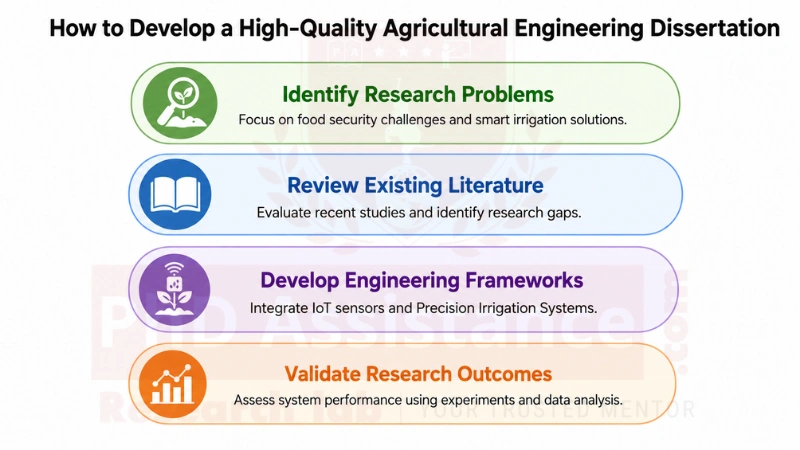
- Identify Research Problems in IoT-Based Smart Irrigation and Agricultural Engineering
- Conduct Literature Review and Research Gap Analysis
- Develop Engineering Frameworks and Precision Irrigation System Architecture
- Select Research Methodologies, IoT Technologies and Validation Techniques
- Evaluate Results and Dissertation Contributions
- Strategies for Writing a Strong Agricultural Engineering Dissertation
- Conclusion
Recent Post
Introduction
UAE is making substantial investments in sustainable agriculture in order to attain food security, considering parameters such as shortage of water, global warming, and lack of arable land. In this connection, the subject matter of Agricultural Engineering becomes more related to IoT in agriculture, precision irrigation, and data-driven farming, resulting in water conservation efficiency.
Such research opportunities can be useful for doctoral students who can concentrate their efforts on such areas as smart irrigation, sensor technology, water automation, and data analysis. Nevertheless, completing a high-quality dissertation involves the selection of a relevant research problem and conducting its investigation.
The article illustrates how one can create a technically sound dissertation using Sensors in Agriculture and Precision Systems. Moreover, those who are looking for PhD Dissertation Writing Help in UAE will also be able to get help in writing such dissertations, which can also be submitted to universities.
What you will learn?
Step 1: Identify Research Problems in IoT-Based Smart Irrigation and Agricultural Engineering
The UAE government is spending millions of dollars on agricultural sustainability to maintain food security in view of the issues of water scarcity, climatic changes, and inadequate agricultural lands. This way, the subject matter of Agricultural Engineering becomes increasingly focused on IoT in agriculture, precision irrigation, and smart farming, which ensures water efficiency.
Rather than broad topics, researchers should look into specific engineering challenges like monitoring soil moisture, irrigation scheduling using automation technologies, wireless sensor network systems, or irrigation prediction based on machine learning. Well-defined goals would contribute to measurable outcomes and advancement of Agricultural Engineering Research along with sustainable agricultural methods.
Additionally, focusing dissertation topics on water management, precision agriculture, food security, and other issues of national importance adds practical value to research work. Professional Agricultural Engineering Dissertation Help is ready to assist researchers in the development of research questions.
What Research shows:
Benzaouia et al. (2023) have come up with an intelligent irrigation system that utilises IoT technology. Information regarding the moisture content of the soil as well as the temperature and humidity levels of the surroundings was obtained using wireless sensors in order to regulate the irrigation process using the information obtained. There has been considerable optimisation of water usage without compromising crop production.
Tips
Step 2: Conduct Literature Review and Research Gap Analysis
Conducting a thorough literature review helps lay the academic ground for an Agricultural Engineering dissertation. Researchers need to analyse recent works on IoT in Agriculture, precision systems, wireless sensor networks, artificial intelligence, and smart farming. The researchers need not just summarise earlier work; they must analyse different methods used, contradictions between earlier results, limitations of the research, and gaps in knowledge that validate their work.
Organising the literature under themes like sensor-based irrigation, crop monitoring in real time, smart water management, and predictive models of irrigation helps scholars appreciate the situation as well as recognise areas where innovation can occur. The literature review will help clarify the objective of the research as well as show how this research will help UAE Agricultural Engineering Research and sustainable food security.
What Research shows:
Abioye et al. (2024) provided a review of the use of AI and Internet of Things for precision agriculture. The review has shown significant progress in the areas of crop monitoring, irrigation management, and decision-making systems; however, at the same time, it has raised issues of the lack of interoperability and scalability.
Tips
Step 3: Develop Engineering Frameworks and Precision Irrigation System Architecture
Once the research gap has been identified, the researcher must formulate an effective engineering framework explaining the interactions between the Internet of Things devices, communication networks, data processing, and irrigation control systems. A good engineering framework will help enhance the effectiveness of the dissertation, showing the application of intelligent agriculture.
Typical components of system architecture are soil moisture sensors, environmental sensors, wireless communications, cloud storage, predictive analysis, and automatic irrigation systems. In some cases, depending on the research purposes, machine learning algorithms can be added to optimise irrigation schedules considering weather forecasts, soil state, and crops’ water needs.
What Research shows:
The study by Mekonnen et al. (2023) is focused on the development of an IoT-supported precision agriculture model that combines the use of sensor network technology, cloud computing, and real-time data analytics to optimise decision-making in Precision Irrigation Systems. It proves that smart systems architectures help to manage resources more effectively, increase irrigation efficiency, and ensure sustainable agricultural production.
Tips
Example modal:
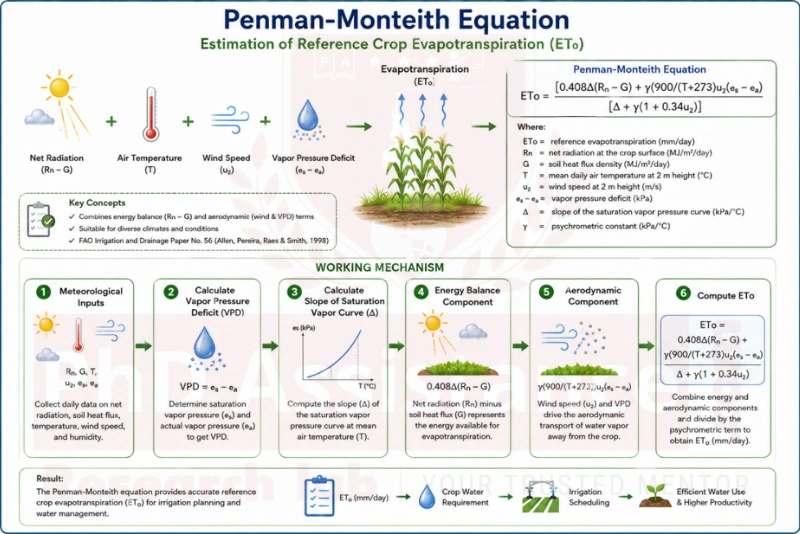
FAO-56 Penman-Monteith equation
Penman-Monteith equation was formulated by Allen, Pereira, Raes, and Smith in 1998 within the framework of Irrigation and Drainage Paper No. 56 of the Food and Agriculture Organisation. This equation is applied in the determination of reference crop evapotranspiration (ETo) through the application of energy balance and aerodynamic concepts. These factors include net radiation, air temperature, wind speed, and vapour pressure deficit; therefore, an accurate estimation of crop water requirements in diverse climatic conditions is achieved.
ETo = [0.408Δ(Rn − G) + γ(900/(T+273))u2(es − ea)] / [Δ + γ(1 + 0.34u2)]
Where:
ETo = reference evapotranspiration (mm/day)
Rn = net radiation at the crop surface (MJ/m²/day)
G = soil heat flux density (MJ/m²/day)
T = mean daily air temperature at 2 m height (°C)
u2 = wind speed at 2 m height (m/s)
es − ea = vapor pressure deficit (kPa)
Δ = slope of the saturation vapor pressure curve (kPa/°C)
γ = psychrometric constant (kPa/°C)
Step 4: Select Research Methodologies, IoT Technologies and Validation Techniques
The selection of the right methodology is very critical in ensuring that valid results are generated. The methodology must correspond to the goals of the research and provide a clear understanding of how the IoT technologies, Smart Irrigation Technologies, and engineering models are designed and evaluated.
Quantitative research, experimental research, and mixed methods research are some of the more popular methodologies that researchers select for a particular study. Methods to collect data may include soil moisture sensors, weather stations, IoT systems, and cloud-based monitoring systems. Statistical analysis, simulation techniques, and machine learning can all be applied to analyse irrigation efficiency, water efficiency, and crop yield.
What Research shows:
Khan et al. (2024) have recently carried out an empirical study that combined the use of IoT sensors with machine learning models to optimise the irrigation schedule under arid climate. Real-time data analysis using the developed system helped to enhance irrigation process efficiency and minimise the use of excess water.
Tips:
Step 5: Evaluate Results and Dissertation Contributions
The last phase of any PhD dissertation consists of analysing the research findings and showing their contribution to both theoretical knowledge and practical usage in agriculture. It is important to compare the results obtained by researchers with the data from previous studies, as well as highlight the benefits and drawbacks of the suggested system.
Besides the technical results, the discussion should also emphasise the wider implications of the research in terms of precision agriculture, water conservation, and food security in the UAE. The contributions could be in the form of better algorithms for irrigation, enhanced IoT-based monitoring systems, improved irrigation efficiency, or recommendations for future smart farming endeavours.
Stating the contributions in a clear manner ensures that the originality of the dissertation and relevance to Agricultural Engineering Research are achieved.
What Research shows:
Cárdenas et al. (2023) conducted a systematic review on IoT- and AI-enabled smart irrigation systems, demonstrating their efficiency in increasing the efficiency of water use and ensuring sustainable crop production. This work also indicated the necessity of developing scalable and economically feasible irrigation technologies as guidance for further studies.
Tips
Strategies for Writing a Strong Agricultural Engineering Dissertation
Conclusion
Intelligent use of Water through IoT Sensors in Agriculture and Precision Irrigation has changed the field of agricultural engineering by introducing intelligent means of managing water and producing sustainable food. With the continued efforts of the UAE in implementing smart technologies for agriculture, there are plenty of chances for PhD students to make contributions to engineering.
The development of an effective dissertation involves the selection of an important research problem, conducting an analytical literature review, creating an efficient engineering model, applying suitable methodologies, and showing some contribution to the research area. Through this process, high-standard dissertations can be achieved for universities while contributing to UAE Agricultural Engineering.
Need expert support for your doctoral dissertation? Experts at the PhD Assistance research lab assist with agricultural engineering research, smart irrigation systems, IoT applications, research methodology, and academic writing to help you achieve successful research outcomes.
References
- Abioye, E. A., Obaideen, K., Alhuyi Nazari, M., Seghayer, M., Sayed, E. T., Abo-Khalil, A. G., & Olabi, A. G. (2024). A comprehensive review on technological breakthroughs in precision agriculture: IoT and emerging data analytics. Alexandria Engineering Journal, 95, 150–175. https://doi.org/10.1016/j.aej.2024.03.078
- Benzaouia, M., Hajji, B., Mellit, A., & Rabhi, A. (2023). Fuzzy-IoT smart irrigation system for precision scheduling and monitoring. Computers and Electronics in Agriculture, 215, 108407. https://doi.org/10.1016/j.compag.2023.108407
- Cárdenas, A. A., Cárdenas, J. A., & Moreno, J. C. (2023). Smart Irrigation Systems in Agriculture: A Systematic Review. Agronomy, 13(2), 342. https://doi.org/10.3390/agronomy13020342
- Khan, M., et al. (2024). Integrating artificial intelligence and Internet of Things (IoT) for enhanced crop monitoring and management in precision agriculture. Sensors International, 5, https://doi.org/10.1016/j.sintl.2024.100292
- Mekonnen, Y., Namuduri, S., Burton, L., Sarwat, A., & Bhansali, S. (2023). Review—Machine Learning Techniques in Wireless Sensor Network Based Precision Agriculture. Journal of The Electrochemical Society, 170(5), 057512. https://doi.org/10.1149/1945-7111/acb8f3
References
1. How do I choose a suitable research topic for an Agricultural Engineering dissertation?
Choose a research topic that addresses current agricultural challenges such as water conservation, precision irrigation, or smart farming. Ensure it aligns with your research interests and contributes to sustainable food security.
2. Why are IoT Sensors important in Agricultural Engineering research?
IoT sensors enable real-time monitoring of soil moisture, weather conditions, and crop health. They improve irrigation efficiency, support data-driven decision-making, and enhance sustainable agricultural practices.
3. What research methods are commonly used in Precision Irrigation Systems?
Researchers commonly use experimental studies, IoT-based data collection, simulation models, statistical analysis, and machine learning techniques to evaluate irrigation performance and optimise water management.
4. How do Precision Irrigation Systems support sustainable agriculture?
Precision Irrigation Systems deliver water based on real-time crop and soil requirements, reducing water wastage, improving resource efficiency, and supporting sustainable food production in water-scarce regions.
5. How can I improve the quality of my Agricultural Engineering dissertation?
Develop a clear research framework, conduct a critical literature review, apply appropriate methodologies, validate your findings, and demonstrate practical contributions to smart agriculture and food security.