
How to Write a Literature Review in UAE Petroleum Engineering: Synthesising AI-Optimized Reservoir Recovery Research
Sustainable Practices in Environmental Science
- Identify Relevant Literature for AI-Optimized Reservoir Recovery
- Critically Analyse the Literature and Identify Research Gaps
- Apply Theories and Conceptual Frameworks
- Evaluate Research Methodologies and Analytical Approaches
- Develop Research Questions and Identify Research Contributions
- Practical Solutions for Writing a Strong Petroleum Engineering Literature Review
- Conclusion

Recent Post
Introduction
Many PhD students in the UAE find it difficult to conduct a literature review that does not just involve the summary of the available academic works, since it is hard to identify the existing gaps in the literature and build a solid theoretical framework. Since the oil industry has embraced the use of technology for reservoir optimisation, it is imperative for the researcher to critically analyse the emerging evidence in areas like machine learning.
It is crucial to conduct an effective Petroleum Engineering Literature Review in UAE when creating valuable scientific work. Instead of summarising what has been done before, the literature review is to compare methods and approaches used, evaluate the evidence that has been gathered, define gaps in knowledge, and show why there is a need for additional research. In this way, it becomes possible to prove the novelty of the work being done.
This article explains how researchers can prepare a technically rigorous literature review by identifying relevant literature, critically analysing previous studies, and synthesising research findings that contribute to the advancement of petroleum engineering.
What you will learn?
Step 1: Identify Relevant Literature for AI-Optimized Reservoir Recovery
The first process in preparing a literature review is conducting a comprehensive search of credible scholarly literature. It is important to use peer-reviewed journal articles, SPE articles, proceedings from conferences, and industry reports dealing with reservoir engineering, production optimisation, and digital oilfields. Scholarly databases such as Scopus, Web of Science, OnePetro, ScienceDirect, and SpringerLink can be used.
After the collection of literature, the works must be categorised by themes such as AI-optimized Reservoir Recovery, reservoir characterisation, forecasting of production, digital twin, and uncertainty quantification. Categorisation of the literature in terms of themes helps in making comparisons easier and gives an idea about the trends in research. The other criteria for assessing the quality of the literature include the methodology and the applicability to industry.
What Research shows:
According to Zhang et al. (2021), a deep learning framework combined with numerical simulation of reservoirs can be used to forecast production in heterogeneous reservoirs. The researchers showed that their method is more accurate and takes less time compared to traditional methods of reservoir simulation.
Tips
Step 2: Critically Analyse the Literature and Identify Research Gaps
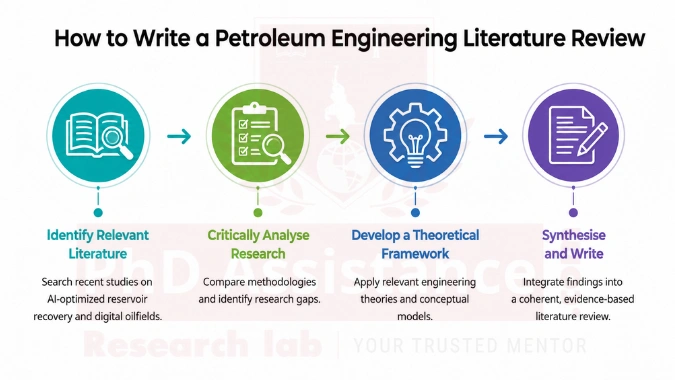
A good literature review is not only about summarising the findings but also about evaluating the past studies. It involves the comparison of methodologies, examination of contradictory findings, analysis of the weaknesses in the past studies, and the extent to which the findings have contributed to further studies.
Identifying the differences between reservoir parameters, assumptions in the modelling, validation approaches used, and data quality allows for identifying any possible inconsistencies in the studies. Such an approach is especially useful in examining Enhanced Oil Recovery Research.
What Research shows:
While AI in Reservoir Engineering has brought about better predictions of reservoir properties and enhanced production optimisation, most studies lack adequate validation from field data, as Sun et al. (2019) noted. Their research suggested combining physics-based simulations and data-driven models, thus offering potential areas for Petroleum Engineering Research in the future.
Tips
Step 3: Apply Theories and Conceptual Frameworks
An ideal literature review will include theoretical bases on which the research topic is based. It is crucial to develop proper concepts that will explain how the behaviour of the reservoir, production methods, and recovery rates are understood. This will enable the development of theories of variable relationships and guide the study.
It will be necessary for the researcher to look at recent literature works with the integration of Machine Learning in Reservoir Engineering with reservoir simulation and optimisation models. The comparison of theoretical bases will help the researcher assess the adequacy of the framework.
What Research shows:
It was noted that a combination of physics-based reservoir simulation together with machine learning models enhances history matching and production prediction by Zhou et al. 2024 This was because engineering principles could enhance machine learning models.
Example theory:
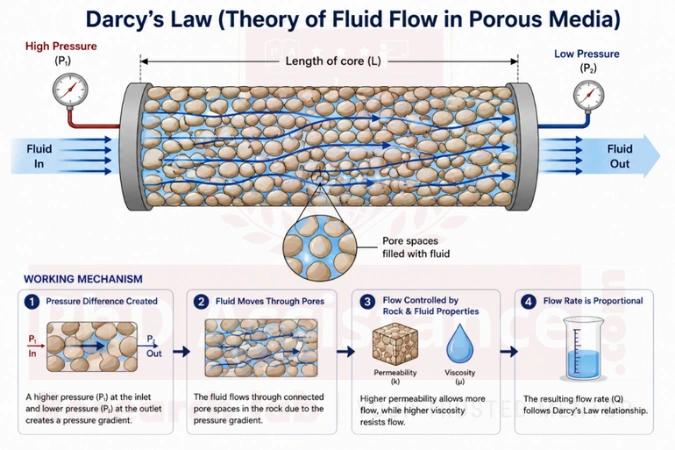
Darcy’s Law (Theory of Fluid Flow in Porous Media)
Darcy’s Law was formulated by Henry Darcy in 1856 based on his experiments with the filtration of water through sand beds. This is the basic physics law that explains how fluids (oil, gas, water) flow in a porous rock reservoir. The flow rate of the fluid through the porous media is proportional to the pressure gradient causing the flow and the permeability of the rock, and inversely proportional to the viscosity of the fluid (Muskat & Meres,1936)
q = -(kA/μ)(dP/dx)
Where:
Tips
Step 4: Evaluate Research Methodologies and Analytical Approaches
The methodology employed by researchers in previous research greatly affects the outcome of their work. Researchers must be able to make an evaluative comparison of methodologies, such as quantification, computation, and simulation in reservoir engineering, based on aspects such as data quality, validity, uncertainties and efficiency.
This will enable researchers to identify the strengths and weaknesses of various methodologies such as numerical simulations, optimisation methods, digital twins, and predictive modelling. Knowing all these techniques, especially the use of Artificial Intelligence in Reservoir Engineering, will enable the researchers to choose the proper approach to make their future studies more reliable and relevant.
What Research shows:
According to Zhou et al, who conducted a review on the various AI-based methods for modelling reservoirs, a hybrid approach to modelling reservoirs performed better than machine learning alone. The study concluded that engineering knowledge and advanced analysis were important in reservoir modelling.
Tips
Step 5: Develop Research Questions and Identify Research Contributions
The last step in doing a literature review is converting the research gaps that have been identified into questions that can be used in the research. The research question formulated should be able to help address the gap and add value both theoretically and practically to the discipline. There should be proof from the literature review to support each objective of the research.
There must be an explanation of how the research will contribute to the knowledge that already exists in terms of improving the methods used or validating some technology that has not yet been validated before.
What Research shows:
Du et al. (2023) created an ensemble learning proxy model embedded with the Particle Swarm Optimisation (PSO) technique for optimising production in carbonates. Though the model showed great improvement in oil production along with reduced computational time, the model validation was done only under certain reservoir conditions, indicating that there is still much room for research on this subject.
Tips
- Develop research questions through the identification of literature gaps.
- Relate the research objectives to industry and academic problems.
- Show the theory-based and practical contribution to reservoir engineering.
- Show how the research moves forward current knowledge and approaches.
Practical Solutions for Writing a Strong Petroleum Engineering Literature Review
Conclusion
A good literature review is essential to provide an adequate basis for any petroleum engineering study by analysing previous research, finding the existing research gaps, and laying the groundwork for further studies. Instead of simply providing summaries of past literature, researchers should analyse, compare, and evaluate existing scientific studies to achieve effective Research Synthesis in Petroleum Engineering
Adopting a systematic approach assists in honing research aims, methodological choices, and highlighting the importance of the study. With continued progress in petroleum engineering through AI and digital technologies, it is necessary to conduct a literature review to carry out innovative research.
Struggling to build a strong foundation for your petroleum engineering research? Collaborate with subject experts to analyse contemporary petroleum engineering literature, evaluate reservoir modelling techniques, and develop a technically rigorous literature review.
References
- Zhou, Wensheng & Liu, Chen & Liu, Yuandong & Zhang, Zenghua & Chen, Peng & Jiang, Lei. (2024). Machine Learning in Reservoir Engineering: A Review. Processes. 12. 1219. 10.3390/pr12061219. https://www.researchgate.net/publication/381449587_Machine_Learning_in_Reservoir
- Du, S.-Y., Zhao, X.-G., Xie, C.-Y., Zhu, J.-W., Wang, J.-L., Yang, J.-S., & Song, H.-Q. (2023). Data-driven production optimization using particle swarm algorithm based on the ensemble-learning proxy model. Petroleum Science, 20(5), 2951–2966. https://doi.org/10.1016/j.petsci.2023.04.001
- Sun, Z., Liu, J., Wang, P., & Zhao, Q. (2019). Artificial intelligence applications in reservoir engineering: Progress, challenges and future directions. Journal of Petroleum Science and Engineering, 236, 112614. https://www.researchgate.net/publication/334744951_Artificial_Intelligence_Applications
- Zhang, H., Chen, Y., Li, X., & Wang, J. (2021). Deep learning-assisted reservoir simulation for production forecasting in heterogeneous reservoirs. SPE Journal, 28(6), 3521–3538. https://www.researchgate.net/publication/348583420_A_Deep-Learning-Based_Approach_for_Reservoir_Production_Forecast_under_Uncertainty
- Muskat, M., & Meres, M.W. (1936). The Flow of Heterogeneous Fluids Through Porous Media. Physics, 7, 346-363. https://www.semanticscholar.org/paper/The-Flow-of-Heterogeneous-Fluids-Through-Porous-Muskat-Meres/e4c8d4329af23be03f582f256faf5688b28572d1
References
- How do I write a literature review in petroleum engineering?
Start by identifying relevant peer-reviewed studies, organise the literature into key research themes, critically compare methodologies and findings, identify research gaps, and synthesise evidence to establish a strong foundation for your research.
- Why is a literature review important in petroleum engineering research?
A literature review helps researchers understand the current state of knowledge, evaluate existing methodologies, identify unresolved challenges, and justify the need for new research. It also supports the development of well-defined research objectives and theoretical foundations.
- What databases are best for petroleum engineering literature?
Researchers commonly use Scopus, Web of Science, OnePetro, ScienceDirect, SpringerLink, and IEEE Xplore to access peer-reviewed studies on reservoir engineering, production optimisation, artificial intelligence, and enhanced oil recovery.
- How is artificial intelligence transforming reservoir engineering research?
Artificial intelligence is improving reservoir characterisation, production forecasting, history matching, and reservoir optimisation by enabling data-driven decision-making, reducing computational time, and enhancing prediction accuracy when combined with conventional engineering models.
- How can I identify research gaps in a petroleum engineering literature review?
Research gaps can be identified by comparing findings across multiple studies, evaluating methodological limitations, analysing conflicting evidence, and recognising areas where existing research lacks validation, scalability, or practical application.