
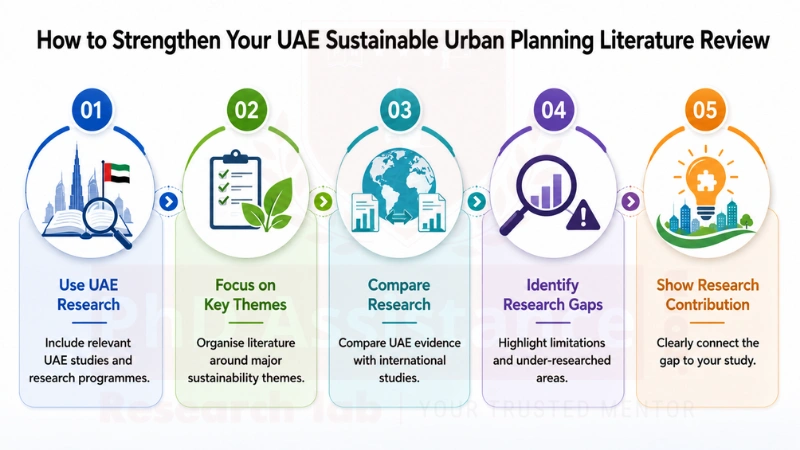
How to Strengthen Your UAE Sustainable Urban Planning Literature Review
Sustainable Practices in Environmental Science
- What Are the Common Problems in UAE Urban Planning Literature Reviews?
- How to Strengthen?
- Start With UAE-Specific Research Programmes
- Use Peer-Reviewed UAE Case Studies
- Include Research From Different UAE Cities
- Compare International Research With UAE Evidence
- Organise the Literature Around Major Themes
- Identify the Research Gap from Evidence
- Practical Framework for Your Literature Review
- Quick Self-Check
- Conclusion

Recent Post
Introduction
A literature review plays a significant role when it comes to building a research foundation for sustainable urban planning. This is particularly important in the United Arab Emirates, where rapid urbanisation, climatic conditions, infrastructure, resource constraints, and sustainability priorities create a distinctive urban-planning context. The literature review for Sustainable Urban Planning in the UAE should include more than just international studies.
UAE-based research programs offer a significant basis for examining sustainable urban development. Programmes such as the Dubai 2040 Urban Master Plan and UAE sustainability programs cover issues of sustainable mobility, resource efficiency, greenery, climate change resilience, and urban development.
This article explores the common challenges researchers encounter when developing a UAE-focused sustainable urban planning literature review.
What you will learn?
What Are the Common Problems in UAE Urban Planning Literature Reviews?
The common problems in UAE urban planning literature reviews include:
A stronger review should connect research evidence → UAE context → critical comparison → research gap.
How to Strengthen?
1. Start With UAE-Specific Research Programmes
A literature review should include relevant UAE research programmes alongside journal articles. For example, Khalifa University’s Urban Research Studio focuses on urban design and planning for sustainable development and aims to examine how urban forms and policy initiatives can improve environmental, social, and economic integration.
Including such programmes helps establish the research context before moving into individual studies.
Researchers can structure this section as:
UAE Research Programme → Research Focus → Findings → Limitations → Relevance to Your Study
This is particularly useful for UAE urban planning research because it demonstrates how academic research connects with local urban-development priorities.
2. Use Peer-Reviewed UAE Case Studies
Rather than simply stating that Masdar City is sustainable, researchers should examine what peer-reviewed studies have found about its sustainability.
For example, Randeree and Ahmed studied the aspect of social sustainability of Masdar City and found that, although the project contributed to environmental and economic innovation, its social dimension required greater attention.
Similarly, Griffiths and Sovacool analysed the development of Masdar City and highlighted how the carbon neutrality and zero-waste objectives of the project had transformed over time.
These examples demonstrate the importance of conducting comparative analysis of evidence in a literature review rather than just reviewing projects.
3. Include Research From Different UAE Cities
A strong review should not be limited to Abu Dhabi and Masdar City; it should include evidence from multiple UAE cities to strengthen contextual comparison.
For example, when analysing the Deira Enrichment project of Dubai, the Analytic Hierarchy Process has been used to determine the importance of Sustainable urban development in the UAE. In the study, environmental, economic, and sociocultural factors were identified as important considerations for sustainable urban-regeneration planning.
Other studies have shown that compactness, connectivity, transportation choices, cultural significance, and consideration for the climate were key issues for sustainable neighbourhood design in the urban development of Dubai.
Studies of Abu Dhabi, Dubai, and other UAE urban areas can help identify the similarities and differences in the two cities’ development experiences.
4. Compare International Research With UAE Evidence
International literature provides theories and established sustainability approaches, while UAE research demonstrates how those approaches perform under local conditions.
For example:
International Research
↓
Sustainable urban form / green infrastructure / smart cities
↓
UAE Evidence
↓
Masdar City / Dubai regeneration / Abu Dhabi planning
↓
Critical Comparison
↓
Contextual limitations and research gaps
This approach is particularly important because research on Dubai has found that sustainable urbanism cannot simply be studied independently of local social, economic, cultural, and climatic conditions.
5. Organise the Literature Around Major Themes
Instead of discussing studies one after another, organise the review around themes such as:
For example:
Theme → International Evidence → UAE Studies → Comparison → Limitation → Research Gap
This structure can provide a stronger foundation for UAE urban sustainability research.
6. Identify the Research Gap from Evidence
A strong research gap should emerge from comparing existing studies, highlighting what is well established, what remains limited, and where further research is needed.
For example:
Existing research:
Studies have examined Masdar City’s environmental, social, economic, and planning dimensions.
Limitation:
These studies often focus on dimensions or individual developments.
Research Gap:
There may be limited integrated evidence connecting urban form, environmental performance, social outcomes, and governance across multiple UAE urban contexts.
Research Opportunity:
Develop a comparative framework for evaluating sustainable urban planning outcomes across UAE cities.
This provides a stronger foundation for Sustainable urban planning research in the UAE.
Practical Framework for Your Literature Review
UAE Research Programmes
↓
International and UAE Literature
↓
Thematic Analysis
↓
Critical Comparison
↓
Methodological Limitations
↓
Research Gap
↓
Proposed Contribution
Quick Self-Check
Conclusion
A strong UAE literature review should combine international theories, UAE research initiatives, and peer-reviewed evidence. Studies on Masdar City show the importance of analysing environmental, economic, social, and governance aspects, while the Dubai case studies show the need for planning strategies that consider local urban culture.
The key is therefore not simply to collect UAE studies, but to critically compare them, identify what they have established, recognise what remains unresolved, and use those limitations to establish your research gap. This will make the review more rigorous and provide a stronger foundation for future Urban planning research in the UAE.
Need to strengthen your UAE Urban Planning Literature Review? Connect with the experts at PhD Assistance Research Lab for support in identifying relevant UAE studies, organising the literature, strengthening critical analysis, and developing a clear research gap.
FAQs:
- How to improve a UAE urban planning literature review?
Focus on recent and relevant UAE studies, organise the literature by key themes, critically compare findings, and clearly identify limitations and research gaps. - What are the key themes in UAE sustainable urban planning?
Key themes include sustainable urban development, smart cities, sustainable mobility, climate resilience, green infrastructure, energy and water efficiency, urban regeneration, and sustainable governance. - What are the research gaps in UAE urban planning?
Common gaps may include limited comparative studies across UAE cities, insufficient integration of social, economic, and environmental factors, and limited evidence on the long-term outcomes of sustainability initiatives. - How to identify UAE urban planning research gaps?
Compare UAE and international studies, examine their methodologies and findings, identify limitations or under-researched areas, and determine which issues remain insufficiently addressed in the UAE context. - Why is UAE-specific research important in sustainable urban planning?
UAE cities have distinctive climatic, environmental, economic, and urban-development conditions, making locally focused research important for developing planning approaches suited to the country’s sustainability needs.
References
- Khalifa University. (2026). Khalifa University’s contributions towards UN’s SDGs. Khalifa University. https://www.ku.ac.ae/
- Randeree, K., & Ahmed, N. (2018). The social imperative in sustainable urban development. Smart and Sustainable Built Environment, 8(2), 138–149. https://doi.org/10.1108/SASBE-11-2017-0064
- Griffiths, S., & Sovacool, B. K. (2020). Rethinking the future low-carbon city: Carbon neutrality, green design, and sustainability tensions in the making of Masdar City. Energy Research & Social Science, 62, Article 101368. https://doi.org/10.1016/j.erss.2019.101368
- Awad, J., & Jung, C. (2022). Extracting the planning elements for sustainable urban regeneration in Dubai with AHP (Analytic Hierarchy Process). Sustainable Cities and Society, 76, Article 103496. https://doi.org/10.1016/j.scs.2021.103496
- Alawadi, K. (2017). Rethinking Dubai’s urbanism: Generating sustainable form-based urban design strategies for an integrated neighbourhood. Cities, 60(Part A), 353–366. https://doi.org/10.1016/j.cities.2016.10.012