
- / Title
Climate-Resilient Smart Urban Infrastructure Titles | phdassistance.com
Info: Climate-Resilient Smart Urban Infrastructure Titles | phdassistance.com
Published: 13th May 2026 in Climate-Resilient Smart Urban Infrastructure Titles | phdassistance.com
Share this:
Related Services
Introduction
The researchers created new PhD research topics after they completed their research about environmental issues, technological difficulties and current urban infrastructure challenges. The researchers studied three areas, which included climate adaptation and urban sustainability and resilient city development. The selection of an appropriate research topic has become vital for scholars who intend to develop sustainable urban solutions through their doctoral research work. Smart Climate-Resilient Urban Infrastructure Research develops urban systems that use technology to improve their climate hazard protection capabilities through adaptive sustainable design. PhD Assistance helps researchers identify academically relevant dissertation topics with strong publication potential, practical significance, and alignment with current university and industry requirements. Our experts assist researchers in selecting advanced research fields, which include climate resilience, smart infrastructure systems, urban governance, green technologies and sustainable urban development.
Proposed PhD Title 1: Building Smart Climate-Resilient Infrastructure Frameworks Through Sustainable Construction and Inclusive Governance in the Global South
Researchers at Smart Climate-Resilient Infrastructure develop sustainable solutions that enable cities to manage increasing flood risks, heatwave incidents, infrastructure failures, and environmental destruction caused by climate change. The Global South faces critical challenges because its population growth surpasses the capacity of its existing infrastructure, which operates with outdated systems, and its governments struggle to cope with climate change impacts. The combination of sustainable building practices with digital infrastructure development functions as a fundamental capability that enables urban systems to achieve improved resilience. The 2026 study by El-Kholei and his team shows that smart city sustainable construction projects lack proper development because financing restrictions, policy linkages, and community involvement in climate adaptation planning are not effectively managed.
Problem Statement:
The urban infrastructure systems that developing regions currently maintain face multiple climate-related vulnerabilities because their governance structures and financing mechanisms, digital infrastructure, and sustainable construction technologies face multiple deficiencies. Existing urban development models struggle to integrate climate adaptation, resilience planning, and smart infrastructure systems effectively. The various limitations that exist in urban areas throughout the Global South increase the likelihood of flooding and service interruptions, and the formation of urban heat islands and environmental inequalities.
Research Gap:
Existing research has discovered only a small number of integrated Smart Urban Infrastructure frameworks, which use sustainable construction methods together with inclusive governance and digital infrastructure and climate adaptation strategies to create urban solutions for rapidly developing cities in the Global South.
Research Question:
How can the development of Smart Urban Infrastructure in climate-sensitive cities throughout the Global South benefit from integrated sustainable construction and governance frameworks?
Outcome:
The research will examine the development of a complete urban infrastructure, which will combine sustainable building techniques with climate change adaptation measures, as well as digital infrastructure components. The aim will be to enhance the resilience and sustainability of development within new urban areas.
Reference:
El-Kholei, A., Yassein, G., & Younan, M. (2026). A systems-oriented bibliometric and qualitative synthesis of sustainable construction for climate-resilient smart cities in the Global South.
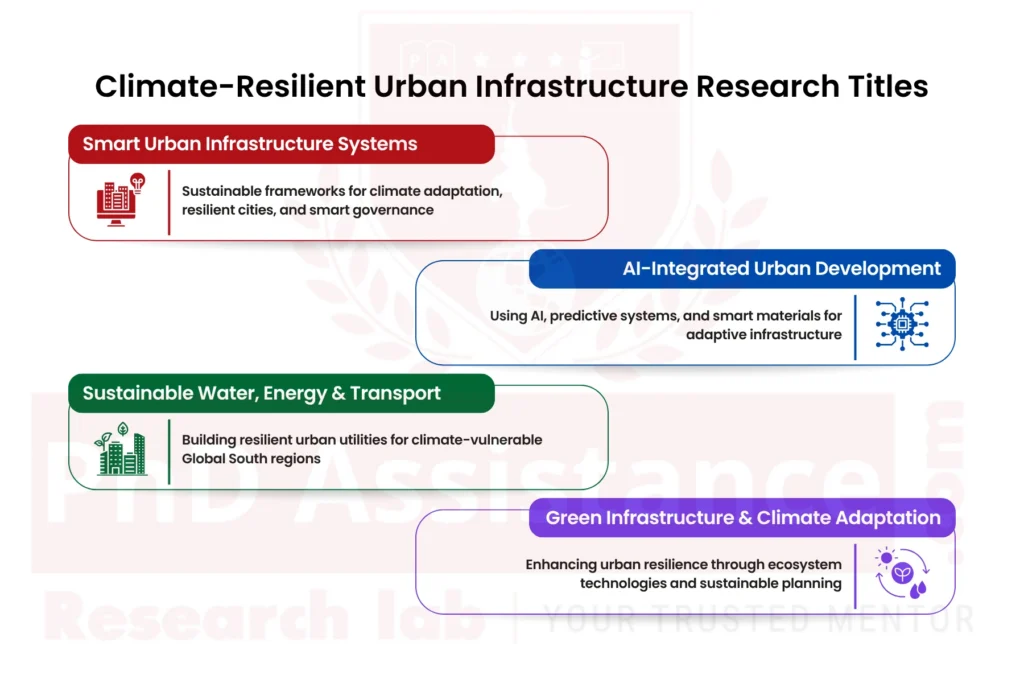
Proposed PhD Title 2. Designing AI-Integrated Smart Infrastructure for Adaptive Climate Resilience and Sustainable Urban Development
Scholars study smart city infrastructure because urban systems face sustainability challenges, which climate change, environmental degradation and rapid urban growth create. Artificial Intelligence (AI) and smart materials now empower urban infrastructure to improve its predictive maintenance capabilities, energy efficiency and environmental monitoring and adaptive infrastructure performance. Shahjalal et al. (2025) demonstrated that AI-enabled smart materials improve infrastructure resilience and sustainability, but the implementation of AI-driven systems for climate-vulnerable urban areas needs to overcome challenges in both technology and operations and system integration.
Problem Statement:
The current city infrastructure systems experience operational challenges together with environmental issues because traditional infrastructure systems fail to manage climate-related disruptions, which include floods, heatwaves and other severe weather events. Existing smart infrastructure systems face three major obstacles, which include their real-time adaptation failure, their predictive maintenance capabilities, their high implementation costs, their fragmented digital systems, and their limited ability to scale in emerging urban areas. The existing limitations hinder the effectiveness of climate adaptation initiatives and sustainable urban management initiatives.
Research Gap:
The existing literature shows that researchers have studied only a small number of AI-based smart infrastructure systems. This uses intelligent monitoring systems together with smart materials and urban design methods to enhance climate resilience in cities experiencing fast urban growth.
Research Question:
How does this research investigate AI smart city solutions that help cities develop their climate change adaptation and mitigation strategies?
Outcome:
The researchers will create an artificial intelligence system that uses predictive to manage adaptive smart materials. The system will improve its ability to withstand climate conditions because it uses sustainable infrastructure management methods, which maintain operational capacity.
Reference:
Shahjalal, M., Yahia, A. K. M., & Rahaman, T. (2025). AI-driven sustainable infrastructure: Smart materials for climate-resilient urban design. American Journal of Advanced Technology and Engineering Solutions, 1(1), 438–466
Proposed PhD Title 3. Developing Climate-Resilient Infrastructure Frameworks for Sustainable Urban Water, Energy, and Transport Systems in the Global South
Researchers are investing in climate resilience because Global South urban systems experience repeated major disruptions, which occur during floods and droughts, rising temperatures and severe weather events. The existing condition of water systems, combined with transportation networks and energy infrastructure systems, faces increasing threats because their systems have deteriorated through time, urban growth continues, government operations are inefficient, and adaptation measures fail to achieve their intended outcomes. Das 2025 shows that current urban resilience methods do not work because they lack three vital components, which are integrated governance, technological innovation and infrastructure adaptation needs long-term sustainability planning.
Problem Statement:
The current urban infrastructure systems of developing countries suffer from serious climate vulnerabilities because their existing adaptation solutions consist of separate components that lack necessary funding and face technological limitations. The combination of weak governance systems and inadequate maintenance practices, together with restricted climate financial resources, prevents cities from building resilient water, transport and energy infrastructure systems. The existing restrictions raise the likelihood of infrastructure breakdowns and service interruptions while creating environmental disparities in areas that experience climate impacts.
Research Gap:
The present research literature provides limited studies on integrated climate resilient infrastructure frameworks that combine adaptive governance, technological innovation, and sustainable infrastructure retrofitting for urban systems in the Global South.
Research Question:
How does the implementation of integrated climate-resilient infrastructure frameworks enable Global South cities to achieve sustainable and adaptive urban water systems, energy systems, and transportation systems?
Outcome:
The research project will build an urban infrastructure system that combines three components because it needs to enhance the resilience and operational reliability of essential urban infrastructure systems.
Reference:
Das, D. K. (2025). Resilient and sustainable urban infrastructure in the Global South: Strategies to address climate change-linked vulnerabilities. Urban Planning, 10, Article 10037.
Proposed PhD Title 4. Enhancing Urban Resilience Through Green Infrastructure and Ecosystem-Based Climate Adaptation Technologies
Cities around the world must now deal with increased challenges that come from environmental problems, together with additional urban challenges that require cities to create better plans for urban resilience than they needed before. The practice of using green infrastructure together with ecosystem-based adaptation technologies has gained recognition. This is an effective method for cities to enhance their climate resilience and protect their environmental sustainability. The research conducted by Seidu et al. (2025) shows that cities face main obstacles to successful green infrastructure implementation because of their weak digital monitoring systems, their limited policy integration capacity and their low adoption rates of ecosystem-based climate adaptation strategies during urban planning activities.
Problem Statement:
Current urban development systems encounter various difficulties because traditional grey infrastructure systems fail to control increasing environmental threats and urban climate risks. The current resilience planning system experiences operational difficulties because its different components operate as separate entities, and its digital monitoring system lacks sufficient capability, and it does not establish proper connections with stakeholders, and it fails to integrate climate adaptation with sustainability practices.
Research Gap:
The current research literature does not present sufficient studies that examine integrated urban resilience planning models that utilise green infrastructure together with ecosystem-based adaptation technologies and digital monitoring systems to enhance climate resilience in urban areas.
Research Question:
How do ecosystem-based adaptation and green infrastructure technologies create climate benefits and urban development improvements in cities that face environmental threats?
Outcome:
Researchers will create a digital urban resilience framework that combines green infrastructure systems with ecosystem-based technologies and climate adaptation monitoring systems to enable sustainable urban resilience and environmental management.
Reference:
Wijenayake, A. (2025). Climate change and urban resilience: Strategies for sustainable cities. International Journal of Academic Research in Business and Social Sciences, 15(4).
Proposed PhD Title 5. Constructing Sustainable Infrastructure Models Using Climate Adaptation Investments and Smart Governance Systems
Sustainable infrastructure must meet its essential environmental requirements through climate change threat management, which arises from rising temperatures and flooding events, greenhouse gas emissions and resource shortages. The urban resilience strategies need three essential components, which include effective governance systems and funding for climate adaptation and development of advanced infrastructure solutions. Wijenayake 2025 found that cities that allocate additional resources to climate adaptation while developing stronger governance frameworks will attain superior resilience results. Urban areas continue to experience challenges from three main problems, which include difficulties with policy implementation, financial limitations and problems with institutional coordination.
Problem Statement:
The existing urban governance systems in cities face operational difficulties because they need to manage three separate elements, which include climate adaptation policies, along with sustainability initiatives and infrastructure development projects. The existing urban planning systems face difficulties because they cannot integrate smart infrastructure technologies
Research Gap:
The existing research literature provides limited studies on sustainable urban infrastructure governance models that integrate climate adaptation investments with smart urban development systems and institutional resilience frameworks, which are needed by rapidly urbanising cities.
Research Question:
Why do urban infrastructure control systems help fast-growing cities with enhanced climate adaptation and sustainable urban development?
Outcome:
The research will create a policy decision framework that connects intelligent infrastructure systems with sustainability planning through climate adaptation and green adaptation practices.
Reference:
Wijenayake, A. (2025). Climate change and urban resilience: Strategies for sustainable cities. International Journal of Academic Research in Business and Social Sciences, 15(4)
Need assistance finalising your dissertation topic? Selecting a strong, researchable topic can be challenging — but you don’t have to do it alone.
Our research consultants can help refine your ideas, identify literature gaps, and guide you toward a topic that aligns with current academic trends and your programme requirements.
Contact us to begin one-on-one topic development and refinement with PhdAssistance.com Research Lab.
Share this:
Cite this work
PhDAssistance. (n.d.). Virtual Influencers Dissertation Titles Retrieved 30th January 2026, from https://phdassistance.com/title/virtual-influencers/
“Virtual Influencers Dissertation Titles, https://phdassistance.com/title/virtual-influencers/
“Virtual Influencers Dissertation Titles” PhDAssistance, PhDAssistance, Tuesday, January 30th,2026.
PhDAssistance, n.d. Virtual Influencers Dissertation Titles[Online]. Available at: https://phdassistance.com/title/virtual-influencers/ [Accessed January 30th, 2026].
PhDAssistance. Virtual Influencers Dissertation Titles[Internet]. PhDAssistance; [cited 2026 January 30th]. Available from: https://phdassistance.com/title/virtual-influencers/
PhDAssistance (n.d.).
Virtual Influencers Dissertation Titles. Retrieved January 30th, 2026, from https://phdassistance.com/title/virtual-influencers/
PhDAssistance, Virtual Influencers Dissertation Titles(PhDAssistance, n.d. January 30th accessed 2026.
Study Resources
Free resources to assist you with your university studies!