
The source and why it matters
The paper under review is Fiolet et al. (2026), "Researcher social and emotional wellbeing: A qualitative exploration of workplace supports and self-care strategies while engaging in sensitive-topic research", published open access in the Journal of Academic Ethics (volume 24, article 23). The authors are based at Deakin University, the University of Melbourne and the University of New South Wales.
Sensitive-topic research, on subjects such as family violence, sexual assault, addiction, suicide, chronic disease or dying, produces knowledge that societies need. It also exposes researchers, repeatedly and often alone, to accounts of suffering. The authors set out to understand how researchers experience workplace support while doing this work and what self-care strategies they use (Fiolet et al., 2026).
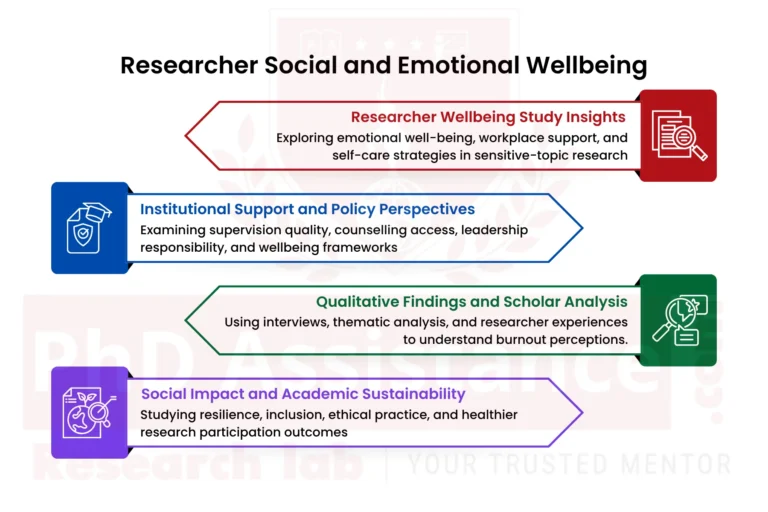
The topic matters for doctoral researchers in particular. Large studies have found high levels of psychological distress among PhD students (Levecque et al., 2017; Satinsky et al., 2021; Hazell et al., 2021), and the doctoral environment, including supervision and workload, contributes to it (Mackie & Bates, 2019). A candidate whose project involves distressing material faces those general pressures and the specific demands of the topic, often with less experience and job security than senior colleagues.
What the study reports
The authors interviewed 42 researchers from 13 Australian universities and research organisations, recruited through LinkedIn and university newsletters. Participants ranged from doctoral candidates and research assistants to fellows and established researchers, and most were women. Semi-structured interviews were held face to face, by telephone or by video call, and analysed with reflexive thematic analysis (Braun & Clarke, 2006; Braun & Clarke, 2021). A summary of themes was sent to participants for comment (Fiolet et al., 2026).
Two overarching themes were developed.
| Overarching theme | Subthemes (paraphrased) | What participants described |
|---|---|---|
| Researchers are being failed | Barriers to accessing support; academic culture; missing shared responsibility; unable to find the support needed | Isolation and solo working, unclear or slow routes to counselling, fear of disclosing to supervisors or managers, competitive and output-driven cultures, and support that varied from project to project |
| An isolated fight for survival | Disconnecting and creating distance; knowing personal limits; reflexivity and gratitude; self-care practices | Taking breaks from the material, limiting the number of interviews per day, setting time boundaries on analysis, reflecting on their own position, and using exercise and time in nature |
The second theme is not simply a list of coping techniques. Participants described tensions within it: stepping back from the material protected them but conflicted with their commitment to participants, and some recognised less healthy ways of coping. Several also described reflecting on their own privilege relative to participants, and feeling gratitude for being trusted with their stories, as something that helped to balance the weight of the work. The authors present these strategies as attempts to fill gaps left by institutions rather than as a model to be recommended in place of organisational support (Fiolet et al., 2026).
The authors conclude that universities, ethics committees, departments, supervisors and funders should share responsibility for researcher well-being, through policies, trauma-informed leadership and supervision, and practical measures such as workload planning and leave, developed with researchers themselves (Fiolet et al., 2026).
Strengths
- A neglected question. Research ethics has focused on protecting participants. This study centres the researcher, and its sample spans career stages and institutions.
- Appropriate design. Interviews analysed with reflexive thematic analysis suit an exploratory question about experience and meaning (Braun & Clarke, 2021).
- Rich, actionable detail. The self-care strategies participants described, such as limiting interviews per day and setting boundaries around analysis, translate directly into planning.
- Practising what it recommends. The team prepared a distress protocol, informed participants of support, offered access to a trauma-informed psychologist, and arranged supervision and reflective practice for the interviewer.
- Consistent with other evidence. The findings echo team accounts of secondary trauma in research on gender-based violence (Williamson et al., 2020) and practical principles proposed by qualitative researchers working on difficult topics (Silverio et al., 2022).
Limitations and methodological issues
- Self-selection. Researchers who answered an advertisement about well-being may have had stronger experiences, positive or negative, than those who did not. The authors note that recruitment through LinkedIn and newsletters excluded researchers who do not use those channels.
- Sample composition. Most participants were women, with few men and one queer-identifying participant; the authors call for research that reaches these groups. Differences by career stage, discipline and cultural background are not a main focus.
- Limited participant checking. Only four of the 42 participants responded to the summary of themes. In reflexive thematic analysis, participant checking is optional rather than a test of validity (Birt et al., 2016; Braun & Clarke, 2021), so this is a minor point, but it should not be read as confirmation.
- Saturation language. The paper describes stopping when no new meaning emerged. Within reflexive thematic analysis, sample adequacy is better argued through information power, that is, the aim, specificity of the sample and quality of dialogue (Malterud et al., 2016).
- One national system. Australian funding, employment and ethics arrangements shape the findings, and the authors call for studies elsewhere, including the Global South.
- No measures of impact. As a qualitative study it describes experience; it does not estimate how common harm is or test whether any intervention reduces it.
Readers appraising the study can use reporting checklists such as COREQ (Tong et al., 2007) to locate information on the research team, setting and analysis. The appropriate citation is as rich evidence that many Australian sensitive-topic researchers experience institutional support as inadequate and rely on self-care, not as an estimate of prevalence.
How the study sits in the wider literature
For doctoral education, the most striking comparison is with Orr et al. (2021), who reviewed 230 Canadian dissertations and theses using qualitative research on sensitive subjects. Fewer than 5 per cent described a protocol to limit psychological risk to the researcher, and 83 per cent reported neither a protocol nor general strategies such as reflexive journaling or peer debriefing. The authors recommend trauma- and violence-informed principles in graduate supervision. Fiolet and colleagues' finding that responsibility falls on individuals is consistent with that gap.
Williamson et al. (2020) described a team of ten interviewers who carried out 251 interviews with survivors of gender-based violence, and argued for formal clinical supervision in sensitive research, as is routine in therapeutic professions, with dedicated funding. Reflexivity, understood as critical attention to how the researcher's position and feelings shape the work (Finlay, 2002), is both a quality criterion and, as Fiolet's participants suggest, a way of processing emotional impact.
One finding deserves particular attention in doctoral settings: the effect of power. Participants described hesitating to disclose distress to supervisors or managers on whom their contracts, references or progression depended, and some reported responses that minimised their concerns or removed them from a project altogether (Fiolet et al., 2026). Doctoral candidates are in exactly this position. The authors' observation that progress review committees could identify and support candidates at several points in candidature suggests a route that does not depend solely on the supervisory relationship.
The study also leaves open questions that doctoral researchers in education, health or social research could take up. How common is distress among sensitive-topic researchers, and does it differ by career stage, discipline or method? Do the measures the authors recommend, such as clinical supervision, workload limits or trauma-informed training for supervisors, actually reduce harm? And how do researchers who analyse distressing documents, images or online material, rather than conducting interviews, experience the same demands? Each would need a different design, from surveys with validated measures to evaluations of interventions, which illustrates how one qualitative study can seed a programme of research.
Related reviews in this series examine stress among PhD scholars, supervisor support and psychological capital and well-being.
What it means for doctoral researchers
This article does not offer clinical advice. If research is affecting your well-being, speak to your supervisor or graduate school and use your university's counselling, employee assistance or wellbeing services, or your own doctor. What the study does support is planning for researcher safety as part of research design, in the same way as planning for participant safety.
| Area | What to include in your plan | Who to involve |
|---|---|---|
| Ethics application | Risks to you as well as participants; a distress protocol for both | Supervisor; ethics committee |
| Fieldwork schedule | A limit on interviews per day, no late sessions, time between interviews | Supervisor; fieldwork partners |
| Analysis | Time limits on transcribing and coding distressing material; breaks | Supervisor; transcription service if used |
| Debriefing | Regular debriefs with a supervisor, peer or, where available, a professional | Supervisory team; graduate school |
| Support routes | Named university services and how to access them quickly | Graduate school; wellbeing services |
| Reflexive record | A journal of reactions and decisions, useful for both well-being and the methods chapter | You; discussed in supervision |
Worked example (illustrative)
A second-year candidate plans 25 interviews with carers of people at the end of life. In her ethics application she adds a section on researcher safety: no more than two interviews a day, none in the evening, a fortnightly debrief with her supervisor, and the contact details of the university counselling service. She budgets time for breaks during transcription and keeps a reflexive journal, which later informs the positionality section of her methods chapter. When one interview proves especially difficult, she pauses fieldwork for a week, as her plan allows, and discusses it in supervision.
Common mistakes
- Treating the ethics application as being only about participants.
- Scheduling interviews back to back to save travel time or meet a deadline.
- Waiting until distress builds before finding out what support the university offers.
- Assuming that supervisors will raise well-being; candidates may need to put it on the agenda.
- Leaving emotional impact out of the methods chapter, when reflexive reporting strengthens the study (Finlay, 2002).
Key takeaways
- Fiolet et al. (2026) interviewed 42 Australian researchers and found that many felt failed by institutions and relied on self-care.
- The design suits the question, but self-selection, a mostly female sample and one national setting limit how far findings transfer.
- Graduate research appears to share the gap: few Canadian theses on sensitive topics described any researcher-safety protocol (Orr et al., 2021).
- Researcher safety can be planned like participant safety, through scheduling, debriefing and named support routes (Silverio et al., 2022; Williamson et al., 2020).
- Doctoral researchers who are affected by their research should use supervision and university support services.