
The source and why it matters
The paper under review is Krumsvik (2025), "Chatbots and academic writing for doctoral students", published open access in Education and Information Technologies (volume 30, issue 7, pages 9427 to 9461). The author is based in the Department of Education at the University of Bergen, Norway.
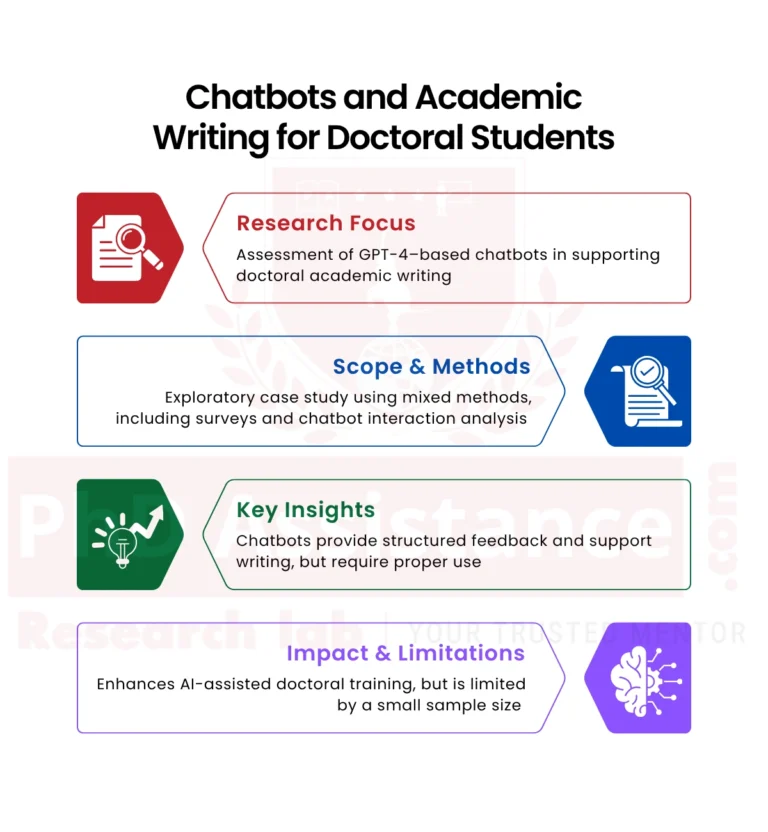
The study addresses a specific writing problem. Many Norwegian PhD theses are article based: the candidate publishes or submits a set of papers and then writes a synopsis of roughly 60 to 90 pages that frames the articles, sets out the theory and methods, and argues for the contribution of the whole. Candidates often find this synopsis hard, because it is a different genre from a journal article and the quality expectations are spread across rubrics and guidance documents. Krumsvik asks whether a domain-specific chatbot, built on GPT-4 and trained on those rubrics and on literature about article-based theses, can act as a sparring partner that gives formative feedback on the synopsis (Krumsvik, 2025).
The question matters well beyond Norway. Doctoral researchers everywhere are already using general-purpose chatbots for feedback, often without guidance, and universities are still working out what such use means for learning and for integrity (Kasneci et al., 2023; Dai et al., 2023). A carefully built, rubric-based tool is a useful test case for what more deliberate use might look like.
What the study reports
Krumsvik describes the work as an exploratory, intrinsic case study using formative dialogue research, with data gathered cumulatively across doctoral courses and supervision seminars. It has three strands.
- A pilot survey of PhD candidates and supervisors attending courses and seminars, about their experience of ChatGPT or GPT-4 and their views on AI in academic writing. Roughly four in ten candidates reported having used such tools, and about 60 per cent of supervisors were sceptical about AI in academic writing.
- Pre-testing of the synopsis chatbot, in which the author posed questions across ten areas of a synopsis (such as transparency, coherence, theoretical framework, methodology, analysis, discussion and ethics) and rated the answers on a ten-point scale. Two prompt types were compared: short descriptive questions and procedural, step-by-step (chain-of-thought) questions.
- Digital fieldwork, testing the chatbot on tasks such as commenting on academic papers, interpreting figures and tables, assessing text against rubrics, and offering suggestions for next steps.
The chatbot scored markedly better on procedural, chain-of-thought questions than on descriptive ones, and performed well when asked to comment on multimodal material and to give forward-looking suggestions. Krumsvik interprets these results through formative assessment theory, in particular the model of Hattie and Timperley (2007), which distinguishes three questions a learner needs answered: where am I going (feed up), how am I going (feedback) and where to next (feed forward). He argues that rubric-trained chatbots could be added to this model as complementary "digital supervisors" (Krumsvik, 2025).
| Strand | What was done | What it can show | What it cannot show |
|---|---|---|---|
| Pilot survey | Questions to candidates and supervisors at courses and seminars | Attitudes and prior use in a self-selected group | How chatbots affect writing or completion |
| Pre-testing | Author rated chatbot answers across ten synopsis areas and two prompt types | Relative quality of answers to different kinds of question | Agreement between independent raters; effect on candidates |
| Digital fieldwork | Chatbot tried on papers, figures, rubrics and feed-forward tasks | Range of tasks the tool can attempt | Whether candidates act on the feedback, or how well |
Strengths
- A real and specific problem. The synopsis of an article-based thesis is a recognised difficulty, and targeting one genre gives the study focus that general discussions of ChatGPT lack.
- Grounded in theory. Building the tool on rubrics and on the feed up, feedback and feed forward model gives a clear rationale for what the chatbot should do (Hattie & Timperley, 2007).
- Useful finding on prompting. The contrast between descriptive and chain-of-thought questions is practical: it suggests that how a candidate asks matters as much as which tool they use.
- Candid about limits. The author states that validation was done by him alone, that testing was by spot checks, and that the study is early-phase and not generalisable. That candour makes the paper easier to read correctly.
- Supervisors included. Surveying supervisors as well as candidates acknowledges that adoption depends on supervisory culture as much as on the tool (Lee, 2008).
Limitations and methodological issues
The central issue is the kind of evidence produced. The chatbot was designed, trained, tested and rated by the same person, who is also the author of much of the literature it was trained on. This is a legitimate way to develop and explore a tool, and the author says so, but it is not an independent evaluation.
- Single rater. All quality ratings come from the author. Without a second rater and a measure of agreement, the scores cannot be separated from one expert's judgement.
- No outcome measure. The study does not compare synopses written with and without the chatbot, or track candidates' progress, so it cannot show that the tool improves writing.
- Self-selected survey. Participants were attending courses and seminars, so their views may not represent all Norwegian candidates or supervisors.
- A moving target. Results describe one GPT-4 configuration at one time; model updates can change behaviour, which limits replication.
- Accuracy checks. General chatbots can produce fabricated or erroneous references (Walters & Wilder, 2023). A rubric-trained tool may reduce this, but the paper's spot checks do not establish how often feedback is wrong.
These points do not undermine the paper's purpose, which is exploratory. They determine how it should be cited: as a theoretically informed demonstration that a rubric-based chatbot can produce plausible formative feedback on a synopsis, not as evidence that such chatbots improve doctoral writing or outcomes.
A stronger follow-up design is easy to sketch, and doing so is a useful exercise for any doctoral researcher planning an evaluation. Several experienced supervisors, blind to whether feedback came from the chatbot or a human, could rate a sample of feedback comments for accuracy and usefulness, with inter-rater agreement reported. Candidates could be followed over a semester, comparing the quality of synopsis drafts, as judged by independent assessors, between those who used the tool and those who did not. Interviews could then explain how candidates decided which suggestions to accept. Each step moves the evidence from what the tool can say towards what it does for learners.
How the study sits in the wider literature
The paper joins a fast-growing literature on generative AI in higher education. Reviews of large language models in education list feedback on writing among the main opportunities, alongside risks to learning and integrity (Kasneci et al., 2023), and Australian postgraduate research students have described ChatGPT as supporting, but not replacing, their supervision (Dai et al., 2023). Krumsvik's supervisors' scepticism echoes concerns that reliance on AI may reduce the independent thinking that writing develops (Gerlich, 2025).
Integrity is the other main context. Tools that claim to detect AI-generated text have been found neither accurate nor reliable (Weber-Wulff et al., 2023), and some misclassify writing by non-native English speakers as machine generated (Liang et al., 2023). Publication ethics bodies and journals agree that AI tools cannot be authors and that their use should be disclosed (Committee on Publication Ethics, 2023; Thorp, 2023; Stokel-Walker, 2023). Commentators have called for transparency and human verification as research priorities (van Dis et al., 2023). A feedback chatbot sits at the less contentious end of the range of uses, but the same principles apply: the candidate decides what to accept, checks every factual claim and owns the text.
For related reviews in this series, see AI writing tools and PhD scholars in India and PhD students' use of generative AI in writing for publication.
What it means for doctoral researchers
The study suggests a disciplined way of using any chatbot for feedback. The worked example below is illustrative and hypothetical.
Worked example (illustrative)
A third-year candidate has three published articles and a draft synopsis. She has rewritten the methods section several times without satisfying her supervisor. Rather than asking "Is my methods section good?", she pastes her university's assessment criteria and her section, then asks the chatbot to work step by step: first list what the criteria require of a methods section, then say which requirements her text meets and which it does not, quoting the relevant sentence for each, and finally suggest the two changes that would most improve coherence between the articles. She records the prompt and output in a log, checks each claim against the criteria herself, rewrites the section in her own words and takes both the log and the revised text to supervision. Her supervisor, not the chatbot, decides whether it now meets the standard.
| Do | Avoid |
|---|---|
| Give the tool your institution's criteria or rubric and ask it to assess against them | Asking open, descriptive questions such as "Is this good?" |
| Ask for step-by-step reasoning and quoted evidence from your text | Accepting general praise or criticism without examples |
| Treat output as suggestions to evaluate, then revise in your own words | Pasting generated text into your thesis |
| Verify every reference and factual statement against the source | Trusting references the tool supplies |
| Keep a log and disclose use as your university and target journals require | Using tools your institution prohibits, or using them silently |
Common mistakes
- Treating a chatbot as a supervisor rather than as one source of feedback that a supervisor helps you weigh.
- Uploading unpublished data, participants' information or co-authors' drafts to a tool without checking data protection rules and permissions.
- Assuming that an AI detector score proves or disproves authorship.
- Citing Krumsvik (2025) as showing that chatbots improve doctoral writing, when the study is exploratory and author validated.
- Forgetting that model updates change behaviour, so a prompt that worked last term may not work now.
Key takeaways
- Krumsvik (2025) built a GPT-4 chatbot on Norwegian doctoral rubrics to give formative feedback on the synopsis of article-based theses.
- The chatbot answered step-by-step, chain-of-thought questions much better than short descriptive ones, in the author's ratings.
- The study is exploratory and validated by its author alone, so it shows what the tool can attempt, not that it improves writing.
- Feedback models such as feed up, feedback and feed forward offer a sound frame for using chatbots deliberately (Hattie & Timperley, 2007).
- Candidates should verify all output, revise in their own words and disclose AI use as their institutions require (Committee on Publication Ethics, 2023).