
How to use this list
Supervisory control and data acquisition (SCADA) systems collect measurements from substations and send commands to breakers, generators and other equipment. Many were designed for closed networks, and older protocols such as Modbus carry no authentication, so an attacker who reaches the network can read or alter data. Research on detecting such attacks spans network intrusion detection and physics-based methods that check whether measurements agree with how the grid should behave (Mitchell & Chen, 2014; Giraldo et al., 2018).
The rebuilt titles keep every idea and say which attack, which data and which evaluation each project will use. For related pages see the critical review of digital twin intrusion detection for SCADA, cybersecurity dissertation topics, zero trust titles for smart grid security and the topics hub.
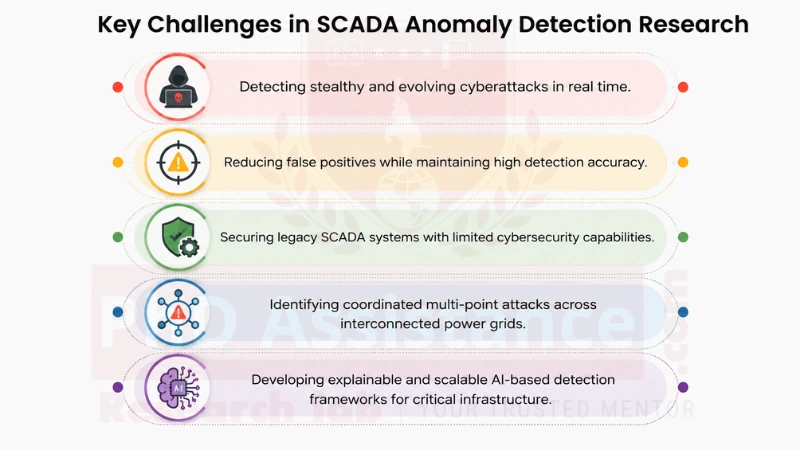
Theme 1: Detecting data integrity attacks
| Dissertation title | Possible research question | Likely design and data | Why it matters now |
|---|---|---|---|
| A hybrid statistical and deep learning detector for stealthy false data injection attacks in Modbus/TCP-based power grid SCADA systems | Does combining residual-based statistical tests with a sequence model detect stealthy false data injection better than either alone, at an acceptable false-alarm rate? | Testbed or co-simulation of a grid with Modbus/TCP traffic; injected attacks of graded stealth; comparison with each component alone | Stealthy injections are designed to pass simple checks, so layered detection is needed (Giraldo et al., 2018; Prudhvi et al., 2025) |
| Koopman operator learning for explainable detection of cyberattacks under stressed power grid conditions: separating attacks from faults and high-load operation | Can a Koopman-based model of grid dynamics flag attacks while keeping false alarms low during faults and stressed operation? | Simulated IEEE test systems with attack, fault and stress scenarios; comparison with residual-based and deep learning detectors; analysis of explanations | Detectors that alarm on every disturbance are ignored by operators |
Evidence that the gap is real. Giraldo et al. (2018) survey physics-based attack detection and show how much the results depend on the attacker model: an attacker who knows the detector can shape injected data to stay below its threshold. Work on real-time detection for power system SCADA continues (Prudhvi et al., 2025), but the hard question for a doctorate is whether a detector can separate deliberate manipulation from the faults and stressed conditions that operators see every week.
Theme 2: Graph, digital twin and threat intelligence models
| Dissertation title | Possible research question | Likely design and data | Why it matters now |
|---|---|---|---|
| Spatiotemporal graph neural networks for detecting and localising coordinated cyberattacks from measurement data on IEEE test power systems | Does modelling the grid topology as a graph improve detection and localisation of attacks on several buses at once, compared with models that ignore topology? | Simulated PMU or SCADA telemetry on IEEE test systems; coordinated multi-bus attacks; detection and localisation metrics; tests on an unseen topology change | Coordinated attacks across several substations are harder to spot than single-point attacks |
| An explainable digital twin and knowledge graph framework for cyber threat intelligence in IEC 61850 substation networks | Can linking threat intelligence in a knowledge graph to a digital twin of a substation help analysts prioritise alerts and explain them? | Substation model with GOOSE and MMS traffic; knowledge graph of assets, vulnerabilities and attack techniques; evaluation with analysts or replayed scenarios | Digital twins are increasingly proposed for industrial control security (Abraham et al., 2025; Erceylan et al., 2025) |
Evidence that the gap is real. A systematic review of industrial control system security brings together a fast-growing body of work on context-based modelling, digital twins and machine learning (Abraham et al., 2025). Erceylan et al. (2025) argue that digital twins can also support threat modelling, not only detection. Sayghe (2025) reported a digital twin detector for an industrial SCADA case study, but on a simulated process. Studies that test graph or twin-based models on realistic substation traffic, and that measure whether explanations help analysts, remain under-studied.
Theme 3: Lightweight detection on edge devices
| Dissertation title | Possible research question | Likely design and data | Why it matters now |
|---|---|---|---|
| Lightweight deep learning for real-time SCADA anomaly detection on edge devices: grey wolf optimiser tuning compared with standard hyperparameter search | Does grey wolf optimiser tuning give a smaller or more accurate model than standard search, and does the model meet latency limits on named edge hardware? | Public industrial control datasets plus a power grid dataset; latency, memory and energy measured on the device; ablation of the tuning method | Detection near the field equipment avoids sending all traffic to a central server |
Evidence that the gap is real. Edge detection is attractive, but the gain from metaheuristic tuning such as the grey wolf optimiser is often reported without a fair comparison against simpler search under the same budget. Public datasets help comparison: the Secure Water Treatment (SWaT) dataset was released to support this kind of research (Goh et al., 2017), though it comes from a water process, not a power grid. A doctoral study that reports latency and memory on real hardware, and tests on more than one dataset, adds evidence that accuracy tables alone cannot.
How to test a title before you commit
Use the general method in how to choose a PhD topic and how to select a PhD topic, or our topic selection support, and screen each idea for feasibility, interest, novelty, ethics and relevance (Hulley et al., 2013). Security machine learning has its own pitfalls: Sommer and Paxson (2010) explained why anomaly detection is harder in security than in other domains, and Arp et al. (2022) list common errors such as data snooping, unrealistic splits and inappropriate baselines. Check the following.
| Check | What to confirm | Why it matters |
|---|---|---|
| Attacker model | What the attacker knows, can reach and can change | Stealthy attacks defeat detectors built for naive ones (Giraldo et al., 2018) |
| Data | Testbed, co-simulation or public dataset, and its protocol | Results on one dataset rarely transfer |
| Normal variation | Faults, switching and load changes in the test data | Separates attacks from ordinary disturbances |
| Evaluation | Time-ordered splits, false alarms per day, detection delay | Avoids the pitfalls listed by Arp et al. (2022) |
| Access and ethics | Permission to use utility data or equipment | Real operational data needs agreements and security review |
Worked example (illustrative). A student starts from the live title on a hybrid detector for stealthy false data injection over Modbus/TCP. His department has a co-simulation of a 14-bus test system but no utility data. He defines an attacker who knows the state estimator, injects attacks of increasing stealth, adds faults and load changes to the normal data, and plans to report detection delay and false alarms per day beside accuracy. The title now promises an answer his testbed can support.
Common mistakes
- Calling a detection study "prevention".
- Leaving the attacker model unstated, so no one can judge how hard the attacks were.
- Training and testing on randomly shuffled records from the same capture, which inflates results.
- Reporting accuracy without false-alarm rates or detection delay.
- Describing IEC 61850 as a legacy protocol, or mixing up substation and control-centre networks.
Key takeaways
- Physics-based and network-based detection answer different questions; many strong titles combine them (Mitchell & Chen, 2014; Giraldo et al., 2018).
- A detector must be judged against faults and stressed operation as well as attacks.
- Digital twin and graph models need testing on realistic substation data (Abraham et al., 2025; Sayghe, 2025).
- Avoid the evaluation pitfalls common in security machine learning (Sommer & Paxson, 2010; Arp et al., 2022).
- Screen each shortlisted title for feasibility, novelty and relevance before writing a proposal (Hulley et al., 2013).