
Critical Review of Digital Twin-Driven Intrusion Detection for Industrial SCADA: A Cyber-Physical Case Study
Introduction
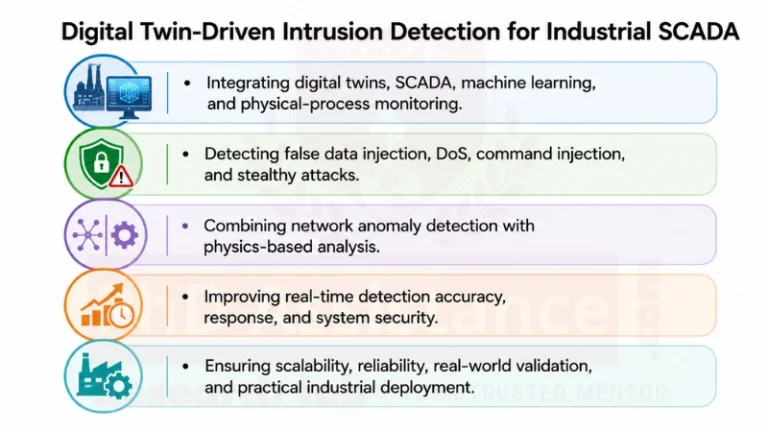
The integration of OT with IT, IIoT, and remote monitoring technology has expanded the cyber-attack surface area for ICS and SCADA networks. Conventional intrusion detection mechanisms depend on network data and attack signature identification, which makes them ineffective at combating attacks involving manipulation of sensor data or control signals of actuators or physical process parameters. Sayghe (2025) presents an effective solution using the Digital Twin-based Detection (DT-ID) approach.
The study combines a high-fidelity digital twin with real-time SCADA data, adversarial attack simulation, physics-based residual analysis, and machine learning. It evaluates FDI, DoS, and reconnaissance/command injection attacks, reporting an F1-score of 96.3%, an FPR of approximately 2.4%, and an average detection latency of around 480 ms.
This review critically examines the study’s contribution to Digital Twin for SCADA Intrusion Detection, its methodology, findings, limitations, and relevance to Industrial cybersecurity.
Summary of the article
Sayghe (2025) presents the framework for Intrusion Detection using the Digital Twin called DT-ID, and this framework includes four major elements: a high-fidelity virtual SCADA system model, a simulation engine for adversarial attacks, a hybrid anomaly detector, and an automated response engine.
The digital twin refers to the simulation of the water treatment process that includes tanks, chemical dosage, sensors, pumps, PLCs, and SCADA. The process model is executed in MATLAB/Simulink, whereas Python is used for data integration and communication purposes. The digital twin is synchronised with the process (physical/simulation) at 100 Hz through a delta-based synchronisation approach. This enables the detection of deviations in process states.
The framework evaluates three major attack types: False Data Injection (FDI), Denial-of-Service (DoS), and reconnaissance/command injection, together with adversarially generated stealthy attacks.
However, the hybrid approach to anomaly detection is the combination of the LSTM-attention approach for detecting network anomalies and the one-class SVM and digital twin residuals for process anomalies. As seen from the results, DT-ID was able to achieve an F1-score of 96.3%, a false positive rate of 2.4%, and the mean delay of 480 ms.
Significance and contribution of the field
The main contribution of the study is its application of digital twin-based intrusion detection to SCADA environments by combining cyber and physical process information. Conventional IDS approaches can identify suspicious network traffic but may lack awareness of whether the underlying physical process is behaving normally. The proposed digital twin addresses this limitation by comparing actual process behaviour with expected modelled behaviour.
This approach is particularly relevant to SCADA cybersecurity, where attackers can manipulate sensor values or actuator commands without producing obvious network anomalies. The study’s hybrid architecture is also significant because it combines physics-based residual analysis with machine learning rather than relying exclusively on either approach.
Another contribution is the adversarial attack simulation environment, which exposes the IDS to both conventional and stealthy attacks. The randomised attack scheduling over a 72-hour simulation provides a more challenging evaluation environment than testing only predetermined attack sequences.
However, the significance of these contributions should be considered alongside the study’s limitations. Its findings are primarily based on a simulated water treatment environment, and the authors acknowledge that real industrial environments may introduce greater noise, operational variability, and unknown disturbances. In conclusion, the research presents convincing proof for the capabilities of Digital Twin cybersecurity, but more real-life testing is required before being able to generalise the results to other industrial settings.
Critical Analysis of the Main Findings
- Detection Performance
The strongest finding is the reported performance of the DT-ID framework. It achieves an F1-score of 96.3%, an FPR of approximately 2.4%, and an average detection latency of 480 ms. These results are better than the selected Snort and physics-only baselines.
Interpretation: The results provide convincing evidence that combining cyber-network information with physical-process information can improve intrusion detection. The lower false-positive rate is particularly valuable in industrial environments because excessive alarms may cause operator fatigue and reduce trust in the security system.
Limitation: The comparison alone cannot prove the universal superiority of the method. The study is performed in one artificial water treatment plant, and the attack situations, system processes, and data-generating procedures are controlled by the researchers.
Implication: This finding suggests a need for more research in Digital Twin for Intrusion Detection, but independent validation is needed through the use of real-world industrial datasets.
- Hybrid Detection Architecture
The study’s hybrid detector is arguably its most technically significant component. The cyber module uses LSTM-attention to identify temporal patterns in network traffic, while the physical module uses digital-twin residuals and a one-class SVM to identify deviations in process behaviour.
The fusion strategy gives greater weight to physical information, with the final anomaly score calculated using weights of 0.3 for the cyber component and 0.7 for the physical component. The threshold was selected through ROC analysis.
Interpretation: This design reflects an important principle in Industrial SCADA cybersecurity: cyber anomalies should not be interpreted independently from the physical process. An unusual network event becomes more meaningful when it is associated with an unexpected process deviation.
Limitation: The weighting scheme is optimised for this case study. The higher weight assigned to physical residuals may not remain optimal for other industrial processes, especially processes where network attacks are more significant than physical deviations.
Implication: Future research should investigate adaptive fusion mechanisms in which cyber and physical weights are automatically adjusted according to process characteristics, attack type, and operating conditions.
- Digital Twin Synchronization
The digital twin operates at a synchronisation frequency of 100 Hz, with tolerances derived from physical process dynamics and sensor noise. For example, the tank-level tolerance is approximately 0.5% of full scale.
Interpretation: High-frequency synchronization is a strength because it allows rapid process changes and potential attacks to be detected. The study also provides an analytical basis for selecting synchronization thresholds rather than relying on arbitrary values.
Limitation: Nevertheless, 100 Hz synchronisation might be impractical in some cases due to high computational and communication demands in certain industrial SCADA scenarios involving many sensors and PLCs. Moreover, the authors have faced some problems related to I/O and data handling at the Python-OPC UA interface level, which were solved using data caching and data batching.
Implication: Future Digital twin security research should explore scalable and adaptive synchronisation strategies based on process criticality and attack risk.
- Attack Coverage
The study evaluates FDI, DoS, and reconnaissance/command injection attacks, along with adversarially generated stealthy attacks. These attacks are randomised across a 72-hour simulation period, making the evaluation less predictable.
Interpretation: Incorporating stealth and adversarial attacks increases the difficulty of evaluating SCADA security measures since this takes into consideration real-world attack scenarios rather than just using conventional attack signatures.
Limitation: These attacks do not take into consideration all the potential threat vectors that a SCADA system may encounter in an industrial environment, such as malware infection, credential theft, insider threats, etc.
Implication: In future research, it is recommended to use a more comprehensive taxonomy of attacks as well as to investigate the possibility of manipulating a digital twin or producing process-consistent malware.
Technical Feasibility versus Economic Feasibility
A key issue in the study is the distinction between technical feasibility and practical feasibility.
Technically, the system demonstrates strong performance. It operates at 100 Hz on a standard PC, with each 10 ms simulation step requiring approximately 3–5 ms of computation and average CPU utilisation below 30%. The reported detection latency is approximately 480 ms.
These results demonstrate that the framework can support real-time detection under the study’s experimental conditions.
However, practical feasibility remains less certain because the testbed represents a simulated water treatment plant rather than a live industrial facility. The authors acknowledge that real-world systems may involve greater noise, unknown disturbances, sensor behaviour, and operational variability.
Therefore, the study demonstrates real-time computational feasibility, but not yet full industrial deployment feasibility. This is important for digital twin-based detection, as laboratory performance may differ when deployed with legacy equipment, incomplete sensor coverage, changing configurations, and safety requirements.
Comparison with the Literature
The performance of DT-ID is assessed against several new digital twin and machine learning methods. DT-ID attains an F1-score of 96.3%, while Zhao et al. (2023) have 90.0%, Lin et al. (2024) get 94.1%, Xu et al. (2023) get 91.7%, Pan et al. (2024) attain 93.8%, and Xu et al. (2024) have 99.0%.
The findings show that DT-ID performs better than most of the compared methods in terms of F1-score and latency. However, the F1-score is higher at 99.0% in Xu et al.(2024).
The comparison is valuable; however, it cannot be seen as a direct comparison of IDS systems, as different data sets, different production processes, attacks and experiments have been used in the research studies. A common benchmark would make the comparison more credible.
Methodology and research design
The experiment uses a well-defined architecture and several evaluation parameters such as F1 score, precision, recall, FPR, and detection latency. The ground truth is derived using attack event logs and timestamped traces, while the 72-hour simulation is divided into 70% training and 30% testing datasets.
A further strength is the ablation study. The CNN plus Isolation Forest approach achieved an F1-score of 88.1% and an FPR of 8%, compared with 96.3% and 2.4% for the proposed LSTM-attention and SVM approach.
However, some methodological limitations remain. The training and testing data come from the same simulated environment, which may limit generalisability. In addition, the simulated attackers remain constrained by the researchers’ attack framework. The study also does not report statistical significance or confidence intervals, making it difficult to assess variability across repeated experiments.
Overall methodological judgement:
The methodology provides a strong proof of concept, but external validation and more extensive statistical analysis are needed to establish generalisability.
Theoretical and Interdisciplinary Analysis
The study combines several areas, including:
The digital twin replicates the physical process, while the cybersecurity elements analyse both the network and the process behaviour. The framework also includes OPC UA, Modbus/TCP, machine learning, time series data, and real-time visualisation.
This interdisciplinary design is a major strength. Digital twin security becomes particularly valuable when the twin contributes to security analysis rather than being used only for visualisation.
The study also addresses concept drift by periodically retraining the LSTM and SVM models and using the Page–Hinkley test to identify changes in data distributions.
However, adaptive learning introduces another security concern: attackers could potentially influence retraining data and cause malicious behaviour to be learned as normal. Future research should therefore investigate secure model updating and protection of the digital twin.
Practical Implementation and Policy Considerations
The study’s practical contribution is its integration of intrusion detection with response. The response module includes operator alerts, forensic logging, PLC command lockdown, and controller failover for severe attacks.
This is important for Industrial cybersecurity, where detecting an attack is not enough when physical processes may also be affected. A rapid and proportionate response is necessary to reduce operational and safety risks.
The human-in-the-loop option is another strength, as critical actions such as process lockdown or controller failover can require operator confirmation. The use of OPC UA also demonstrates potential integration with existing SCADA environments.
However, the security of the digital twin itself requires further attention. If the twin is compromised, incorrect predictions could undermine the IDS. Therefore, Digital twin security should address both protecting SCADA systems through the twin and protecting the twin from manipulation.
Limitations of the Study
Limitation | Critical Significance | Required Improvement |
Simulated water treatment environment | Limits real-world generalizability | Validate using physical testbeds and industrial datasets |
Limited attack categories | Does not cover the full range of cybersecurity threats | Expand the attack taxonomy |
Single industrial process | Findings may be specific to water treatment | Test across different industrial sectors |
Same environment for training/testing | May encourage environment-specific learning | Use external and cross-domain datasets |
Limited statistical reporting | Makes experimental variability difficult to assess | Include confidence intervals and repeated trials |
Digital twin dependency | Twin errors could cause false alarms or missed attacks | Develop twin validation and integrity monitoring |
High synchronisation frequency | 100 Hz may be difficult to scale | Investigate adaptive synchronisation |
Data not publicly available | Limits independent replication | Provide anonymised datasets or benchmark traces |
Simulated adversarial attacks | May not fully represent real attackers | Conduct red-team and physical testbed validation |
Table 1. Critical Limitations of the Reviewed Study
Research Gaps from the Study
Research Gap 1: Real-World Validation
The most significant gap is the limited validation in operational industrial environments. Although the study uses a 72-hour high-fidelity simulation, the authors acknowledge that real industrial systems involve greater noise, unknown disturbances, and operational variability.
Future research should therefore evaluate the framework using real SCADA datasets and physical industrial testbeds.
Research Gap 2: Cross-Industry Generalizability
The study focuses on a simulated water treatment plant, where the relationships between sensors, actuators, and processes may differ from other industries.
Future research should examine whether the Digital Twin for Intrusion Detection architecture can be applied to energy, manufacturing, oil and gas, chemical processing, and other critical infrastructures.
Research Gap 3: Advanced SCADA Cybersecurity Threats
The study evaluates FDI, DoS, reconnaissance, command injection, and stealthy adversarial attacks. However, the wider threat landscape remains broader.
Future studies should examine coordinated attacks, insider threats, credential compromise, lateral movement, malware, supply-chain attacks, and attacks specifically targeting digital twins.
Overall Critical Appraisal
Sayghe (2025) provides a strong conceptual and experimental contribution to intrusion detection by combining physical process modelling with machine learning. Its main strength is recognising that SCADA attacks cannot always be identified through network traffic alone.
The strongest argument is the better performance relative to the chosen benchmarks. DT-ID gets an F1-score of 96.3%, while Snort only manages 80.5% and the physics-based detector only 89.2%.
Nevertheless, the most obvious limitation is the difference between experimental efficiency and applicability. The research is largely based on the simulation of data, and the necessity of its validation is explicitly stated by the authors.
Therefore, the study can be regarded as a promising proof of concept for digital twin-based detection, but more validation is needed to prove the efficacy of the solution in large industrial SCADA systems.
Dimension | Finding | Critical Judgement | Assessment |
Detection performance | F1 = 96.3%, FPR = 2.4%, latency = 480 ms | Strong performance under experimental conditions | Strong |
Hybrid architecture | LSTM-attention + physical residuals + SVM | Combines complementary detection methods | Strong |
Digital twin integration | 100 Hz Synchronisation | Enables process-aware detection | Strong |
Attack evaluation | FDI, DoS, command injection and adversarial attacks | More comprehensive than basic signature testing | Moderate–strong |
Real-time capability | 3–5 ms computation per 10 ms step | Demonstrates computational feasibility | Strong |
Generalisability | Simulated water treatment environment | External validity remains uncertain | Moderate–weak |
Industrial deployment | OPC UA and legacy integration | Promising but lacks field validation | Moderate |
Reproducibility | Code available on request; data unavailable | Limits independent replication | Moderate |
Research contribution | Integrates DT, physics, ML, SCADA and response | Provides a valuable cyber-physical framework | Strong |
Table 2. Critical appraisal of the Reviewed Study
Conclusion
Overall, Sayghe (2025) presents a strong technical contribution to Digital Twin for Intrusion Detection, demonstrating that combining physical process models with machine learning can improve the detection of stealthy attacks. The reported results show strong detection performance, although the study is mainly evaluated in a simulated water treatment environment.
However, the findings require further validation before widespread industrial adoption. Future research should focus on real-world testing, broader SCADA cybersecurity threats, and scalable deployment. The study demonstrates the potential of digital twin-based detection as an important approach to strengthening Industrial SCADA security.
These limitations also highlight the importance of rigorous literature comparison, critical evaluation, and evidence-based assessment when developing research on Digital Twin for Intrusion Detection and Industrial cybersecurity.
Need Support with Your SCADA Cybersecurity Critical Review?
Get focused support with literature comparison, methodology and intrusion detection assessment, digital twin cybersecurity analysis, evaluation of study limitations, and evidence-based recommendations to strengthen the quality, academic rigour, and critical depth of your SCADA cybersecurity review.
Frequently Asked Question
Digital twins model the physical SCADA process and compare expected behaviour with real-time system data. Differences between the two can indicate cyberattacks or abnormal process conditions.
Digital twins improve cybersecurity by combining physical-process information with network and machine-learning analysis, helping detect attacks that may not be visible from network traffic alone.
Common threats include false data injection, denial-of-service (DoS), command injection, reconnaissance, malware, credential theft, insider threats, and stealthy attacks.
SCADA intrusion detection monitors network traffic and physical-process behaviour to identify abnormal patterns. Digital twin-based systems can use process residuals and machine-learning models to improve detection accuracy.
The main challenges include limited real-world validation, high synchronisation and computational requirements, digital-twin integrity, limited attack coverage, and difficulty generalising results across industries.
Reference
- Sayghe, A. (2025). Digital twin-driven intrusion detection for industrial SCADA: A cyber-physical case study. Sensors, 25(16), 4963. https://doi.org/10.3390/s25164963
- Zhao, R., Yan, D., Liu, Q., Leng, J., Wan, J., Chen, X., & Zhang, X. (2019). Digital twin-driven cyber-physical system for autonomous control of micro punching system. IEEE Access, 7, 9459–9469. https://doi.org/10.1109/ACCESS.2019.2891060
- Lin, H., Xie, S., & Zheng, R. (2024). Real-time hybrid anomaly detection for SCADA systems using digital twins and deep learning. ISA Transactions, 145, 78–89. https://doi.org/10.1016/j.isatra.2024.01.021
- Xu, Q., Ali, S., & Yue, T. (2023). Digital twin-based anomaly detection with curriculum learning in cyber-physical systems. ACM Transactions on Software Engineering and Methodology, 32(5), Article 113, 1–32. https://doi.org/10.1145/3582571
- Pan, X., Luo, W., & Song, H. (2024). Hybrid deep learning and physics-guided digital twins for industrial cyber-physical anomaly detection. Journal of Process Control, 135, 63–73. https://doi.org/10.1016/j.jprocont.2024.03.008
- Xu, Y., Yang, Z., & He, D. (2024). Towards zero-day attack detection in smart manufacturing: A digital twin and deep learning fusion. IEEE Transactions on Industrial Informatics, 20, 6001–6012. https://doi.org/10.1109/TII.2024.3364527
- Creswell, A., White, T., Dumoulin, V., Arulkumaran, K., Sengupta, B., & Bharath, A. A. (2018). Generative adversarial networks: An overview. IEEE Signal Processing Magazine, 35(1), 53–65. https://www.researchgate.net/publication/320516991_Generative_Adversarial_Networks_An_Overview
- Mitchell, R., & Chen, I.-R. (2014). A survey of intrusion detection techniques for cyber-physical systems. ACM Computing Surveys, 46, 1–29 https://www.researchgate.net/publication/262402153_A_survey_of_intrusion_detection_techniques_for_cyber-physical_systems