- / Title
Zero-Trust Architecture Frameworks for Securing Smart Grid Communication Networks
Info: Zero-Trust Architecture Frameworks for Securing Smart Grid Communication Networks | phdassistance.com
Published: 31st August 2026 inZero-Trust Architecture Frameworks for Securing Smart Grid Communication Networks | phdassistance.com
Share this:
Related Services
Introduction
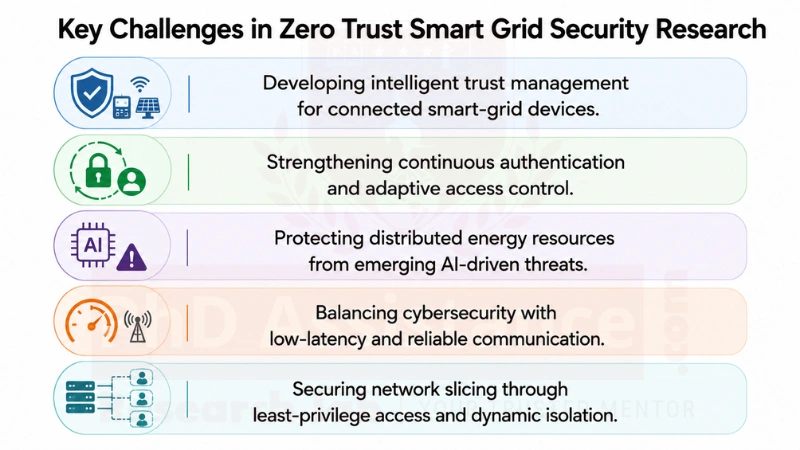
The increasing use of 5G, IoT, and interconnected devices has created a growing need for robust cybersecurity solutions in smart grids. This enables better real-time monitoring, automation, and communication capabilities in power systems, but they also introduce several weaknesses due to enhanced connectivity, remote access, and heterogeneity. Classic perimeter-based security measures may be inadequate in such environments, thus raising the interest in Zero Trust Architecture for Smart Grid Security. The Zero Trust security framework enables continuous verification of users and devices, dynamic access control, and risk assessment without implicitly trusting authenticated identities. Though the field has seen emerging research, some crucial issues remain to be solved in trust management, continuous authentication, authorisation, communication performance, network slicing, and cybersecurity threats.
Proposed PhD Title 1: Intelligent Trust Management for Adaptive Cyber Defence in 5G-Enabled Power Infrastructure
The integration of 5G, IoT, and intelligent technologies into smart grids enhances real-time monitoring, automation, and connectivity across electricity generation, distribution, and transmission infrastructure. Nevertheless, the increased level of connectivity also leads to an expansion of the cyberattack surface, which now includes heterogeneous devices, users, applications, and network services. Traditional perimeter-based security is insufficient because authentication alone does not guarantee that a user or device remains trustworthy after gaining access. Thus, the approach based on the Zero Trust Architecture, which was proposed by Ramezanpour and Jagannath (2021), can be an effective option for dealing with security issues in untrusted 5G and 6G environments.
Problem Statement:
Mimic legitimate communication behaviour between distributed energy resources. Smart grids consist of many interconnected entities such as heterogeneous devices, users, applications, and communications services. Thus, there are continuous changes in security scenarios. This creates a need for an adaptive and intelligent Zero Trust mechanism that evaluates trust, makes appropriate access control decisions, and monitors smart-grid devices.
Research Gap:
The research gap lies in the limited development of AI-based Zero Trust architecture frameworks, which would include such features as intelligent trust management, adaptive authorisation, monitoring, and risk assessment, but focused on smart-grid communication systems. Current research serves as the basis for an intelligent Zero Trust approach but needs additional research in terms of its application to smart-grid communication.
Research Question:
How can intelligent trust management strengthen Zero Trust security for smart grids while maintaining reliable communication and operational performance?
Outcome:
The study will develop an AI-based trust-management framework that continuously evaluates devices, users, and network conditions. The framework will support adaptive authorisation and strengthen smart grid security while maintaining secure communication.
Reference:
Ramezanpour, K., & Jagannath, J. (2021). Intelligent Zero Trust Architecture for 5G/6G Networks: Principles, Challenges, and the Role of Machine Learning in the Context of O-RAN.
Proposed PhD Title 2. Resilient Protection of Distributed Energy Resources Against Generative-AI-Driven Cyber Threats
The increasing integration of distributed energy resources (DERs), which include renewable power plants, storage solutions, and energy-enabled devices, creates a decentralised and interconnected power grid infrastructure. Such resources rely heavily on communication technology to send and receive operational data, thus necessitating reliable communication to guarantee stability within the system. However, generative artificial intelligence introduces new cybersecurity challenges because attackers may generate synthetic identities and mimic legitimate communication behaviour between distributed energy resources between the distributed energy resources. Munir et al. (2024) researched the attacks related to generative-AI-enabled replay and protocol attacks and suggested a Zero Trust approach based on continuous trust validation, risk assessment, and machine learning-based attack detection.
Problem Statement:
But the increased deployment of DERs brings about the possibility of more attack vectors against communication between DERs and power grid systems. Generative AI systems have the potential to produce synthetic identities and mimic normal communication, thus making it difficult for existing authentication techniques to prove effective. This creates a need for a security architecture that can continuously authenticate DER identities, detect fake messages, and deal with AI attacks.
Research Gap:
The gap is in the limited application of DER continuous authentication, communication message integrity validation, and Zero Trust methods to counter generative-AI cyber threats. There is research evidence in existence that shows attacks can be detected; however, further research is needed in the aspects of DER authentication and forgery detection.
Research question:
How can Zero Trust mechanisms provide resilient protection for DERs against generative-AI-driven cyber threats?
Outcome:
The study will develop a Zero Trust framework combining continuous DER authentication, message verification, and AI-based attack detection to improve smart grid security and protect critical energy resources.
Reference:
Munir, M. S., Proddatoori, S., Muralidhara, M., Saad, W., Han, Z., & Shetty, S. (2024). A Zero Trust Framework for Realization and Defense Against Generative AI Attacks in Power Grid.
Proposed PhD Title 3. Dynamic Access Governance for Reliable and Low-Latency 5G Power System Operations
The use of 5G technology in smart grids offers high bandwidth, low latency, reliability, and large numbers of device connections to facilitate applications like advanced metering, grid monitoring, demand response, and load control. The use of 5G and the Internet of Things (IoT) can enhance communication between different layers in the power grid and accelerate the collection and analysis of energy data. On the other hand, connecting many devices in the power system via wireless technologies increases the vulnerability to security threats like unauthorised access, denial of service, false data injection, and device-based attacks. An adaptive information security architecture has been designed by Jiang et al. (2022) incorporating artificial neural networks, Zero Trust security, and various isolation techniques. The approach recognises that authentication alone should not establish permanent trust in smart-grid users or devices. Yet, important functions of the smart grid require security techniques that can provide security without any impact on the delay, reliability, and availability of communications.
Problem Statement:
Nevertheless, the rise in the number of connections using 5G networks poses cybersecurity issues and communication challenges for smart grids. Methods involving security measures that demand constant monitoring and verification can generate more communication traffic, thus affecting latency, reliability, or availability. Thus, there is a need for an adaptive mechanism that could dynamically regulate access based on the current network state and criticality of the service along with the cybersecurity threat level.
Research Gap:
The research gap lies in the lack of a sufficiently developed dynamic access governance model that considers cybersecurity issues, delay, reliability, communication efficiency, and the needs of services in 5G-based smart grids. Current research explores the relationship between Zero Trust and intelligent security controls, but there is a need for further studies on how these controls could be adjusted dynamically.
Research Question:
How can dynamic access governance improve smart grid cybersecurity while maintaining low-latency and reliable communication?
Outcome:
The study will develop a risk- and service-aware access-governance framework that dynamically adjusts security controls according to network conditions and operational requirements, supporting secure smart grid communication networks.
Reference:
Jiang, C., Xu, H., Huang, C., & Huang, Q. (2022). An Adaptive Information Security System for 5G-Enabled Smart Grid Based on Artificial Neural Network and Case-Based Learning Algorithms.
Proposed PhD Title 4. Context-Aware Identity Verification and Risk-Based Control for Connected Electricity Networks
The inclusion of 5G and IoT in smart grids provides constant connectivity among power system equipment, control systems, service providers, and users. This technology facilitates real-time monitoring, automatic control, advanced metering, and coordination among various sectors of the power grid. However, the open, virtualised, and shared nature of this infrastructure can expose vital energy services to excessive access privileges. Alipour et al. (2022) have suggested that Zero Trust can be applied to a smart grid that is powered by 5G technology through continuous identity authentication and dynamic access control. They emphasise that authentication alone should not establish permanent trust in smart-grid users or devices. However, for Zero Trust security in smart grids to work effectively, some extra information regarding device behaviour, location, network situation, and security state is needed.
Problem Statement:
Nevertheless, continuous authentication might not offer enough information for access control decisions in changing smart-grid environments. The behaviour and security state of devices can vary over time, and factors such as location, network environment, credentials, and operational context may affect the amount of risk related to the access attempt. There is thus a requirement for a security paradigm that considers all these contextual aspects during continuous trust evaluation.
Research Gap:
However, the research gap can be seen as the inadequate development of a full-fledged Zero Trust framework that considers not only identities and devices, but also contextual information in making access decisions. It is evident from the existing literature that continuous authentication and dynamic access control are key concepts; however, there is a need for further research on incorporating contextual information into these mechanisms.
Research Question:
How can contextual information improve identity verification and risk-based access control in smart grid communication security?
Outcome:
The study will develop a context-aware trust model that continuously evaluates identity, behaviour, and network conditions to support adaptive access decisions and strengthen smart grid security.
Reference:
Alipour, M. A., Ghasemshirazi, S., & Shirvani, G. (2022). Enabling a Zero Trust Architecture in a 5G-enabled Smart Grid.
Proposed PhD Title 5. Intelligent Network Slicing and Least-Privilege Enforcement for Critical Energy Services
A modern smart grid calls for communication systems that can provide several important functions, such as grid monitoring, protection, advanced metering, demand management, and distributed energy resources. The implementation of 5G network slicing allows for the provision of various smart grid applications by using separate communication resources while still sharing the same physical network infrastructure. On the other hand, the growing application of open and virtualised communication environments creates additional security issues, such as unauthorised access and malicious applications. ZTRAN was proposed by Abdalla et al. (2024), where zero trust is achieved by service authentication, intrusion detection, and secure slicing. The study shows that intelligent slicing could be used to separate malicious users without compromising communication performance in O-RAN. Nevertheless, further research is still needed concerning the challenges related to excessive access rights, untrusted applications, and flexible security measures that adjust to network environment changes. These challenges create an opportunity to investigate intelligent network slicing and least-privilege approaches.
Problem Statement:
But the open, virtualised, and shared nature of such infrastructure will also expose these vital energy services to excessive access privileges, applications of unverified trustworthiness, and devices that are vulnerable to attacks. While network slicing enables separation of various smart-grid services from one another, security of these services would require implementation of security measures that could detect any suspicious activities and limit access to only the resources needed by these services or devices.
Research Gap:
The gap in the study relates to the lack of implementation of least privilege, threat detection, and slice isolation for the provision of key smart-grid services. Research has shown that authentication, intrusion detection, and slice isolation can be achieved, but further research is needed to integrate these methods and apply them to dynamic changes in the network environment to protect smart-grid communication networks.
Research Question:
How can intelligent network slicing and least-privilege enforcement improve secure smart grid networks?
Outcome:
The study will develop an intelligent slicing framework combining Zero Trust, least-privilege access, threat detection, and dynamic isolation to strengthen smart-grid communication security and protect critical energy services.
Reference:
Abdalla, A. S., Moore, J., Adhikari, N., & Marojevic, V. (2024). ZTRAN: Prototyping Zero Trust Security xApps for Open Radio Access Network Deployments.
Need assistance finalising your PhD topic in Zero Trust Architecture for Smart Grid Security? Developing a strong research topic around intelligent trust management, adaptive access control, smart-grid communication security, and emerging cyber threats can be challenging — but you don’t have to do it alone.
Our research consultants can help refine your ideas, identify literature gaps, and guide you toward a topic that aligns with current academic trends and your programme requirements.
Contact us to begin one-on-one topic development and refinement with PhdAssistance.com Research Lab.
FAQs:
- What is Zero Trust in smart grids?
Zero Trust is a cybersecurity approach that follows “never trust, always verify.” Every user, device, and access request is continuously verified before accessing smart-grid resources. - How does Zero Trust secure smart grids?
It uses continuous authentication, dynamic access control, trust evaluation, monitoring, and risk assessment to prevent unauthorised access and limit potential attacks. - Why is Zero Trust important for smart grids?
Smart grids connect many devices and systems through technologies such as 5G and IoT, creating a larger attack surface. Zero Trust helps protect these critical systems from evolving cyber threats. - How does Zero Trust protect smart grid networks?
It continuously evaluates devices and users, applies least-privilege access, monitors network activity, and can isolate suspicious or compromised devices to reduce the spread of attacks. - What are Zero Trust frameworks for smart grids?
They are structured security models that integrate capabilities such as continuous authentication, dynamic authorisation, intrusion detection, risk assessment, and secure network isolation to protect smart-grid communication
Share this:
Cite this work
PhD Assistance. (n.d.). Zero Trust Architecture for Smart Grid Security. Retrieved August 20, 2026, from https://www.phdassistance.com/title/zero-trust-architecture-for-smart-grid-security/
MLA
PhD Assistance. “Zero Trust Architecture for Smart Grid Security.” PhD Assistance, n.d. Web. 20 Aug. 2026.
MLA 7
PhD Assistance. “Zero Trust Architecture for Smart Grid Security.” PhD Assistance. Web. 20 Aug. 2026.
Harvard
PhD Assistance (n.d.) Zero Trust Architecture for Smart Grid Security. Available at: https://www.phdassistance.com/title/zero-trust-architecture-for-smart-grid-security/ (Accessed: 20 August 2026).
Vancouver
PhD Assistance. Zero Trust Architecture for Smart Grid Security [Internet]. [cited 2026 Aug 20]. Available from: https://www.phdassistance.com/title/zero-trust-architecture-for-smart-grid-security/
Wikipedia
PhD Assistance. “Zero Trust Architecture for Smart Grid Security.” PhD Assistance. Retrieved August 20, 2026, from https://www.phdassistance.com/title/zero-trust-architecture-for-smart-grid-security/
OSCOLA
PhD Assistance, ‘Zero Trust Architecture for Smart Grid Security’ (PhD Assistance, n.d.) https://www.phdassistance.com/title/zero-trust-architecture-for-smart-grid-security/ accessed 20 August 2026.
Study Resources
Free resources to assist you with your university studies!